
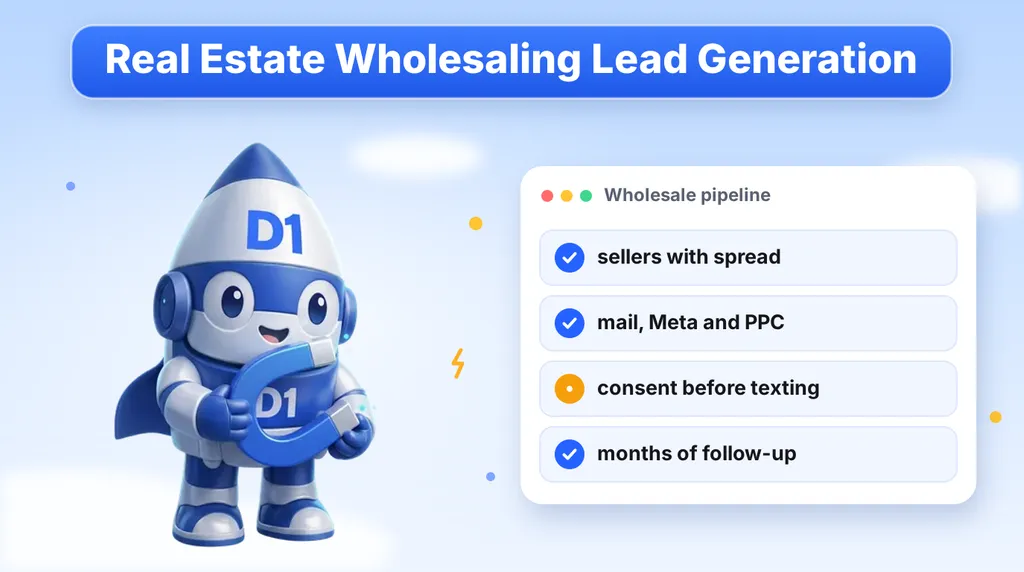
A wholesaler has one job that a retail investor does not: find a seller, tie up the house, and then find a buyer who will pay more. If the spread is not there, the deal is not assignable, no matter how friendly the seller was on the phone. That makes lead quality matter more than lead volume. This guide covers how to aim your marketing at sellers who leave room for a deal, which channels to mix, what to ask on the first contact, and how to keep following up long after the first "not yet".
It is written for new and working wholesalers who already know the basics and want a steadier flow of conversations worth having. For the wider view of every channel investors use, see our lead generation guide for real estate investors. This post narrows that down to the wholesale model. Wholesaling rules vary by state, including licensing and disclosure requirements, and nothing here is legal advice. Check your state's rules or talk to a real estate attorney before you market or sign contracts.
Why Wholesalers Need Quality Over Volume
A retail flipper can sometimes make a thin deal work by cutting renovation costs. A wholesaler cannot. You are paid for the gap between your contract price and what your end buyer will pay, so a seller who wants close to full market value for a house that needs work leaves you nothing to assign.
That changes how you judge leads. Counting form fills tells you how loud your marketing is. It does not tell you how many of those sellers could ever become a deal. A smaller list of owners with a real reason to sell, and a house that makes sense for your buyers, usually beats a large pile of curious homeowners who just wanted a number.
It also changes what you spend on. Time is the real cost. Every unqualified lead eats a call, a follow-up text and a slot in your CRM. The goal of the whole system is to push the wrong leads out early and keep the right ones warm.
Which Sellers Fit a Wholesale Deal
Wholesale deals tend to come from sellers who value speed and certainty over top dollar. The common situations look like this:
| Seller type | Why they may sell below retail | What to watch for |
|---|---|---|
| Distressed condition | Repairs are more than the owner wants to handle or finance | Make sure your buyers actually want that scope of work |
| Inherited property | Heirs often live elsewhere and do not want to manage a house | Several heirs and probate timing can slow a close |
| Tired landlords | Bad tenants, deferred maintenance, or a wish to be done | Tenant leases and rent rolls affect what buyers will pay |
| Behind on payments | A sale may be the way out before things get worse | Be careful with copy and promises. Describe what you do, not what you can fix |
| Vacant or absentee | The owner pays for a house they are not using | Ownership can be hard to confirm. Skip tracing helps |
These are tendencies, not guarantees. Each investor sets their own buy box, and your buyers' list should decide which of these you chase. If your buyers only want light cosmetic rehabs in three zip codes, build your marketing around that, not around every motivated seller in the county.
Be careful with foreclosure-related wording. Do not promise to stop a foreclosure or protect anyone's credit. Say plainly what you do: you make an offer, and the homeowner decides. Our post on pre-foreclosure lead sources covers the data side if you work that segment.
The Channel Mix: Mail, Meta, Search and Your Site
No single channel fills a wholesale pipeline for long. Each reaches a different kind of seller, and each fails in a different way. A practical mix has four parts.
Direct Mail
Mail reaches owners who are not searching at all. You choose the list, so it is the most targeted option you have: absentee owners, inherited properties, vacant houses, long-time owners with visible equity. Response is usually low and follow-up decides the outcome, so plan on repeat touches rather than one postcard. Our guide to direct mail for real estate investors covers list choice, piece types and cadence in detail, including separate advice for land.
Meta Lead Forms
Facebook and Instagram let you reach people who never typed a search term. Because the ad can speak to one situation at a time, such as an inherited house or a rental you are tired of managing, the form can filter early. The cost is that Meta leads often need more warming than search leads, so your speed and follow-up matter even more. Residential Foreclosure Prevention (see the build) is a brand of a real estate investment company. We also built and managed its Meta lead campaigns, which bring in 800+ homeowner leads a month. That is one account, and your results will depend on your market, offer and follow-up.
Google Search (PPC)
Search catches sellers at the moment they decide to look for a buyer. Clicks are expensive, so the keyword list and the negative list decide whether the budget works. Start with our PPC keywords for real estate investors, which covers seller terms, situation keywords and match types. If you are weighing ads against buying leads from a vendor, our comparison of pay per lead vs running your own ads lays out the trade-offs, including who owns the data.
A Website With Situation Pages
Your site is where every channel ends up. A seller who gets a postcard will often search your company name before calling. A page for each situation (inherited, behind on payments, tired landlord, vacant, needs repairs) gives each of them a place that speaks to their reason. See our real estate investor website guide for structure. Our Top Local House Buyers build is an example of a seller site for an investor, and our smart websites and funnels service covers how we build them.
A Short Intake Survey That Filters Without Scaring Sellers Off
The first contact is your best chance to sort leads. Keep it short, because every extra field costs you submissions, but ask enough that you know whether to call today or nurture for later.
- Property address: lets you check ownership, value and condition before you dial.
- Condition: a simple choice such as move-in ready, needs some work, needs a lot of work.
- Timeline: as soon as possible, within a few months, just exploring.
- Reason for selling: an optional dropdown. It tells you the situation without making anyone write a story.
- Phone number and consent: with clear language next to the submit button if you plan to text.
Notice what is missing: a price field. Asking "what do you want for it?" on a web form invites an optimistic number you will have to talk down later. Save the price conversation for the call, once you have seen the address and heard the story.
You can run the same questions as a form, a quiz-style funnel or a short text conversation. The important part is that the answers land in your CRM as fields, not as a note buried in an email.
Consent Before You Text
Texting is how most wholesalers get a reply fast, and it is also where many get into trouble. Texting a number you pulled from a list or a skip trace is not the same as texting someone who asked to hear from you on a form.
- Get clear written consent to text, in plain language, next to the button that submits the form.
- Keep a record of when and how each person agreed.
- Honor opt-outs immediately, every time, including replies like "stop" and "don't text me".
- Do not treat a cold list as permission to send marketing texts.
Rules differ by state and by situation, so get advice for your setup. Our TCPA-compliant SMS guide for real estate investors goes through the basics. A wholesaler who ignores consent is building a pipeline on a legal risk.
Follow-Up That Runs for Months
Most sellers who contact you are not ready to sign that week. A wholesaler who calls twice and gives up leaves most of the pipeline unworked. A seller who said "not yet" in March may be ready in August, and the buyer they pick is usually the one who stayed in touch without being annoying.
Speed matters too. A seller who fills out several forms usually talks first to whoever responds first, so the first few minutes count. Our speed-to-lead guide explains why. The two work together: fast first contact wins the conversation, and long follow-up wins the deal that was not ready yet.
A CRM makes that sustainable. Without one, follow-up lives in your head and a spreadsheet, and both fail the week you get busy. A workable setup has:
- A pipeline with clear stages: new lead, contacted, appointment, offer made, under contract, assigned, and dead or nurture.
- An instant text and call routing so every new lead gets a response in minutes.
- A cadence for the first two weeks, then a slower drip for sellers who said "not yet".
- Tasks that remind you to call back on the date the seller gave you.
- A source field on every lead, so you can see which channel produced contracts, not just calls.
Our motivated seller follow-up system goes through the stages and cadence step by step, and our CRM and automation service is how we build it for investors who do not want to wire it together themselves.
Judge Your Marketing by Deals, Not Leads
A lead counter flatters every channel. A better scorecard follows the lead through the pipeline and asks what each step cost you.
| Question | Where to find the answer |
|---|---|
| How many leads came from each channel? | Source field in the CRM |
| How many became real conversations? | Contacted stage by source |
| How many became appointments or offers? | Appointment and offer stages |
| How many went under contract? | Under contract stage |
| How many did you assign? | Assigned stage |
| How much did each channel cost to get there? | Ad spend and mail cost against the stages above |
Look at the ratio between stages as well as the totals. If a channel produces plenty of leads but few appointments, the problem is usually the offer, the survey or the speed of your first response, not the traffic. If appointments are strong but contracts are rare, look at your pricing conversation and your buyer list.
Tracking this needs your ad platforms and your CRM to share information. If a campaign cannot tell you which leads turned into contracts, you will keep paying for the loudest source instead of the best one.
Common Mistakes
- Marketing to everyone: if your buyers only want certain properties, broad marketing fills your CRM with leads you cannot sell.
- One touch and done: a single mailer or one call is where most pipelines die.
- Slow first response: the first buyer to answer often gets the conversation.
- No consent record: texting without proof of consent can cost far more than any deal.
- Counting leads, not contracts: a cheap lead that never closes is the most expensive kind.
- Promising outcomes: never promise to stop a foreclosure, fix credit or guarantee a price.
Wholesale Lead Generation Checklist
- Write down your buyers' buy box: areas, property types, condition and price range.
- Pick the seller situations that match that buy box and ignore the rest.
- Choose two channels to start (for example mail plus search), and add a third once the first two are tracked.
- Build a situation page on your site for each seller type you pursue.
- Use a short intake survey: address, condition, timeline, reason, phone and consent.
- Put clear text consent language next to the submit button, and keep a record of it.
- Set up instant text and call routing so new leads hear from you within minutes.
- Build CRM stages through assigned, plus a nurture track for sellers who are not ready.
- Tag every lead with its source and review stage-by-stage results monthly.
- Check your state's wholesaling and disclosure rules before you market or sign anything.
If you would rather have a team set up the site, campaigns and follow-up for you, our lead generation and paid traffic service works with investors on exactly this mix, and the CRM keeps every lead in view until it becomes a deal or a clear no.
Want a Wholesale Lead System That Follows Up for You?
We build the seller site, the intake survey, the ad campaigns and the CRM follow-up for wholesalers and investors. Book a call and we will look at where your leads leak today and plan the fix with you.
Or call us directly: (888) 330-1434.
D1TechCreative builds websites, paid traffic, CRM and AI automation systems for service businesses and real estate investors across the United States. Based in Fort Lauderdale, FL.