
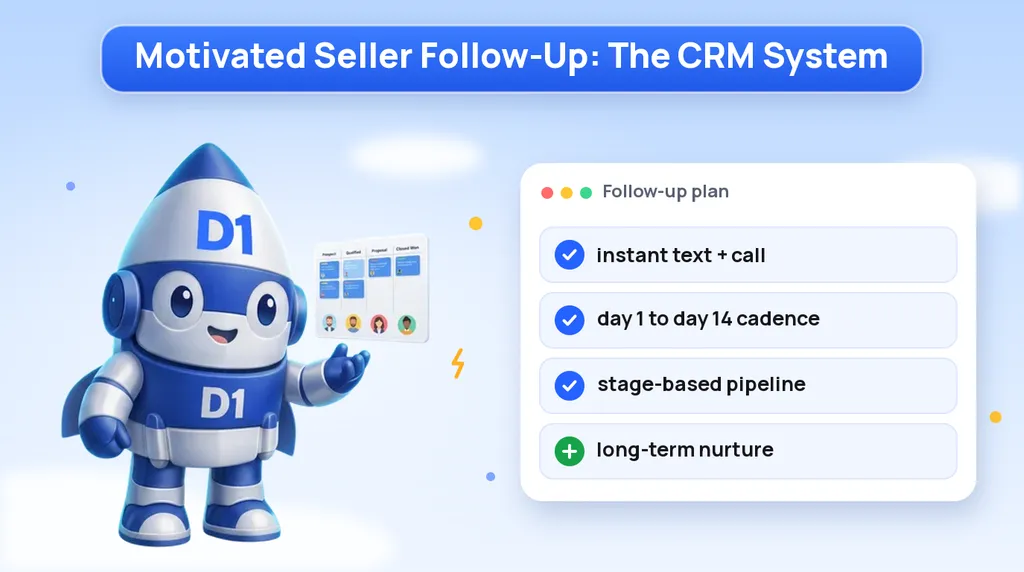
Most investors searching for motivated seller software are really looking for a follow-up system. The software matters, but leads go cold because nobody called back fast enough, nobody called a second time, or the seller said "not yet" and was never contacted again. This guide lays out the follow-up system we build for real estate investors: the pipeline stages, what happens in the first five minutes, a day 1 to day 14 cadence, long-term nurture, after-hours replies and the consent rules that keep it all on the right side of the law.
It is written for wholesalers, flippers, land buyers and small investor teams who already generate seller leads from mail, PPC, cold calling or a website and want more of them to turn into appointments and signed contracts. If you are still building lead flow, start with our lead generation guide for real estate investors and come back here once the leads are coming in.
Why Follow-Up Decides Which Leads Become Contracts
A motivated seller lead is rarely a single event. A homeowner fills out your form, then fills out two more on competitor sites the same evening. Someone who inherited a house calls once, gets voicemail and moves on. A tired landlord says "call me after the lease ends" and means it. In each case the deal goes to whoever is still in the conversation when the seller is ready.
That is why the system matters more than the lead source. A good follow-up process does three things:
- Answers new leads while they are still on their phone, before another buyer does.
- Keeps trying for two weeks across calls, texts and email, because many sellers do not answer the first attempt.
- Stays in touch for months with sellers who are not ready, so you are the name they remember when they are.
None of this needs a big team. It needs clear stages, automation for the repetitive parts, and a person who makes the calls that matter.
Set Up Your Pipeline Stages
Your CRM pipeline should mirror how a deal actually moves. Too few stages and you cannot see where leads stall. Too many and nobody updates them. These six stages cover most investor businesses:
| Stage | What it means | What happens automatically | What a person does |
|---|---|---|---|
| New | Lead just came in from any source | Instant text, call routing, lead source tagged | Call within minutes |
| Contacted | You spoke with the seller at least once | Follow-up tasks created, notes template added | Qualify: address, timeline, condition, reason, price expectation |
| Appointment | Walkthrough or call booked | Confirmation and reminder texts | Show up prepared with comps |
| Offer | Offer made, seller deciding | Check-in reminders for the acquisitions rep | Answer questions, handle objections |
| Contract | Signed agreement | Hand off to transaction tasks, title and closing checklist | Keep the seller informed until closing |
| Dead / Nurture | Not selling now, or unreachable | Long-term nurture sequence starts | Review monthly for anyone worth a call |
Two rules keep the pipeline honest. Every lead must sit in exactly one stage, and every stage change should trigger something, either a message, a task or the end of a sequence. If moving a card does nothing, the stage is decoration.
Tag every lead with its source (mail campaign, PPC keyword group, website, cold call list) the moment it enters. Later, when you look at which leads reached Contract, you will know which sources are worth more of your budget.
The First Five Minutes
The first few minutes after a seller reaches out are the most valuable in the whole process. Our speed-to-lead guide explains why answering fast matters so much. In practice, the first five minutes should look like this:
- Instant text. As soon as the form is submitted, the seller gets a short text from your business: who you are, that you received their request, and that someone will call shortly. Only send it if the form collected consent to text.
- Call routing. The CRM rings your acquisitions rep, or a small group of phones, and connects them to the seller. If nobody picks up, it tries the next person.
- Missed call text back. If a seller calls your tracking number and nobody answers, they get a text right away so the conversation does not end at voicemail.
- Lead record ready. The address, source and form answers are already in the CRM when the rep picks up, so the first call starts with the property, not with "who is this?"
Our CRM and automation platform handles each of these steps without adding staff. The person still makes the call. The system makes sure the call happens fast and the seller hears from you before anyone else.
A Day 1 to Day 14 Follow-Up Cadence
Many sellers will not answer the first call. They are at work, they do not pick up unknown numbers, or they are still deciding whether to sell at all. A set cadence makes sure every lead gets a fair number of attempts across different channels. Here is a starting point you can copy and adjust:
| Day | Call | Text | |
|---|---|---|---|
| Day 1 | Call right away, then again later the same day | Instant confirmation text | Short intro: who you are and how your process works |
| Day 2 | Call at a different time of day | "Is now a better time to talk about [address]?" | None |
| Day 3 | Call | None | What to expect from a cash offer |
| Day 5 | Call | Short check-in text | None |
| Day 7 | Call and leave a voicemail | None | Answers to common seller questions |
| Day 10 | Call | "Still thinking about selling [address]?" | None |
| Day 14 | Final call in this cadence | Let them know you will check back later | Move to nurture |
A few rules make this work:
- Stop the cadence the moment the seller replies. Any reply moves the lead to Contacted and a person takes over. Nothing feels more automated than a scheduled text that ignores a conversation already in progress.
- Vary the time of day. Someone who never answers at noon may answer at six.
- Keep texts short and personal. Use the property address, not a sales pitch.
- Respect opt-outs instantly. If a seller replies STOP, every text sequence ends for that number.
After day 14, a lead that never replied or said "not now" moves to Dead / Nurture. It does not get deleted.
Long-Term Nurture for "Not Yet" Sellers
Some of your best deals come from sellers who were not ready the first time. A probate needs to clear. A tenant's lease has months left. Family members need to agree. If you stop contacting these people after two weeks, someone else will be there when they are ready.
A long-term nurture sequence is low effort once it is built:
- A light monthly touch by email or text, such as a short check-in or a useful note about selling as is.
- Date-based reminders when the seller gave you a timeline. If they said "after the holidays", the CRM creates a call task for that week.
- Re-engagement triggers. If a nurture contact replies, clicks a link or fills out your form again, they jump back to Contacted and a person calls.
- A monthly review of the nurture list by someone who knows the market, looking for anyone worth a personal call.
Keep nurture messages helpful and occasional. The goal is to be remembered, not to be blocked.
AI Voice and SMS for After-Hours Replies
Sellers fill out forms at night and on weekends, often when the house is on their mind and they finally have time. If your team is offline, those leads wait until morning, and by then they may have spoken with another buyer.
An AI voice agent or SMS bot can cover those hours. It can answer a missed call, reply to a text, ask the basic qualifying questions (address, timeline, condition, reason for selling) and book a call on your calendar. It logs the answers in the CRM so your rep starts the next morning with context. We build these through our AI voice and SMS bot service and connect them to the same pipeline.
Set clear limits on what the bot does:
- It collects information and books appointments.
- It never quotes a price or promises an offer amount.
- It never gives legal, tax or financial advice.
- It hands off to a person when the seller asks for one, sounds upset, or raises anything outside its script.
The Consent Rules You Cannot Skip
Automated texts and calls to sellers are covered by federal and state rules, including the TCPA. Breaking them can be expensive, and "the software sent it" is not a defense. Before you turn on any automated sequence:
- Make sure your forms collect clear consent to be contacted by text and call, with wording a seller can understand.
- Store when and how each lead gave consent in the CRM.
- Honor opt-outs right away across every channel and every sequence.
- Be careful with cold lists. A purchased or skip-traced number did not give you consent to send automated texts.
- Respect quiet hours in the seller's time zone.
Our TCPA-compliant SMS guide for real estate investors covers this in more detail. Rules vary by state and change over time, so have an attorney review your consent language and texting practices before you scale.
What to Look For in Motivated Seller Software
Once you know the system you want, choosing software gets easier. You are not looking for the longest feature list. You are looking for a tool that runs this process without workarounds:
| Feature | Why it matters |
|---|---|
| Custom pipeline stages | Your stages should match how your deals move, not a generic sales funnel |
| Instant text and call routing | Covers the first five minutes without someone watching the inbox |
| Multi-channel sequences that stop on reply | Runs the day 1 to day 14 cadence and hands off cleanly |
| Missed call text back | Keeps inbound calls from ending at voicemail |
| Lead source tracking | Shows which mail, PPC or list sources reach Contract |
| Consent and opt-out handling | Records consent and stops messages the moment a seller opts out |
| AI voice and SMS connection | Covers nights and weekends inside the same pipeline |
| Simple mobile app | Your reps update stages from the truck, not at the end of the week |
If you want to see how AI features fit into a CRM more broadly, read our post on AI-powered CRMs for small businesses.
Your Follow-Up System Checklist
- Create six pipeline stages: New, Contacted, Appointment, Offer, Contract, Dead / Nurture.
- Tag every lead with its source the moment it enters the CRM.
- Turn on instant texts and call routing for every new lead.
- Add missed call text back on your tracking numbers.
- Build the day 1 to day 14 cadence and make sure it stops on any reply.
- Move unresponsive and "not yet" sellers into a long-term nurture sequence instead of deleting them.
- Add an AI voice or SMS bot for after-hours replies, with clear handoff rules.
- Check consent wording, opt-out handling and quiet hours before you scale.
- Review the pipeline weekly: where do leads stall, and which sources reach Contract?
Want Your Seller Follow-Up Built for You?
We set up the pipeline, instant replies, follow-up cadence and AI after-hours responses inside our own CRM for real estate investors. Book a call and we will map your current follow-up and show you where leads are slipping.
Or call us directly: (888) 330-1434.
D1TechCreative builds websites, paid traffic, CRM and AI automation systems for service businesses and real estate investors across the United States. Based in Fort Lauderdale, FL.