
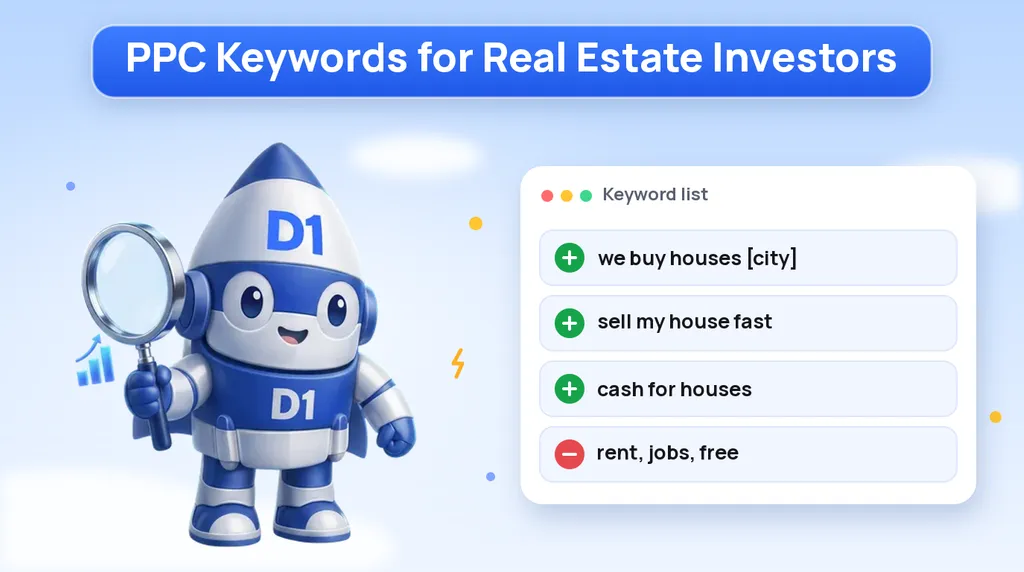
Most investor PPC accounts don't fail because of the bid strategy or the ad copy. They fail at the keyword list. Bid on "real estate" or "houses" and Google will happily send you buyers, renters, agents and people looking for a job, all at seller-keyword prices. This guide is the keyword setup we use when we plan Google Ads for real estate investors and wholesalers: the seller keywords worth paying for, the negative list that protects the budget, the match types to use, and how to group everything so every click lands on a page that matches what the seller typed.
If you want the bigger picture on where paid search fits next to SEO, direct mail and lists, start with our lead generation guide for real estate investors. This post stays on the keywords.
Why the Keyword List Decides Your Cost per Deal
Seller keywords are some of the most expensive clicks in local search. In our Google Ads vs SEO breakdown we put we-buy-houses clicks at roughly $20 to $80 each, depending on the market. At those prices, a click from someone looking for an apartment is not a small leak. Ten of them a day can eat most of a modest budget before a single homeowner calls.
Every search falls into one of three buckets:
- Seller intent: the person owns a property and wants to sell it, usually fast or as is. These are the only clicks you want to pay full price for.
- Research intent: the person is curious about how cash buyers work, what their house is worth, or whether "we buy houses" companies are legitimate. Some will sell later. Most won't sell this month.
- Wrong audience: buyers, renters, agents, other investors looking for deals, job seekers and students. These clicks never turn into a contract.
Good keyword selection buys the first bucket, tests a small slice of the second, and blocks the third with negatives. Everything below follows that rule.
Core Seller Keywords: The Highest Intent Terms
These are the phrases homeowners type when they have already decided to sell and want a buyer, not an agent. They should carry most of your budget.
| Keyword group | Example keywords | Why it works |
|---|---|---|
| Sell fast | sell my house fast, sell my house fast [city], sell house quickly, need to sell my house now | Speed is the main reason people choose a cash buyer over listing |
| We buy houses | we buy houses [city], we buy houses for cash, companies that buy houses, who buys houses near me | The searcher is already looking for an investor |
| Cash offer | cash offer for my house, get a cash offer on my home, sell my house for cash, cash home buyers [city] | Clear transaction intent, often comparing two or three buyers |
| As is and condition | sell house as is, sell my house without repairs, sell house that needs work, sell my house in any condition | Properties that agents struggle to list are often your best deals |
Add your city, county and the larger suburbs to the "sell fast", "we buy houses" and "cash offer" groups. Local modifiers often cost less than the bare phrase and convert better, because the searcher has told you exactly where the property is. Keep "near me" variants as well, since many homeowners search that way on their phones.
Two notes on wording. First, "sell my home" and "sell my house" usually match each other as close variants, so you rarely need to build both. Second, some "ugly house" style phrases overlap with a franchise brand name. If you add them, watch the search terms report closely before you raise the budget.
Situation Keywords: Motivated Sellers With a Reason
The second layer targets the life events that create motivated sellers. Search volume per phrase is small, but intent is very high and competition is often lighter, because many investors never build these ad groups.
- Foreclosure and missed payments: sell house before foreclosure, behind on mortgage payments, sell house in pre foreclosure, sell my house to avoid foreclosure
- Inheritance and probate: sell inherited house, sell probate property, inherited a house what to do, sell house of deceased parent
- Divorce and relocation: sell house during divorce, relocating need to sell house fast, job transfer sell house
- Landlords: sell rental property with tenants, tired landlord sell house, sell house with bad tenants
- Condition problems: sell fire damaged house, sell house with code violations, sell house with foundation problems, sell hoarder house
Give each situation its own ad group with its own ad copy and, ideally, its own landing page section. A homeowner who searched "sell inherited house" should see a headline about inherited property, not a generic "We Buy Houses in Any Condition" banner. That match lifts your click-through rate and Quality Score, which is why situation keywords can come in cheaper per lead than the core terms.
Be careful with foreclosure copy. Don't promise to stop a foreclosure or save anyone's credit. Describe what you actually do, which is buy the house for cash on a set timeline, and let the homeowner decide. If you also work pre-foreclosure lists, our post on pre-foreclosure lead sources covers the data side.
Land, Mobile Home and Other Asset Keywords
Only bid on these if you actually buy the asset. Land and mobile home sellers search differently from house sellers, and they need their own campaign so you can see what each one costs.
- Land: sell my land fast, sell vacant land for cash, who buys land near me, sell inherited land
- Mobile homes: sell my mobile home fast, who buys mobile homes, sell mobile home in park
- Multifamily and condos: sell my duplex, sell condo fast, sell apartment building off market
Land keywords tend to be cheaper and much lower volume. Many land investors buy across a wide area, sometimes several states, so location settings matter more than the bid.
The Negative Keyword List That Protects Your Budget
Negatives are where most of the savings live. Add these as a shared negative keyword list, apply it to every investor campaign on day one, and grow it every week from the search terms report.
| Category | Negative keywords |
|---|---|
| Buyers and renters | for sale, buy a house, homes for sale, rent, rental, apartments, rent to own, foreclosed homes for sale, auction |
| Agents and portals | realtor, real estate agent, mls, zillow, redfin, trulia, listing agent, commission |
| Jobs and education | jobs, hiring, salary, career, license, course, class, book, training, how to become |
| Freebies and DIY | free, template, diy, forms, sample letter |
| Other investors | wholesale deals, investment properties for sale, fix and flip loans, hard money, cash flow properties |
| Finance products | refinance, mortgage rates, home equity loan, heloc, reverse mortgage |
A few terms need a judgment call rather than a blanket block:
- Reviews, scam and legit: people researching cash buyers often search "[company] reviews" or "are we buy houses companies legit". These searchers are close to selling. Block "scam" and "complaints" if you like, but test "reviews" if your own reviews are strong.
- Competitor names: bidding on Opendoor, Offerpad or a local competitor can work, but it belongs in its own campaign with its own budget. Add competitor names as negatives everywhere else so they don't quietly drain your core campaigns.
- "How to sell my house": mostly research, sometimes a real seller. Leave it out at launch and add it later, once your core terms are profitable.
Match Types: How Tight to Go
Use phrase match and exact match for your core and situation keywords at launch. Phrase match catches local variations ("sell my house fast in Tampa", "need to sell my house fast Tampa FL") without letting Google wander into loosely related searches. Exact match gives you tight control over the handful of terms that matter most.
Broad match has improved, but it only works for investors when three things are true: the account already has steady conversion data, you are using a conversion-based bid strategy, and your negative list is mature. Without all three, broad match spends your budget learning what you already know. If you test it, test it in a separate campaign so you can compare cost per lead side by side.
Whatever match type you use, read the search terms report every week for the first two months. It is the best source of new negatives and new situation keywords, and the fastest way to spot a match type that has drifted.
How to Group Keywords Into Campaigns
A simple structure beats a clever one. For most investors buying in one metro, this is enough:
- Core seller campaign: sell fast, we buy houses, cash offer and as-is ad groups, targeted to your buying area.
- Situation campaign: one ad group per life event, each with its own ads and landing section.
- Brand campaign: your company name on a small budget, so competitors can't take your branded clicks.
- Optional test campaign: land, competitors or broad match, kept separate so a test never starves the core.
Set location targeting to people who are in or regularly in your area, not people who show interest in it. The interest setting sends clicks from other states, and for local buyers those clicks rarely close. If you buy in several markets, give each market its own campaign so budgets and bids stay honest.
Match the Landing Page to the Keyword
Keywords and landing pages work as a pair. If the searcher typed "sell my house fast in [city]", the page headline should say almost exactly that, with the city in it, a short address form above the fold and a phone number they can tap. On the Valor House Buyers site we built, the form asks for the property address first and everything else after. Asking for one thing is an easy start, and an eight-field form above the fold scares sellers off before they have read a word.
Our real estate investor website guide walks through the page structure in detail. The short version: one page per keyword theme, local proof on every page, and nothing that sends the visitor away before they submit.
Track the Conversions That Matter
Count calls and form submissions as conversions, and set a minimum call length so a ten-second wrong number doesn't look like a lead. Then go one step further and send each lead's outcome from your CRM back to Google Ads. When Google can see which keywords produced appointments and signed contracts, not just form fills, its bidding moves budget toward the terms that actually close.
Follow-up speed matters as much as the keyword. A seller who fills out three forms usually signs with the first buyer who calls back. If your team can't answer within minutes, set up an instant text and call routing before you raise the budget. Our speed-to-lead guide explains why, and our CRM and automation setup handles it without adding staff. If you text sellers, follow the consent rules in our TCPA-compliant SMS guide.
Starter Checklist
- Build core seller ad groups with city, county and "near me" variants in phrase and exact match.
- Add one ad group for each seller situation you actually buy for.
- Apply the shared negative list before the first click, then review search terms weekly.
- Keep land, competitor and broad match tests in their own campaigns.
- Point every ad group at a landing page whose headline matches the keyword.
- Import qualified leads and contracts from your CRM so bidding learns what a deal looks like.
We set up and manage campaigns like this through our lead generation and paid traffic service, and we have built seller sites for investors including Top Local House Buyers, Homeland Property Solutions and Tri-States Property Solutions.
Want Us to Build and Run Your Investor PPC?
We set up the keyword lists, negatives, landing pages and CRM follow-up for real estate investors, then manage the account month to month. Book a call and we will review your current campaigns or plan a new one with you.
Or call us directly: (888) 330-1434.
D1TechCreative builds websites, paid traffic, CRM and AI automation systems for service businesses and real estate investors across the United States. Based in Fort Lauderdale, FL.