
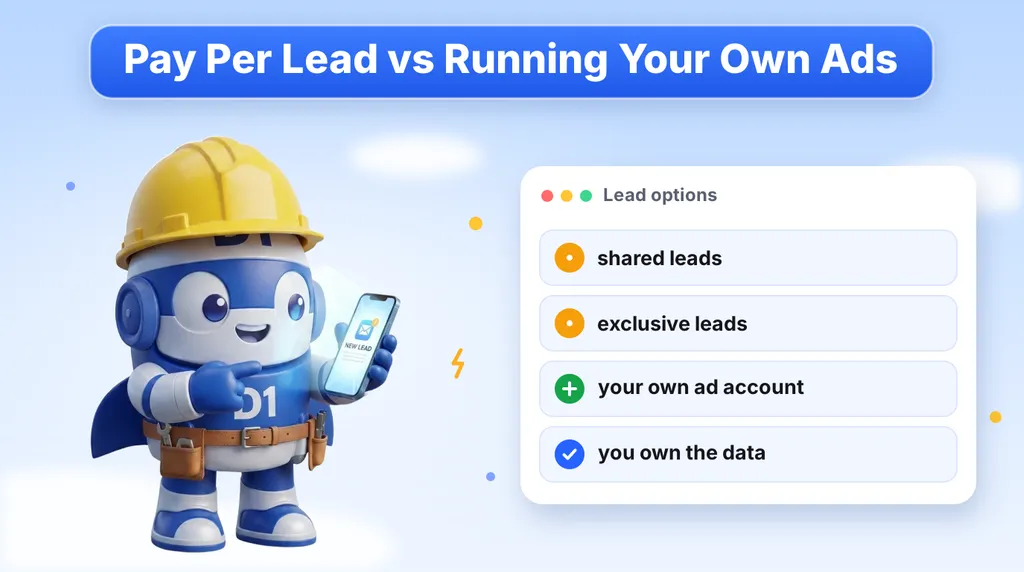
Every investor who wants more seller calls hits the same fork. You can pay a vendor for leads, or you can run your own ads and generate the leads yourself. Both work. They work for different people at different stages, and picking the wrong one is an expensive way to learn the difference. This guide lays out how each option actually behaves, where the hidden costs sit, and how to decide.
It is written for wholesalers, house flippers, land buyers and small buy-and-hold investors who already know their market and are deciding how to fill the pipeline. We stay practical and skip vendor names and price quotes, because those change by market and by month.
The Two Models in Plain Terms
With pay per lead, a vendor runs the marketing and sells you the contact details of people who raised their hand. You pay for each lead, and you do not touch the ads, the landing page or the traffic source.
With your own ads, you (or an agency working for you) open the Google and Facebook accounts, pick the keywords or audiences, build the landing page, and pay the platform for clicks. The leads come straight to you, and the ad account, the data and the audience belong to your business.
The difference is not only who does the work. It is who owns the asset once the money is spent. A purchased lead is a one-time contact. An ad account with a history, a tracked landing page and a record of which keywords produced contracts is something you keep building on.
Shared Leads vs Exclusive Leads
Pay per lead splits into two products, and they behave very differently.
Shared leads are sold to several buyers at once. The price per lead is lower, but the seller may get calls from every investor who bought the same record. By the time you dial, they may already have spoken to someone else, or be tired of the phone ringing. Speed decides who wins, and our speed-to-lead guide explains why the first call usually takes the appointment.
Exclusive leads are sold to you alone. You pay more per lead, but you are not racing three other buyers. The trade-off is that vendors can only supply so many exclusive leads in a market, so volume can be limited and uneven.
| Question | Shared leads | Exclusive leads |
|---|---|---|
| Price per lead | Lower | Higher |
| Competition on the same seller | Several buyers at once | None from that vendor |
| Speed required | Minutes | Still fast, with less pressure |
| Volume you can count on | Usually easier to get | Often capped by market |
| Who owns the data | The vendor, often resold | Contact details only, the source stays with the vendor |
Neither version gives you control over how the lead was generated. You do not see the ad, the page or the promise the seller responded to, which matters when the conversation starts with a seller who expected something different.
What Pay Per Lead Costs Beyond the Price Tag
The per-lead price is the number everyone compares. These are the costs that do not show up in it:
- Quality disputes. Wrong numbers, people who never asked to be contacted, properties you do not buy, and duplicates all happen. Most vendors have a return or credit process, but it takes your time, and you only get credit for problems you can document.
- No data ownership. You get a name and a number. You do not get the search term, the audience or the ad that produced them, so you cannot learn what works and spend more of it.
- Dependence on one supplier. If the vendor changes pricing, lowers quality or drops your market, your pipeline changes overnight and you have nothing of your own to fall back on.
- Consent questions. If you plan to text these leads, you need to know how the vendor collected consent. Read our TCPA-compliant SMS guide before you build any texting on top of purchased leads.
- A ceiling on improvement. You can follow up faster and talk better, but you cannot improve the traffic. The only lever on the front end is the price you agree to pay.
What Running Your Own Ads Costs
Your own campaigns have a different cost shape: more up front, more control, and a curve that improves over time.
- Setup. Account structure, a keyword list and negatives, ad copy, a landing page that matches the keyword, call and form tracking, and a CRM so no lead goes cold. Our PPC keywords guide for real estate investors covers the keyword and negative side in detail.
- Expensive clicks. In our Google Ads vs SEO breakdown we put we-buy-houses clicks at roughly $20 to $80 each. You pay for the click whether or not the person becomes a lead.
- The landing page decides the rest. The same breakdown puts click-to-lead conversion at 8 to 15% for well-built landing pages and 2 to 4% for poorly built ones. Same ad spend, very different number of calls.
- A learning period. The first weeks are for testing keywords, trimming wasted clicks and finding the message that works. Do not judge the account on week one.
- Management time. Someone has to read the search terms report, add negatives, and check that calls and forms are tracked correctly. That someone is you, a staff member or an agency.
What you get for that effort is control and ownership. You choose the market, the message and the budget. You see which keywords produce real appointments and contracts, and you can send that outcome data back to Google so its bidding learns what a good lead looks like. The audience built through your Facebook and Google activity stays with your business too. None of that exists when you buy leads.
Side by Side: Which Model Fits Which Need
| Factor | Pay per lead | Your own ads |
|---|---|---|
| Time to first lead | Fast, often days | Fast once live, with a testing period |
| Upfront work | Low | Higher (account, page, tracking, CRM) |
| Cost predictability | Easy to see per lead | Varies until the account is tuned |
| Control over message and targeting | None | Full |
| Data and audience ownership | Vendor | You |
| Improves over time | Only your follow-up does | Traffic, page and follow-up all do |
| Risk if the source changes | High, one supplier | Lower, you own the account |
New Investor Testing a Market vs Established Buyer Scaling
If you are new or testing a market, buying a small batch of leads can make sense. You learn how sellers in that area talk, what their properties look like, and whether your offers land, before you pay for a campaign build. Treat it as market research that happens to produce deals. Keep the commitment small, keep notes on every lead, and do not sign a long contract with a vendor before you have seen the quality.
If you are established and want to scale, your own ads usually win. You already know your buy box and your numbers, so you can afford the setup and the learning period, and you have enough deal history to tell Google what a good lead is. Owning the account also means a vendor cannot cap your growth.
A third case is the investor who has been buying leads for a while and feels stuck. If you cannot say which source produces your contracts, that is a signal. Start tracking where every lead comes from before you change anything.
A Hybrid Plan That Limits Your Risk
You do not have to pick one forever. A practical hybrid looks like this:
- Keep a small, fixed amount of purchased leads running while you build your own campaigns, so the phone keeps ringing during the learning period.
- Launch a Google search campaign on your highest-intent seller keywords, with a landing page that matches each keyword group.
- Add Facebook for volume and for situations where sellers are not searching yet. Our Facebook ads guide for movers and investors covers the audience and creative side.
- Compare sources by cost per contract, not cost per lead. A cheap lead that never closes is the expensive one.
- Shift budget gradually toward the source that produces contracts. Cut the vendor when your own campaigns can carry the volume.
Whichever source you choose, the follow-up is shared. A lead that waits an hour for a call is worth less than the same lead called in five minutes, whether you paid a vendor or Google. For the bigger picture across mail, lists, SEO and paid, see our lead generation guide for real estate investors.
Decision Checklist
Answer these honestly before you commit budget to either model.
- Do I know my buy box, my offer range and the areas I want to buy in?
- Can I call a new lead within minutes, every day, including evenings?
- Do I have a CRM or at least a spreadsheet that records the source of every lead?
- Can I afford a learning period of lower returns while my own campaigns are tuned?
- Do I want to own the data and audience, or do I only need contacts this month?
- If I buy leads, do I know how the vendor collected consent and how returns work?
- If I run ads, do I have a landing page built to convert, with a short form and a tap-to-call number?
- Will I measure cost per contract, not only cost per lead?
If most answers point to "yes, I am ready to build", your own ads will give you the stronger asset over time. If they point to "I need volume while I learn the market", start with a small test of purchased leads and plan the switch. We set up and manage the campaign side through our lead generation and paid traffic service, and we can build the landing pages and follow-up around it.
Want Help Choosing and Setting Up Your Lead Source?
We build and manage Google and Facebook campaigns for real estate investors, with landing pages and CRM follow-up included. Book a call and we will look at your market, your budget and your current leads, then recommend a plan.
Or call us directly: (888) 330-1434.
D1TechCreative builds websites, paid traffic, CRM and AI automation systems for service businesses and real estate investors across the United States. Based in Fort Lauderdale, FL.