
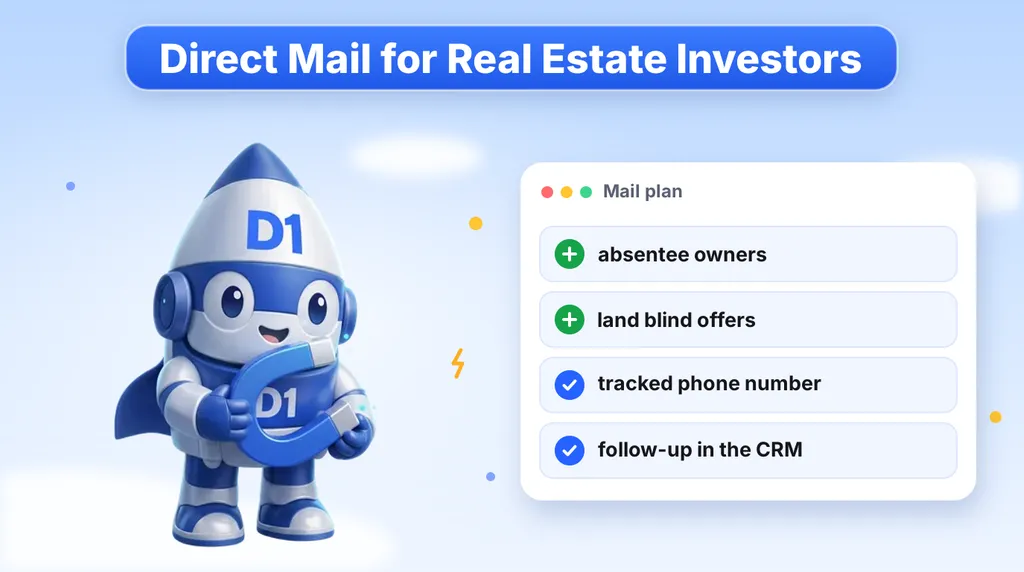
Direct mail still gets sellers to call, but it rarely does it on the first piece. Response to any single letter is low, and the investors who profit from mail are the ones who pick a tight list, send more than once, answer every call quickly and know which campaign produced which lead. This guide walks through that setup for house investors and land buyers: lists, piece types, cadence, tracking and follow-up.
It is written for investors, wholesalers and land buyers who are either starting mail or tired of sending it and hearing nothing back. For the wider picture on where mail sits next to paid search, SMS and SEO, read our lead generation guide for real estate investors. This post stays on the mail.
What Direct Mail Does Well (and What It Doesn't)
Mail reaches owners who are not searching for a buyer. That is its whole advantage. A homeowner with an inherited house in another state, or an owner with a vacant parcel they forgot about, will never type "sell my house fast" into Google. A letter is how you reach them before anyone else does.
The tradeoff is that you are interrupting people. Most of them will throw the piece away. Some will keep it for months and call when something changes: a repair bill, a tax notice, a family decision. That timing is why one mailing is a weak test and a series of mailings is a fair one.
Because response is low on any single send, the result is decided by three things you control:
- The list: who receives the piece.
- The follow-up: how fast and how often you respond to the people who do call.
- The tracking: whether you can tell which list, piece and round produced the lead.
Design and copy matter, but they come after those three.
Choose the List Before You Choose the Piece
A great letter to the wrong list is a waste of postage. Start by deciding which kind of owner you want to reach, then buy or pull a list that matches. Each list type has a different reason the owner might sell.
| List type | Who is on it | Why they might sell |
|---|---|---|
| Absentee owners | Owners whose mailing address differs from the property | Landlords and out-of-town owners who may be tired of managing the property |
| Inherited or probate | Properties passed through an estate | Heirs who live elsewhere and do not want the work or carrying cost |
| Tax delinquent | Owners behind on property taxes | Pressure from unpaid taxes and a deadline |
| Pre-foreclosure | Owners with a recorded default or notice | Time pressure, with timelines that vary by state |
| Vacant or distressed | Empty or visibly neglected properties | The owner is not using the property and it is costing them money |
| Vacant land | Owners of unimproved parcels | Often out of state, often inherited, rarely in a hurry |
Start with one or two list types in one county rather than five lists spread thin. You want enough volume in one place to repeat the mailing and learn from it. You can stack lists later, for example absentee owners who also have a tax issue, to narrow to the owners with the strongest reasons.
Pre-foreclosure lists need extra care because the data source and the timing both matter. Our post on the best pre-foreclosure lead sources covers where that data comes from and how the options compare.
Piece Types: Letters, Yellow Letters and Postcards
Once the list is set, pick the format. The three common choices for house investors each have a place.
Handwritten-style and yellow letters
A yellow letter is a plain letter, often on yellow paper, written to look personal rather than printed by a marketer. The goal is to look like it came from one person who wants to buy one house. Keep it short: who you are, that you buy houses as they are, what the owner can do next and one clear phone number. Letters tend to be a better fit for owners who need to feel they are dealing with a real person, such as inherited or probate owners.
Postcards
Postcards cost less to produce and need no envelope to open, so they are seen even when they are thrown away. They work for repeated contact with a large absentee or vacant list. The tradeoff is limited space, so postcards carry one message and one call to action, not a pitch.
Mixing them
Many investors send a postcard first, then a letter, then a postcard again. Varying the format keeps the same owner from tuning you out, while the repeated name builds familiarity.
Whatever you send, write like a neighbor, not an advertiser. Avoid claims you cannot back up, avoid pressure and never make promises about outcomes, especially on foreclosure or tax lists. Say what you do: you buy the property for cash, you can close on the owner's timeline and there are no agent fees to pay you. Make sure each statement is true for how you actually operate.
Separate Advice for Land Investors
Land owners are not house sellers, and land mail follows different rules. Most land owners are not in distress. They inherited a parcel, bought it years ago as an investment or stopped using it. Many live in another state. They are rarely in a hurry, which means patience and repeated contact matter more than urgency.
The most common land piece is an offer letter or postcard. There are two styles:
- Blind offers: the mailing includes a specific price for the parcel before you have talked to the owner. It gives them something to react to, but it only works if your math is right and you are ready to honor the number.
- Neutral offers: the mailing says you are interested in buying the land and invites the owner to call or visit a page for an offer. It protects you from overpaying on a parcel you have not researched, at the cost of a lower response from owners who want a number first.
Either way, land mail should include the parcel number or a clear description so the owner knows which piece of land you mean. Make it easy to respond by phone, a short web form or a return card. And because many land owners are out of state, a good landing page matters more than it does for a local house list: they will often check you out online before they call.
Land also tends to need more rounds. Plan on repeating the same list on a steady schedule rather than expecting a fast win.
Cadence: One Mailing Is a Test, Not a Campaign
The biggest mistake in direct mail is sending a list once and judging the result. Owners are not ready on your schedule. A repeated sequence gives the right owner the chance to call when their situation changes.
A simple structure to start with:
- Pick a list and mail it with a first piece.
- Mail the same list again on a regular schedule, changing the format or wording so it does not feel identical.
- Keep going for several rounds before deciding the list does not work.
- Remove anyone who asks to stop, anyone who sells to someone else and anyone you have learned is a bad fit.
Decide your rounds and your interval before you spend the first dollar, and put the plan on a calendar. Mail programs fail more often from being dropped halfway than from bad copy.
A Tracked Phone Number and a Matching Landing Page
If every letter carries the same phone number, you will not know which list or piece worked. The fix is cheap: give each campaign its own tracked phone number, and put a matching landing page behind it.
- One tracked number per campaign: for example, one for the absentee postcards and one for the probate letters. Every call tells you where it came from.
- One landing page per campaign: a short URL printed on the piece that sends the owner to a page matching what they received. Keep the form to the address and a phone number.
- A plain "how did you hear about us" check: some owners will call your main line anyway, so ask on every call and write it down.
The landing page should be fast, read well on a phone and explain in simple words who you are, what you do and what happens after the owner submits. For the page structure that works for investors, see our real estate investor website guide. We build these pages as part of our smart websites and funnels service, including seller sites for Valor House Buyers, Top Local House Buyers and Homeland Property Solutions.
Log Every Response and Follow Up
This is where most mail money is won or lost. Many owners who respond to mail are not ready to sell today. They ask a question, say "maybe later" or want to talk to a family member first. If those calls disappear into a notebook, the mailing paid for contacts you never worked.
Put every response into a CRM the same day, whether it came by phone, form, text or email. Record the list, the piece, the date and what the owner said. Then set the next action:
- Ready now: call back within minutes and book the appointment or walkthrough.
- Not yet: add them to a reminder with a date, and keep them on the mail list for the next round.
- Not interested: mark them and stop mailing them.
Speed matters here just as it does for paid leads. An owner who called you and got voicemail may call the next buyer on the list. Our speed-to-lead guide explains why the first answer tends to win, and our CRM and automation setup handles missed calls, instant texts and reminders so no response gets lost. If you text owners, check the consent rules before you do.
The CRM also closes the loop on your numbers. When each lead carries its list and campaign, you can see which lists lead to appointments and contracts, not just calls. Cut the lists that bring calls and no deals. Put more rounds on the ones that do.
Common Mail Mistakes
- Mailing once and quitting: response is low on any single piece, so one round proves very little.
- Buying a huge list: a broad list dilutes the message. A tight list in one county gets repeated and learned from.
- One phone number for everything: you cannot cut a bad list if you cannot see it.
- No landing page: out-of-town owners especially will look you up first.
- Slow callbacks: if you cannot answer, route calls to a service or an automated reply that books the next step.
- Overclaiming: promises about saving a house or fixing credit are unfair to the owner and risky for you.
Direct Mail Starter Checklist
- Choose one or two list types in one county, house or land.
- Pick the piece: postcard, letter, yellow letter or land offer (blind or neutral).
- Decide the number of rounds and the interval, and put them on a calendar.
- Set up a tracked phone number and a matching landing page for each campaign.
- Route every call and form into your CRM the same day, with list and campaign tagged.
- Call back fast, and put "not yet" owners on a dated reminder.
- After several rounds, compare lists by appointments and contracts, then cut or expand.
If you want mail, paid search and follow-up working together instead of as separate experiments, our PPC keyword guide for real estate investors shows the search side of the same system.
Want Your Mail Backed by a Site and a CRM?
We build the landing pages, tracked numbers and CRM follow-up that make a mail campaign measurable. Book a call and we will map out the pieces for your market, house or land.
Or call us directly: (888) 330-1434.
D1TechCreative builds websites, paid traffic, CRM and AI automation systems for service businesses and real estate investors across the United States. Based in Fort Lauderdale, FL.