
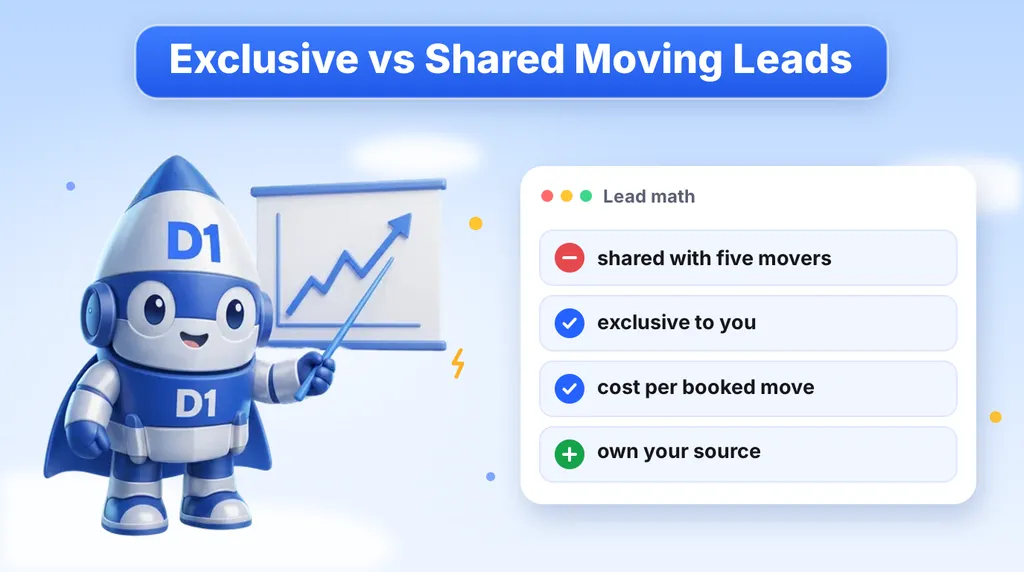
A shared moving lead is a quote request that a lead vendor sells to several moving companies at once. An exclusive moving lead is a quote request sold to one mover only. That is the whole difference on paper, and it changes almost everything about how the lead behaves once it reaches your phone.
This guide is for owners and sales managers at local and long-distance moving companies who buy leads today, or are about to, and want to know which kind is worth the money. It explains how each type works, how to compare them on the number that matters (cost per booked move, not cost per lead), what to ask a vendor before you sign, and when it makes more sense to build a lead source you own. We do not quote vendor prices, because they change by market, season and move type.
How Shared Moving Leads Work
A homeowner fills in a quote form on a lead vendor's site. The vendor sells that same record to several movers who serve the route. Within minutes, the homeowner's phone starts ringing, and every caller is trying to get an estimate booked first.
What that means for you in practice:
- The race starts before you dial. Whoever reaches the customer first usually gets the survey or the in-home estimate. Our speed-to-lead guide covers why the first response wins so often.
- Price becomes the conversation. When the customer has three or four quotes in the same afternoon, the easiest thing to compare is the number at the bottom. Service, insurance and crew quality get less attention.
- The customer gets tired of the phone. By the fourth or fifth call, many people stop answering unknown numbers. Some never pick up again, even for the mover they would have liked best.
- Volume is easy to get. That is why so many movers start with shared leads.
How Exclusive Moving Leads Work
With an exclusive lead, the vendor promises that the record goes to you alone. You pay more per lead, and in return you should not be racing other movers who bought the same name from the same vendor.
Exclusive means exclusive from that vendor. The same customer may have filled in forms on two or three other sites the same evening, so you are the only mover calling from that list, not the only mover calling. Volume is usually capped too: a vendor can only generate so many exclusive requests on a route each month, and supply can thin out fast in quiet months. Exclusive leads still need fast follow-up. The pressure is lower, not gone.
Shared vs Exclusive at a Glance
| Question | Shared leads | Exclusive leads |
|---|---|---|
| Price per lead | Lower | Higher |
| Other movers calling the same customer | Several, from the same vendor | None from that vendor, possibly some from elsewhere |
| How fast you must respond | Within minutes | Still fast, with a little more room |
| What the customer compares | Mostly price | Price, plus how you handled the first call |
| Volume you can count on | Usually easy to get | Often limited by route and season |
| Who owns the source | The vendor | The vendor |
Look at the last row. Whichever type you buy, the ads, the landing page and the customer list behind the lead stay with the vendor. That matters later in this guide.
Why Cost Per Lead Is the Wrong Number
Most movers compare vendors on what each lead costs, because it is the number on the invoice. It is also the number that tells you the least.
A cheap lead that never answers the phone costs you the lead price plus your sales rep's time. A more expensive lead that books an in-home estimate and signs the next day can be the better deal, even at several times the price. The only way to know is to follow each lead source all the way to a booked move.
The number to compare is cost per booked move: everything you spent on a lead source in a month, divided by the moves from that source that actually booked. If you can, go one step further and look at revenue per booked move by source, because a long-distance job and a one-bedroom local move are not the same win.
How to Calculate Cost Per Booked Move
You need four things for each lead source, for the same period (a month is usually enough):
- Total spend. Every lead you paid for from that vendor, minus any credits they gave back.
- Leads you reached. How many of those leads you actually spoke to or texted with.
- Estimates or surveys booked. In-home, virtual or phone surveys that were scheduled.
- Moves booked. Jobs with a deposit or a signed order, not "they said they would call back".
Then work it out per source. You can copy this table into a spreadsheet and fill in your own numbers:
| Line | How to get it | Shared vendor | Exclusive vendor |
|---|---|---|---|
| Spend this month | Invoices minus credits | ||
| Leads received | Vendor report or CRM | ||
| Contact rate | Leads reached divided by leads received | ||
| Estimate rate | Estimates booked divided by leads reached | ||
| Close rate | Moves booked divided by estimates booked | ||
| Cost per booked move | Spend divided by moves booked | ||
| Revenue per booked move | Booked revenue divided by moves booked |
The middle three lines are where shared and exclusive leads usually separate. Shared leads tend to lose people at the contact step, because the customer is fielding calls from everyone. Exclusive leads should hold up better there, and your numbers will tell you whether they do in your market.
What Your CRM Has to Track for This to Work
None of this math works if leads live in someone's inbox. Make sure every lead lands in your CRM with:
- A source field that names the vendor and the lead type (shared or exclusive), filled in automatically, never typed by hand.
- A stage that moves from new to contacted, estimate booked, booked and lost, so you can count each step.
- A lost reason picked from a short list: never reached, booked with another mover, price, date changed, not a real move.
- The booked revenue on the job, so cost per booked move can sit next to what the move was worth.
Our guide to moving company CRM automation shows how to set up those stages and the follow-up that runs behind them.
Speed Matters Even More With Shared Leads
If you buy shared leads, your first response time decides most of the outcome. A shared lead you call back an hour later is often a lead you paid for and handed to a competitor.
- Send an instant text and email the moment the lead arrives, naming your company and the move they asked about.
- Call within minutes during business hours, and have a plan for evenings and weekends.
- Use missed-call text back so a customer who calls you between other movers' calls gets an answer. Our post on missed-call text back for moving companies covers the setup.
- Keep following up for several days with a mix of calls, texts and email. Many customers book a week after the first form, once the noise dies down.
An AI voice and SMS agent can handle the first few minutes when nobody is free. For Safebound Moving and Storage, an AI voice and SMS agent calls every new lead within seconds and books the appointment straight into the CRM.
What to Ask a Lead Vendor Before You Buy
These questions get past the sales pitch:
- How many movers get each shared lead? Ask for the maximum, not the average.
- What does exclusive mean in your contract? Is it exclusive forever, or only for a set number of days before the record is resold?
- Where do the leads come from? Search ads, social ads, comparison sites or partner sites. Ask to see the form the customer filled in.
- How fresh is a lead when it reaches me? Real time, or batched every few hours?
- What can I return, and how? Wrong numbers, duplicates, moves outside your area and fake requests. Ask how long you have and what proof they need.
- Can I filter by route, move size and date? Leads you cannot serve are money spent on someone else's job.
- How was consent collected? Ask for the exact wording the customer agreed to, and whether it names your company.
- Is there a contract term or minimum spend? A short trial on one route tells you more than any sales call.
Consent and Compliance When You Call and Text Purchased Leads
Buying a lead does not automatically give you permission to text or auto-dial it. The rules for calls and texts in the US, including the TCPA, depend on what the customer actually agreed to on the vendor's form, and they have been changing. Before you put purchased leads into automated texting or a dialer:
- Keep a copy of the consent wording and the time the form was submitted for every lead, or make sure the vendor can produce it on request.
- Honor opt-outs straight away, on every channel, and make sure "STOP" in a text removes the number from every sequence.
- Register your texting numbers for A2P 10DLC if you send business texts from a standard US number.
- Ask your attorney to review your setup if you are unsure. This guide is not legal advice.
Our guide to TCPA-compliant SMS is written for investors, but the consent and opt-out basics apply to movers too.
When to Build Your Own Lead Source Instead
Shared and exclusive leads both rent you someone else's marketing. When the vendor raises prices, changes its rules or drops your route, your pipeline changes with it. A lead source you own works differently: the ads, the landing pages, the Google Business Profile and the customer list stay with your company, and every month of data makes them better.
Owned sources for movers usually mean:
- Google Ads on high-intent searches, with a landing page per route or move type. Our moving company Google Ads keywords guide covers what to bid on and what to block.
- Meta lead forms per market. Petrolino Moves runs its own Meta lead form campaigns by market, and Alaska and Hawaii average 75 leads a month each.
- Google Maps for local moves, through a complete and active Business Profile. See how to rank a moving company on Google Maps.
- Your own website with a quote form that feeds the CRM directly.
Owned campaigns can reach real volume. For Safebound Moving and Storage, the campaigns brought in over 5,000 leads. Our lead generation and paid traffic service builds and runs this kind of source for movers, and how to get moving leads walks through the full set of options. For the long-haul side specifically, read our guide to long-distance moving leads.
A Sensible Mix for Most Movers
Most moving companies do not need to pick one model forever. A practical path looks like this:
- Measure what you have. Run cost per booked move on every current vendor for one full month.
- Cut the worst source. Drop or pause the vendor with the highest cost per booked move, or the one with the most returns.
- Test exclusive on one route. If shared leads lose most people at the contact step, try exclusive leads on your best route and compare the same lines.
- Start one owned source. Put part of the saved budget into Google Ads, Meta lead forms or your Maps profile, tracked in the same CRM.
- Shift spend each month. Move budget toward whichever source books moves at the lowest cost, and keep a vendor as a top-up for busy season if it earns its place.
For a wider plan, our lead generation playbook for moving companies covers each channel in more depth.
Common Mistakes When Buying Moving Leads
- Judging vendors on cost per lead and never tracking leads through to booked moves.
- Buying shared leads without a plan to respond within minutes, including nights and weekends.
- Treating "exclusive" as a promise that no other mover will call the customer.
- Paying for routes, dates or move sizes you cannot serve because the filters were never set.
- Skipping returns because the process is a hassle, so bad leads stay on the bill.
- Texting or auto-dialing purchased leads without knowing what consent the customer gave.
- Putting the whole budget into one vendor, with nothing of your own to fall back on.
Lead Source Checklist
Run through this before you renew or sign with any vendor:
- Every lead lands in the CRM with its vendor and lead type set automatically.
- Stages and lost reasons are tracked for every lead.
- Cost per booked move is calculated for each source every month.
- First response goes out within minutes, by text and by call.
- Follow-up runs for several days across calls, texts and email.
- You know how many movers get each shared lead, and what exclusive means in the contract.
- Route, move size and date filters match the jobs you want.
- Consent wording is on file, opt-outs are honored on every channel, and texting numbers are registered.
- At least one lead source belongs to your company, not to a vendor.
Want to Know What Your Leads Really Cost?
We build lead sources that belong to your moving company: Google and Meta campaigns, landing pages, Google Maps and the CRM follow-up behind them. Book a call and we will look at your current lead mix and where the booked moves come from.
Or call us directly: (888) 330-1434.
D1TechCreative builds websites, paid traffic, CRM and AI automation systems for service businesses and real estate investors across the United States. Based in Fort Lauderdale, FL.