
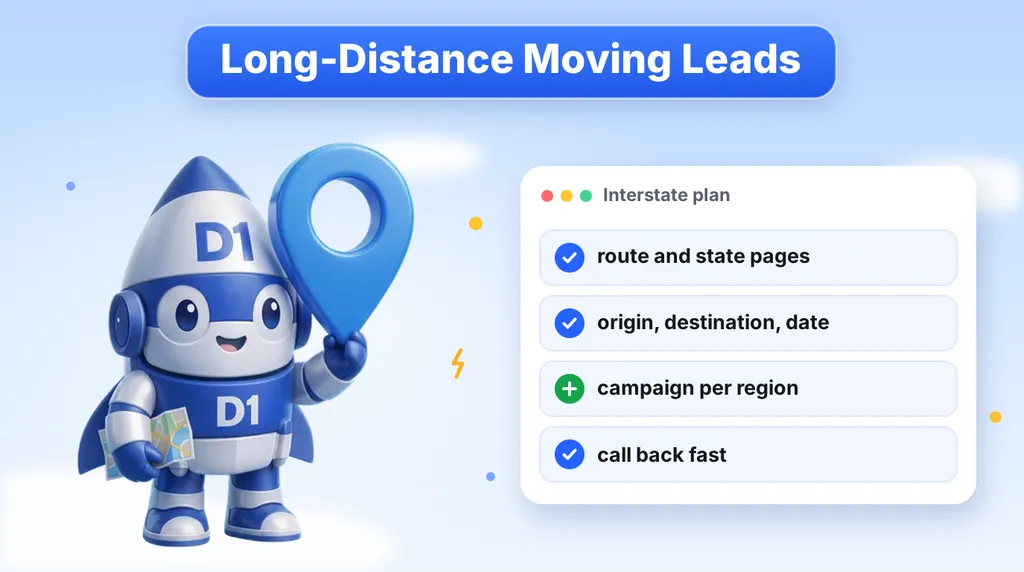
A local move is often booked in a week. A long-distance move is planned over weeks or months, costs far more, and the customer usually asks several carriers for a quote before choosing one. That changes what your website, your ads and your phone team need to do. This guide covers the setup we recommend for interstate movers: pages built around routes, a quote survey that captures the right details first, ad campaigns split by region, and a follow-up routine that gets you on the phone before the other carriers do.
It is written for owners and sales managers at moving companies that take jobs across state lines. If you want the broader picture first, start with our guide on how to get moving leads and the overview of lead generation for moving companies. This post stays on what is different about long-distance work.
Why Interstate Leads Behave Differently
Four things set long-distance leads apart from local ones, and each one should shape how you market.
- A longer planning window. The customer may search months before the move date. Many leads are real but not ready, so you need a way to stay in touch instead of treating "not yet" as a dead lead.
- A higher ticket. Each job is worth more, so each lead is worth more. That supports a higher cost per lead than a local mover could justify, as long as you can actually close.
- More comparison shopping. The customer is almost always collecting several quotes. Speed, clarity and a human voice often decide who wins.
- Distance matters to the price. A move to a neighboring state and a move across the country are different products. Your forms and ads should treat them differently.
The practical result: you win by capturing the details that let you quote accurately, answering fast, and showing up for the specific routes you actually serve.
Build Route and State Pages
Local movers build pages for cities. Interstate movers should build pages for routes and states, because that is how the customer searches: "movers from Chicago to Florida", "moving to Texas from Ohio", "long distance movers Illinois".
A good route or state page does a few things:
- Names both ends of the move in the headline, such as "Long Distance Movers From Illinois to Florida".
- Explains in plain words how that kind of move works with your company: how you pack, how the truck is loaded, how pickup and delivery windows are handled, and how the customer can reach someone during the trip.
- Includes only facts you can stand behind. If you serve a corridor often, say so. If you do not, do not pretend.
- Carries the quote survey or a clear button to it, so the visitor never has to hunt for the next step.
- Links to the neighboring route and state pages, so a visitor can move around the site.
Avoid copy-and-paste pages where only the state name changes. Search engines treat those as thin, and customers can tell. Write something real about each page, even if it is short: the cities you pick up from, the typical questions customers ask about that route, and what your crew does differently on long hauls.
You do not need a page for every possible pair. Start with the origins you win most often and the destinations people ask about most, then add pages as your call logs and Search Console data show demand. Our moving company website guide covers the rest of the site structure around them.
The Quote Survey: Capture Origin, Destination and Date First
A long-distance quote cannot be priced without a few basic facts. The best forms ask for those facts first, one step at a time, and ask for contact details last. A short multi-step survey tends to feel lighter than one long form, because each screen asks for one thing.
For example, The Nationwide Movers, a long-distance mover based just west of Chicago, has a three-step quote survey that sits beside the video hero, above the footer and in a popup that every quote button opens. It also has a clickable map of all 50 states that draws the route from their base, plus ten city pages covering the local details. That is the pattern: make the quote easy to start from anywhere on the page, and make the route feel real.
Here is a field order that works for most interstate movers:
| Step | What to ask | Why it comes at this point |
|---|---|---|
| 1 | Moving from (city or ZIP) and moving to (city or ZIP) | It is the one fact you cannot quote without, and it is quick to answer |
| 2 | Move date, or a rough month if flexible | Lets you flag urgent jobs and sort out the long-range ones |
| 3 | Size of the move (bedrooms or a rough inventory) | Gives the estimator enough to start a number |
| 4 | Name, phone and email, plus the best time to call | Asked once the visitor is invested in getting a quote |
Two details are worth getting right. First, save the answers from every step, not just the final submit, so you can see where people drop off. Second, put your consent language next to the submit button if you plan to text the lead, and follow the rules that apply to your state and your messaging. Keep the survey free of fields you do not use. Every extra question is a reason to leave.
Split Your Ad Campaigns by Region
Long-distance ads should not be one big campaign for the whole country. Different regions cost different amounts to serve, have different demand, and need different budgets. Splitting them gives you control and clean reporting.
A real example: Petrolino Moves is a case where D1TechCreative runs the lead generation, not the website. The setup is Meta lead form campaigns for Alaska, Hawaii and the lower 48, one campaign per market, so each area gets its own budget and targeting. As that page puts it, "The Alaska and Hawaii campaigns average 75 leads a month each, 150 between them in July 2026." We quote it only for that account and that month. Your numbers will depend on your market, your offer and your follow-up.
The idea behind it carries over to any mover:
- Give hard-to-serve regions their own campaign. Alaska, Hawaii and other regions with limited carriers behave differently from the lower 48. A shared budget lets the cheap, easy region soak up the spend while the harder one gets starved.
- Group by origin, not just destination. The place the truck leaves from determines your cost and your crew availability, so campaign targeting should start there.
- Match the ad to the audience. Someone leaving a coastal city for a smaller town has different worries than someone moving the other way. Say the route in the ad when you can.
- Use search for intent and social for reach. Searches like "long distance movers" show a person who is ready to ask for quotes. Facebook and Instagram help you reach people who have not started searching yet. Our guide to Facebook ads for moving companies covers the social side.
For the search side, the keyword groups, match types and negatives are covered in our Google Ads keywords for moving companies post. If you want the campaigns built and managed for you, that is what our lead generation and paid traffic service does.
Match the Landing Page to the Ad
Ads for long-distance moves should land on a page that repeats what the ad promised. If the ad says "Movers From Chicago to Florida", the page should say it too, with the quote survey right there. Sending that click to a generic home page makes the visitor repeat the work of finding the right place.
Keep the page focused. One headline, a short explanation of how the move works, a few trust items you can really back up (licensing and insurance details, a real office address, reviews that exist), and the survey. Add a phone number that is easy to tap on mobile, because some long-distance customers prefer to talk to a person before they fill anything in.
If your carriers are licensed for interstate work, show the numbers the way your regulators require. Customers comparing movers often look for them, and so do reviewers.
Fast Follow-Up Wins the Quote Race
The lead you just received is probably asking four or five other carriers at the same moment. The first carrier to call, answer questions and send a clear estimate has a strong advantage. This is the same pattern we describe in our speed-to-lead guide, and for interstate movers it matters just as much as it does for local ones.
A simple follow-up routine for a long-distance lead:
- Within minutes: an automatic text and email that confirm the request, say who will call and when, and thank them by name.
- Same day: a real phone call from a person who has the origin, destination and date in front of them. If the lead does not answer, leave a short voicemail and send a text.
- The next few days: a written estimate or a clear next step, followed by a check-in call. Answer the questions that come up on every long-distance move: the delivery window, what happens if the date shifts, and how claims work.
- Long-range leads: for people moving in a few months, set a reminder and follow up on a schedule instead of letting the lead go cold. Many interstate customers decide late.
All of this needs a place to live. Put every lead in a CRM with the route, the move date and the status, so nothing depends on someone remembering to call. Our CRM and automation setup handles the instant replies and reminders. Do not promise a delivery date or price in an automated message, and leave the final quote to a person.
What to Measure
You cannot improve what you do not count. Track these by region and by route, not just in total:
- Cost per lead for each campaign.
- How many leads were answered, and how fast.
- How many leads turned into written estimates.
- How many estimates turned into booked moves, and the booked value.
- Where visitors leave the quote survey.
The point is to see whether a region is cheap and weak, or expensive and strong. A low cost per lead means little if those leads never become booked jobs, and a higher cost per lead can be a good deal if the jobs are bigger and close more often.
Common Mistakes Interstate Movers Make
- Running one national campaign with one shared budget.
- Building route pages that only swap the state name.
- Asking for a phone number before the visitor has said where they are moving.
- Calling back the next day, after the customer has already booked with someone else.
- Dropping leads who say they are moving later instead of nurturing them.
- Promising a price or a delivery date in an automatic message.
Interstate Lead Checklist
- List your top origins and destinations, and build a real page for each.
- Add a short multi-step quote survey that asks origin, destination and date first.
- Make the survey reachable from every page, including a popup from quote buttons.
- Split ad campaigns by region, with a separate budget for hard-to-serve areas.
- Point each ad at a page that repeats the route it promised.
- Set up an instant text and email, then a same-day phone call.
- Log every lead in a CRM with the route and move date, and schedule follow-ups for long-range moves.
- Review cost per lead, response time and booked moves by region every month.
If you are also looking at business relocations, our post on commercial moving leads covers how those buyers are won. To plan the website and the ads together, take a look at our moving company website design service.
Want More Interstate Moving Leads?
We build moving company websites with route pages and quote surveys, and we run the ads and follow-up behind them. Book a call and we will look at how your long-distance leads come in today and where they are slipping away.
Or call us directly: (888) 330-1434.
D1TechCreative builds websites, paid traffic, CRM and AI automation systems for service businesses and real estate investors across the United States. Based in Fort Lauderdale, FL.