
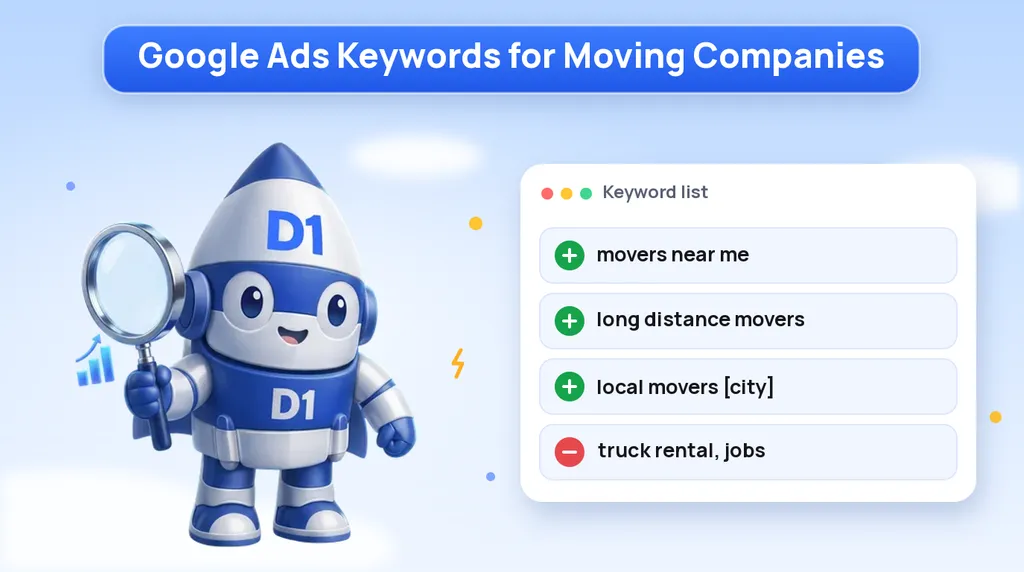
A moving company can lose a surprising amount of ad money to people who were never going to hire a mover. Someone pricing a rental truck, someone looking for a moving job, someone hunting for free boxes: Google will show all of them your ad if your keyword list lets it. This guide covers the keyword setup for Google Ads that we use when planning paid search for movers: the local, long-distance and specialty terms worth buying, the situation keywords most competitors skip, the negative list, match types, and how to group it all by move type.
It is written for owners and office managers of local and long-distance moving companies who run their own Google Ads account or want to check the work of whoever runs it. If you want the wider view of where paid search sits next to referrals, SEO and lead vendors, read our guide on how to get moving leads first. This post stays on keywords.
Why Moving Keywords Need a Tight List
Moving searches look similar on the surface but come from very different people. "Moving truck" might be someone who wants a crew, or someone who wants to drive a rented box truck themselves. "Movers" might be a homeowner, or a person who wants to work as one. The words overlap, and Google's matching will happily spend your budget on both sides of that overlap unless you tell it not to.
Clicks are not free, either. In our Google Ads vs SEO breakdown we list moving services at roughly $8 to $22 per click. At that range, a few dozen wasted clicks a week from DIY movers and job seekers is real money that could have bought calls from people with a move date.
Sort every search into three groups before you add it:
- Hiring intent: the person wants a company to move their things. Pay full price for these.
- Planning intent: the person is researching costs, checklists or how far ahead to book. Some will hire soon. Test a small amount.
- Wrong audience: DIY movers, truck and container renters, job seekers, box shoppers and people looking for free help. Block them.
Core Local Moving Keywords
Local moves are usually priced by the hour and booked on short notice, so the searcher often wants a phone number and a price range today. These terms should carry the local campaign.
| Keyword group | Example keywords | What the searcher wants |
|---|---|---|
| Near me | movers near me, moving company near me, local movers near me, moving help near me | A nearby crew they can call now, mostly on a phone |
| City and suburb | local movers [city], movers in [city], [city] moving company, best movers [suburb] | A company that already works in their area |
| Home type | apartment movers [city], house movers, condo movers, small move movers | A crew sized for their kind of move |
| Quote | moving quote [city], local moving estimate, how much do movers charge [city] | A price before they commit, often comparing a few companies |
Build the city group for every town and larger suburb you actually serve, not every town in the state. Local modifiers tell you exactly where the job is, and your ad can repeat that town back to the searcher. Keep "near me" in its own ad group so you can see how it performs on its own, because it tends to be the biggest and broadest local term.
Long-Distance and Interstate Keywords
Long-distance moves are bigger jobs, so they are worth a separate campaign with its own budget. The searcher is usually further from move day, compares more companies, and cares about how the price is set.
- General: long distance movers, long distance moving company, interstate movers, cross country movers, state to state movers
- Route: movers from [city] to [city], [state] to [state] movers, moving from [origin state] to [destination state]
- Quote: long distance moving quote, cross country moving cost, interstate moving estimate
Route keywords are where long-distance campaigns get specific. If most of your interstate work runs along a few lanes, build an ad group for each lane and point it at a page about that route. The site we built for The Nationwide Movers uses a clickable 50-state route map and ten city pages, which gives route keywords somewhere relevant to land.
For interstate work, decide whether to target searchers at the origin, the destination or both. Most movers start with the origin, since that is where the estimate and the loading happen.
Specialty and Situation Keywords
Specialty and situation keywords have lower volume per phrase, but the searcher has told you exactly what they need. Many movers never build these ad groups, so competition is often lighter. Only add the ones you actually offer.
| Ad group | Example keywords |
|---|---|
| Senior moves | senior movers, moving help for elderly parents, assisted living move, downsizing movers |
| Last-minute moves | last minute movers, same day movers, emergency movers, movers available this weekend |
| Office and commercial | office movers [city], commercial moving company, business relocation services |
| Packing | packing services [city], full service movers, movers who pack for you |
| Storage | moving and storage [city], movers with storage, store and move |
| Heavy items | piano movers, safe movers, pool table movers, hot tub movers |
Give each situation its own ad group, ad copy and landing page section. A family moving a parent into assisted living wants to read about patience, care and a set schedule, not a headline about cheap hourly rates. A last-minute searcher wants to know you have a crew available. When the ad and page speak to the situation, more of those clicks turn into calls.
Be careful with promises. Don't say "same day guaranteed" unless your dispatch can deliver it every time. Describe what you actually offer and let the customer decide.
The Negative Keyword List for Movers
This is where most moving accounts save the most. Build these as a shared negative list, attach it to every moving campaign before launch, and add to it every week from the search terms report.
| Category | Negative keywords |
|---|---|
| Truck and equipment rental | truck rental, rent a truck, van rental, trailer, dolly, uhaul, u haul, penske, budget truck |
| Containers | pods, portable storage container, moving container, shipping container |
| Jobs | jobs, hiring, careers, salary, pay, driver jobs, mover jobs, apply, indeed |
| DIY and how-to | diy, how to move, how to pack, moving checklist template, tips |
| Boxes and supplies | boxes, moving boxes, bubble wrap, packing tape, supplies |
| Free and cheap help | free, free movers, volunteer, craigslist, labor only (if you don't offer it) |
| Wrong kind of moving | moving pictures, moving image, house moving (lifting buildings), mobile home moving (if you don't offer it) |
Some terms need a judgment call instead of a blanket block:
- "Cheap movers": often a price-sensitive but real customer. If you offer small or budget moves, test it in its own ad group. If you only do full-service moves, block it.
- Brand names of national van lines: bidding on competitors can work, but give it a separate campaign and budget. Add those names as negatives everywhere else.
- "Moving labor" and "loading help": worth buying if you sell labor-only jobs, wasteful if you don't.
- "Reviews": people searching "[your company] reviews" are close to booking. Leave it in your brand campaign.
Match Types: Start Tight
Launch your core local, long-distance and situation keywords in phrase and exact match. Phrase match covers the natural variations ("movers near me cheap", "local movers in Newark NJ") without wandering into loosely related searches. Exact match gives you close control over the few terms that matter most, such as "movers near me" and your top city terms.
Broad match can work for movers once the account has steady conversion data, you use a conversion-based bid strategy, and your negative list has had a few months to grow. Until all three are true, broad match mostly finds the truck rental and job searches you were trying to avoid. If you want to test it, put it in its own campaign so you can compare cost per booked move side by side.
Whatever you choose, read the search terms report weekly for the first two months. It shows exactly what people typed, and it is the fastest source of new negatives and new route or situation keywords.
Group Campaigns by Move Type
The cleanest structure for most movers follows the type of move, because each type has different budgets, booking windows and job values:
- Local campaign: near me, city, home type and quote ad groups, targeted to your local service area.
- Long-distance campaign: general, route and quote ad groups, with its own budget so local spend never starves it.
- Specialty campaign: one ad group per situation you offer, such as senior, last-minute, office or piano moves.
- Brand campaign: your company name on a small budget so competitors can't take your branded clicks.
- Optional test campaign: competitor names or broad match, kept apart so a test never eats the core budget.
Set location targeting to people in or regularly in your area, not people showing interest in it, for the local campaign. For long-distance, decide on purpose whether you want origin or destination searchers and set targeting to match. Schedule your ads around the hours someone can actually answer the phone, or make sure an instant text goes out when they can't.
Match Every Ad Group to a Quote Page
A keyword is only half the job. The page it lands on should repeat what the searcher typed: "Local Movers in [City]" for a city keyword, "Long Distance Movers From [City]" for a route keyword, and a short quote form near the top. The site we built for Smooth Relocation Van Lines uses a three-step quote funnel, so a visitor answers a few easy questions instead of facing one long form.
If your current site sends every ad to the homepage, that is usually the first thing to fix. Our moving company website design service builds quote pages for each move type and service area, and our post on moving quote calculators covers how to show a price range without scaring people off.
Track Booked Moves, Not Just Clicks
Count calls and quote form submissions as conversions, and set a minimum call length so short wrong numbers don't look like leads. Then send outcomes back from your CRM: which leads got an estimate, and which booked. When Google can see which keywords produce booked moves, its bidding shifts budget toward them.
Speed matters as much as the keyword. People who want movers often request quotes from several companies at once, and the first to respond has the advantage. On Safebound Moving and Storage, an AI voice and SMS agent calls every new lead within seconds, qualifies it and books the appointment into the CRM. Our lead generation playbook for moving companies covers follow-up in more depth, and the PPC keyword guide for real estate investors shows the same keyword method applied to a different industry.
Starter Checklist
- Build local ad groups for near me, each city you serve, home type and quote, in phrase and exact match.
- Give long-distance its own campaign, with route ad groups for the lanes you run most.
- Add one ad group for each specialty or situation move you actually offer.
- Attach the shared negative list (rentals, containers, jobs, DIY, boxes, free) before the first click.
- Read the search terms report weekly and keep growing the negatives.
- Send each ad group to a quote page whose headline matches the keyword.
- Import booked moves from your CRM so bidding learns what a real job looks like.
We set up and manage campaigns like this through our lead generation and paid traffic service. For AMEX Moving and Storage, a long-distance mover in Bergen County, NJ, the ads we run in New York, New Jersey and Connecticut bring in around 400 to 500 moving leads a month.
Want Us to Build and Run Your Moving Company Ads?
We set up the keyword lists, negatives, quote pages and CRM follow-up for moving companies, then manage the account month to month. Book a call and we will review your current campaigns or plan a new one with you.
Or call us directly: (888) 330-1434.
D1TechCreative builds websites, paid traffic, CRM and AI automation systems for service businesses and real estate investors across the United States. Based in Fort Lauderdale, FL.