
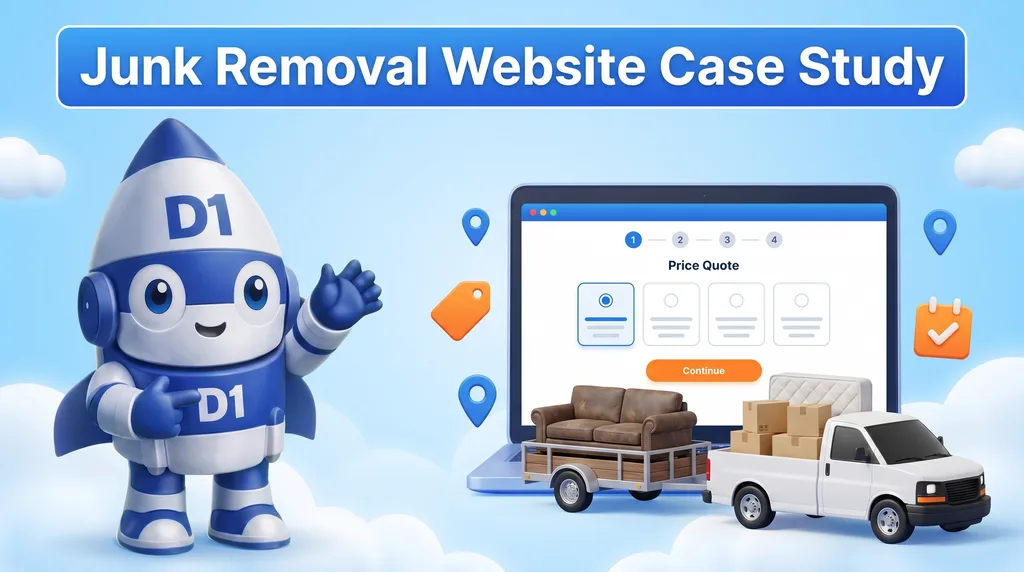
Most junk removal websites ask the same thing first: your name, your phone number, and a box to describe the job. Then the homeowner waits for someone to call back with a price. That wait is where the job goes to whoever answered faster.
Florida Local Remove & Haul is a junk removal and hauling crew out of Boynton Beach. Their site opens on a price wizard instead of a contact form, and every page after that is built to be found by someone searching for a pickup in their own city. This post walks through why each piece is there and what you can borrow for your own hauling business.
You can see the build on our portfolio, or visit the live site.
The Client
Locally owned, based in Boynton Beach, and working across Palm Beach, Broward and Miami-Dade. They take almost anything that fits in the trailer: household junk, full property cleanouts, construction debris, appliances, furniture, garage cleanouts, yard waste and commercial jobs. Their pricing is simple on purpose. They quote by how much space the load takes up, and the price they give is the price they charge.
That last point shaped the whole site. If the business promise is a clear price up front, the website should start with the price, not end with it.
The Problem With the Usual Junk Removal Site
Hauling is an impulse purchase. Someone is standing in a garage or a cleared-out rental, looking at a pile, and they want to know two things: what will it cost and how soon can you come. A form that only says “we’ll get back to you” answers neither.
- Contact-first forms ask for personal details before the visitor has a reason to give them.
- One generic services page can’t rank for “appliance removal” and “construction debris removal” at the same time.
- A single “areas we serve” list puts the business nowhere in the search when the caller is in Delray Beach or Coral Springs.
What We Built
1. A price wizard in the hero
The first thing a visitor sees under the headline is “What’s it going to cost?” and a four-step wizard: the job, the load size, where and when, then contact details. The first step is a set of tiles for the eight job types, so the visitor starts by tapping what they need hauled, not by typing.
By the time the wizard asks for a name and phone number, the visitor has already described the job. That is the same principle behind every smart funnel we build: earn the contact details by being useful first. A phone number sits right under the wizard for people who would rather call.
2. Eight service pages
Each thing they haul away has its own page: junk removal, property cleanouts, construction debris removal, appliance removal, furniture removal, garage cleanouts, yard waste removal and commercial junk removal. Each page speaks to the person who searches for that exact job.
Separate pages give search engines a clear answer for each search, and give the visitor proof that this crew does their kind of job.
3. Ten city pages
Boynton Beach, Delray Beach, West Palm Beach, Boca Raton, Lake Worth Beach, Wellington, Jupiter, Fort Lauderdale, Pompano Beach and Coral Springs each get a page. People search for junk removal with a city name attached, and a page built for that city is what shows up. We cover the reasoning in more depth in our guide to local SEO for service businesses.
4. A brand that looks like a real local crew
We set a bold orange accent on a dark base with warm sand sections, a rounded display face for headlines and a clean body font. It reads as friendly and local without looking like a template. Trust markers sit near the top: their star ratings on the review platforms they use, free quotes, same-day and next-day pickups, and a note that they donate and recycle what they can.
5. Built as a custom Next.js site
No page builder and no plugin stack. The site is a custom Next.js build, which keeps it fast on a phone in a driveway and easy to add more city pages to later. If you are weighing that choice for your own business, see our custom website vs WordPress comparison.
What Other Hauling Businesses Can Take From It
- Put the price question first. If you quote by volume, let the visitor start there.
- Ask about the job before asking for a name. Tapping tiles is easier than typing, and a visitor who has started is more likely to finish.
- One page per service. “Appliance removal” and “estate cleanout” are different searches from different people.
- One page per city you actually serve. Write each one for that place, not a copy with the name swapped.
- Answer fast. A quote request is worth the most in the first few minutes. Pair the form with speed-to-lead follow-up so nobody waits on a callback.
FAQ
Should a junk removal website show prices? It should at least start the price conversation. A wizard that collects the job type and load size lets you give a real number quickly without publishing a price list that can’t fit every job.
How many steps should a quote form have? As few as it takes to price the job. Here it is four: the job, the load size, where and when, and contact details last.
Do I really need a page for every city? For the cities where you want calls, yes. A city page is how you show up when someone searches with that city name.
What happens after someone submits the wizard? That is where a CRM and automated follow-up come in. See our guide to marketing automation for service businesses.
Want a Quote-First Website for Your Hauling Business?
We build custom websites, quote funnels and local SEO for junk removal, hauling and home service companies, then wire them to a CRM so every request gets answered.
Or call us directly: (888) 330-1434.
D1TechCreative builds custom websites, AI voice agents, CRM systems and lead generation funnels for service businesses across the United States. Based in Fort Lauderdale, FL.