If “marketing automation” sounds like an enterprise term that doesn’t apply to a 5-person service business, you’re missing the biggest competitive advantage available to small companies in 2026. Automation isn’t about scale anymore — it’s about speed, consistency, and not letting things fall through the cracks because nobody had time.
This guide explains marketing automation for service businesses in practical terms. What it actually means, the five highest-ROI workflows to turn on first, what a realistic stack looks like, and the order to do it in.
What Marketing Automation Actually Is
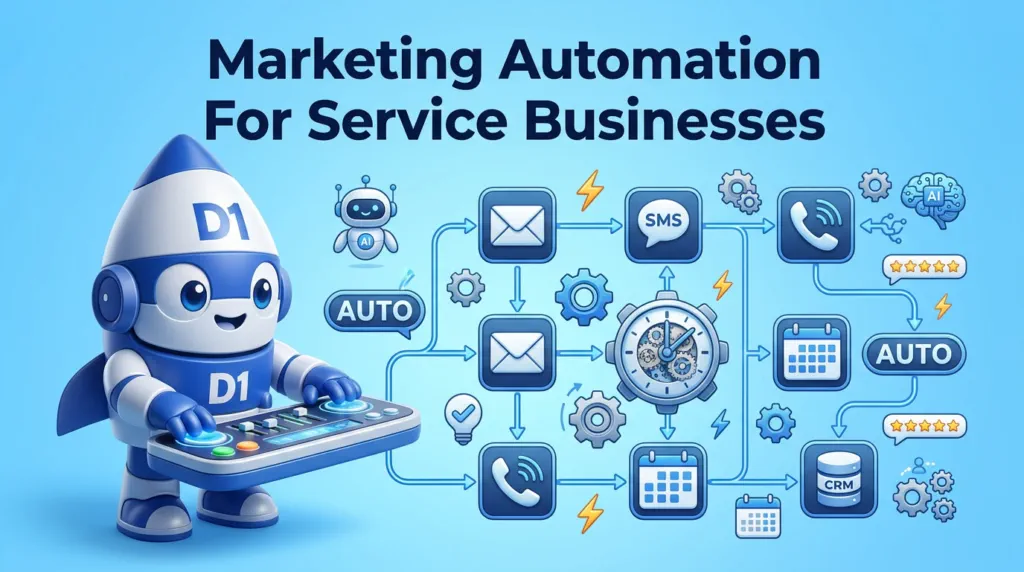
Marketing automation is software that performs marketing actions — sending an email, firing an SMS, updating a CRM record, scheduling a follow-up — when specific conditions are met. Without anyone clicking a button.
Examples that already exist around you:
- The “abandoned cart” email Amazon sends when you didn’t check out
- The appointment reminder text your dentist sends 24 hours before
- The “leave us a review” message you got after the last service call
Those are all automation. None of them required a human at the moment they happened.
For a service business, automation is the difference between “we always mean to follow up but never do” and “every lead gets seven touches in the first ten days, even when the owner is asleep.”
What Automation Is NOT
Three myths worth killing up front:
Myth 1: Automation means impersonal. Done well, automated messages are more personalized than manual ones, because the system actually knows the prospect’s name, service interest, last interaction, and timeline. It doesn’t forget.
Myth 2: Automation replaces salespeople. It removes the repetitive work — reminders, follow-ups, qualifying questions — so salespeople focus on the conversations that close revenue.
Myth 3: Automation is only for big companies. The opposite is true. A solo operator needs automation more than a 50-person sales team. You’re the bottleneck.
The Five Automations Every Service Business Should Run
Run these in this order. Each one stands alone, and each multiplies the impact of the next.
1. Missed-Call Text-Back
The instant a call goes unanswered, an SMS goes out: “Hey — sorry we missed your call, this is [Business Name]. What can we help you with?”
ROI: roughly 25-40% of missed-call leads reply to this text. Without it, they call your competitor. Setup time: 15 minutes.
2. Instant Form-Fill Response
The instant someone submits a contact form, two things happen: (a) they get an SMS or AI-voice call within 30 seconds confirming receipt and asking the next qualifying question, and (b) your team gets a notification with the lead’s info.
ROI: contact rate jumps 40-80% versus same-day-but-slower follow-up. Setup time: 30-60 minutes.
3. Appointment Reminder Sequence
For any booked appointment, automatic reminders go out at 24 hours, 2 hours, and 15 minutes before. SMS works best.
ROI: no-show rate drops 30-50%. Setup time: 20 minutes.
4. Post-Job Review Request
Within 24 hours of completing a job, the customer gets an SMS with a link to leave a Google review. If they don’t click within 3 days, they get a gentle follow-up.
ROI: review velocity goes up 5-10x. Reviews are a top local AI SEO ranking factor and a top sales conversion factor.
5. Long-Term Lead Nurture
Any lead that doesn’t convert in the first 14 days gets dropped into a 90-day nurture sequence: educational content via email, occasional check-in via SMS, retargeting campaigns on Meta and Google.
ROI: 10-25% of “dead” leads convert eventually because you stayed in front of them.
These five together represent 80% of the value most service businesses will ever get from marketing automation. Build them first.
The Realistic Tech Stack
You don’t need 15 tools. The leanest stack that covers all five automations above:
- CRM with built-in workflows + SMS + email + voice — one tool, not five. The D1TechCreative CRM is built specifically for this combination.
- Calendar tool — should be embedded directly in the CRM, not a separate Calendly account that needs sync.
- Phone system with call tracking — preferably native to the CRM.
- AI voice + SMS agent — connected to the CRM so AI-handled leads end up in the same pipeline as human-handled ones.
The temptation to assemble best-of-breed point solutions is strong. The reality is that integration friction eats the value of “best of breed” within 3 months. One tool that does 80% of every job beats five tools that each do 100% of one job.
What Automation Won’t Fix
Automation amplifies what’s already happening. If your offer is weak, automation will spread the weak offer faster. If your service quality is inconsistent, automation will collect inconsistent reviews.
Fix the upstream issues before automating downstream. Specifically:
- A clear, compelling offer
- Service delivery that earns 5-star reviews
- Reps who can close when handed a qualified appointment
- Pricing and packaging that don’t require 30 minutes of explanation
The 14-Day Rollout Plan
Days 1-3: Pick a CRM with built-in workflows. Migrate your contacts in. Connect your business phone number.
Days 4-7: Turn on missed-call text-back. Turn on instant form-fill response. Test both yourself.
Days 8-10: Build the appointment reminder sequence. Build the post-job review request workflow. Trigger both on past customers to validate.
Days 11-14: Map out the 90-day nurture sequence (8-12 touchpoints). Build the first 4 touchpoints. Connect retargeting pixel to your traffic accounts.
The Reporting That Actually Matters
- Lead response time — median time from form fill or call to first contact. Aim for under 60 seconds.
- Contact rate — percentage of leads who actually engage after the first touch. 60-80% is good.
- Show rate — percentage of booked appointments that actually happen. 70-85% with reminders.
- Review velocity — number of new Google reviews per week.
- Reactivation rate — percentage of dead leads from 60+ days ago who eventually convert. 10-25% is realistic.
Ignore vanity metrics (email open rates, click-through rates, social engagement) unless they’re directly tied to one of the above.
A Final Honest Note
Marketing automation has a reputation problem because it’s been over-sold by software companies who’d rather sell you eight subscriptions than one solution. Strip away the marketing and the reality is simple: automation is just systematizing the things you already meant to do but didn’t.
Done right, it’s the closest thing in business to free money — same leads, same team, more revenue, less effort.
Frequently Asked Questions
What is marketing automation in plain English?
Software that does marketing tasks automatically — sending emails, firing texts, updating records, scheduling follow-ups — when specific things happen.
Do I need marketing automation if my business is small?
Yes. Small businesses benefit more than large ones because the owner is usually the bottleneck.
What’s the cheapest way to get started?
Pick one of the five automations above (missed-call text-back is the easiest), get it running with a single tool, and measure results for 30 days before adding more.
How long until I see ROI on marketing automation?
Missed-call text-back and instant form-fill response produce measurable revenue in week one. The compounding ROI shows up in months 2-4.
Want Us to Build the System?
If you’d rather not piece this together yourself, we set up the entire stack — CRM, AI voice, automated workflows, review system, retargeting — and tune it for your business.
Or call us directly: (888) 330-1434.
D1TechCreative builds marketing automation, CRM, AI voice, and lead generation systems for service businesses across the U.S. Based in Fort Lauderdale, FL.