
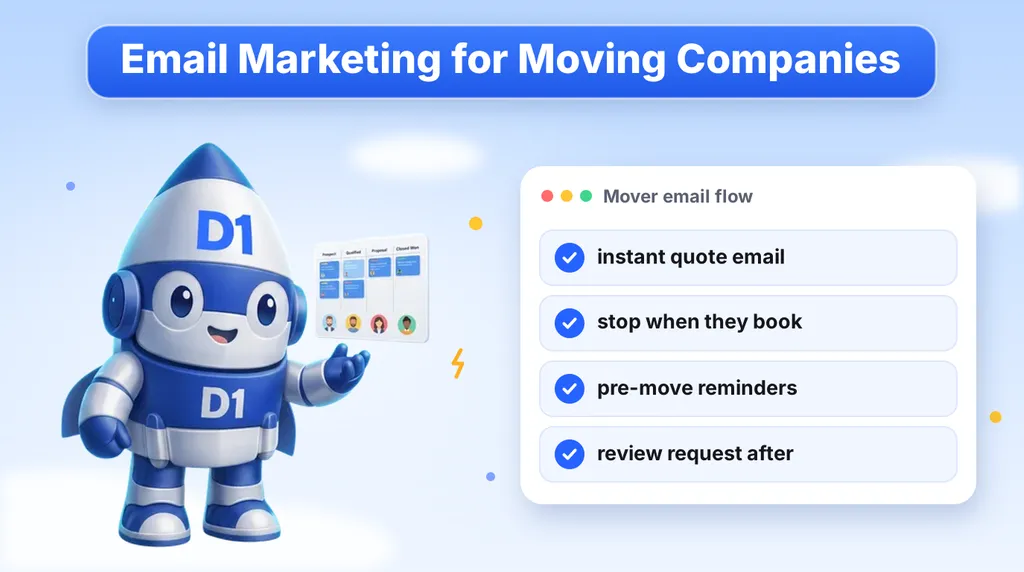
For a moving company, email is not a newsletter. Most people who request a quote decide within days, so the emails that matter are a short sequence tied to where the customer is in your pipeline: quote received, estimate sent, booked, move day, move finished. This guide walks through that sequence, what each message should say, and how to wire it into your CRM so it runs without anyone remembering to press send.
It is written for movers who already have leads coming in and want fewer of them to go quiet. If you are still choosing a system, start with our comparison of CRMs for moving companies. If you want the full list of workflows beyond email, read our moving company CRM automation guide. This post stays on email.
Why Email Works for Movers (and Where It Does Not)
A moving lead is a short, high-stakes decision. The customer often asks several companies for a quote on the same day and then goes quiet while they compare. Email helps in three ways:
- It leaves a record. The customer can find your quote, your date and your contact details later without scrolling through texts.
- It carries detail. Prep checklists, what to expect on move day and what the quote includes do not fit well in a text.
- It costs almost nothing per message. A sequence can follow up on every lead, including the ones your office is too busy to call back twice.
Email is slower than a call or a text, though. Many people read email hours later. So treat it as the written backbone of your follow-up, and pair it with a fast call or text for the first touch. Our speed-to-lead guide explains why the first response matters so much, and missed-call text back covers the phone side.
The Sequence at a Glance
Here is the whole flow in one table. You can copy it into your CRM as a build list.
| Stage | Trigger | Stops when | |
|---|---|---|---|
| 1. Quote received | Form or call logged | Instant confirmation: what you received, what happens next, who to call | Never (single send) |
| 2. Estimate sent | Estimate marked sent | The estimate in writing, what it includes, how to book | Never (single send) |
| 3. Follow-up | No reply or booking | A short series of check-ins that each add something useful | Lead books, replies, or opts out |
| 4. Booked | Deposit or booking recorded | Confirmation with date, arrival window and prep checklist | Never (single send) |
| 5. Pre-move | Days before the move | Reminder with crew arrival, parking and access notes | Move completed |
| 6. After the move | Move marked complete | Thank you and a direct review link | Review left or one reminder sent |
| 7. Re-engagement | Seasonal date | A friendly note to past customers and their referrals | Customer opts out |
Stage 1: The Instant Quote Confirmation
This is the one email every mover should send first. It goes out the moment a quote request lands, whether the lead came from your site, a call your office logged or an ad form. It should be short and plain:
- Thank them by first name and confirm what you received (move date, from and to areas, size of the move).
- Say what happens next and roughly when, such as a call from a named person or an estimate by email.
- Give one phone number and one reply address that a real person watches.
- Ask for one missing detail if you need it, such as stairs, elevators or a storage need.
Do not attach a long brochure or a wall of text. The goal is to prove you are real and responsive while the customer is still comparing. Send it from a person's name, not a no-reply address, so a customer can answer with a question and get one.
Stage 2 and 3: Estimate and Follow-Up That Stops When It Should
Once the estimate is out, most deals are won or lost in the silence. A follow-up series fixes that, as long as it behaves like a helpful person and not a robot.
Make every follow-up add something
"Just checking in" is easy to ignore. Give each message a reason to exist:
- The first check-in: restate the date and what the estimate covers, and ask if they have questions.
- The second: answer the questions movers hear most, such as how packing works, what is covered if something breaks, and how the deposit is handled. Only state policies your company actually has.
- The third: note that the date is not held until it is booked, and offer a quick call.
- The last: a polite close that tells them the door stays open and where to reach you.
Stop rules are the whole game
Nothing damages trust faster than a follow-up email to someone who already booked. Build stop rules into the CRM before you build the messages:
- Stop the sequence the moment the lead is marked booked, lost or do not contact.
- Stop it when the customer replies to any email, and create a task for a person to answer.
- Stop it when they unsubscribe, with no further marketing email of any kind.
- Pause it if a quote is being revised, so they do not get a reminder about a price you are changing.
This is the main reason email belongs inside your CRM rather than in a separate tool. The CRM knows the deal stage, so the email can react to it. Our CRM and automation service builds those stage-based triggers and stop rules for service businesses.
Stage 4 and 5: Booking Confirmation and Move-Day Reminders
Once a customer books, email shifts from selling to reducing surprises. Surprises are what cause bad reviews, so this part earns its keep.
The booking confirmation should restate the date, the arrival window, the origin and destination addresses, what the price covers and how to reach the office. Add a short prep checklist:
- Label boxes by room and keep valuables and important papers with you.
- Disassemble or empty what the crew will not handle, as your policy states.
- Reserve elevators and parking at both addresses if the building requires it.
- Keep pathways clear and pets secured on move day.
Then send a reminder shortly before the move with the arrival window, the crew lead's contact if you share it, and anything the customer needs to have ready. If your crew notes include building access or parking details, put them in the reminder so the customer can fix problems before the truck arrives.
Stage 6: The Review Request
The best time to ask for a review is right after a good move, while the experience is fresh. Send the email the day the move is marked complete, with a thank you, a single direct link to your Google review page and one sentence on why it helps other families choose a mover.
Keep it honest. Ask every customer, not only the happy ones, and do not offer money or gifts for a review. Review gating, where you only send the link to people who rate you well, breaks Google's rules and is not worth the risk. If you want a text version to go with the email, send both, but make sure the customer has agreed to be texted (more on that below).
Stage 7: Seasonal Re-Engagement
Moving is seasonal in most markets, and your past customers are your cheapest source of work. They move again, and they know people who are about to. A couple of times a year, send past customers a short, friendly note:
- Thank them for choosing you and ask whether friends or family are planning a move.
- Make it easy to reply or forward, with your phone number and a quote link.
- Do not send a discount you do not actually offer, and do not promise results you cannot back up.
Segment by what the CRM already knows: local or long-distance, residential or commercial, and the month they moved. A note that feels written for them gets answered. A blast to everyone gets ignored.
Pair Email With Text and Calls
Email should not carry the whole load. A simple split works well:
| Channel | Best used for |
|---|---|
| Phone call | The first response and any complex or high-value quote |
| Text | Quick confirmations, arrival updates, and nudges to reply |
| Written quotes, checklists, policies, receipts and the review request |
If you want the first touch to happen within seconds at any hour, an automated agent can do it. On Safebound Moving and Storage, an AI voice and SMS agent calls every new lead within seconds, qualifies it, and books the appointment straight into the GoHighLevel CRM we set up. Email then picks up from there with the written details. You can read more about that kind of setup in our AI voice and SMS bots service.
Consent, Unsubscribe and Keeping It Clean
Email is easier to run than text from a consent standpoint, but it still has rules. In the United States, commercial email must identify who is sending it, include your physical business address and give people a working way to unsubscribe. Honor unsubscribe requests promptly. Keep transactional messages, such as booking confirmations and move-day details, separate from marketing messages such as seasonal offers, and let customers opt out of marketing without losing the details of a move they booked.
Text is stricter. Get clear consent before you text anyone, record it in the CRM and keep opt-out handling working. Our TCPA-compliant SMS guide covers the basics, and although it is written for investors, the consent principles apply to movers as well. This is general information, not legal advice, so check your own setup with a qualified advisor.
A few habits keep the list healthy:
- Collect email addresses with an accurate form label that says how you will use them.
- Remove bounced and unsubscribed addresses automatically.
- Send from a real domain you control, and set up the standard authentication records so your mail reaches the inbox.
- Test every sequence on yourself before it goes live, including the stop rules.
What to Measure
You do not need a dashboard full of numbers. Track a few things that connect email to jobs:
- Replies and bookings that follow an email, not only opens, since opens are unreliable.
- Quotes that went quiet and later booked after the follow-up series.
- Review requests that turned into reviews.
- Unsubscribes and complaints, which tell you when a message is too frequent or off target.
Review these monthly in your CRM next to the pipeline, and adjust the wording of the message that is doing the least.
Starter Checklist
- Write the instant quote confirmation and send it from a real person's name.
- Build the follow-up series with a stop rule for booked, replied, lost and unsubscribed.
- Write the booking confirmation with a prep checklist and arrival window.
- Add a move-day reminder that includes access and parking notes.
- Send the review request the day the move is marked complete, with a direct link.
- Schedule one or two seasonal notes a year to past customers.
- Add the unsubscribe link and business address, and keep consent records in the CRM.
- Test the full flow with your own email and phone before turning it on.
If you would rather not build this yourself, our CRM service sets it up inside the pipeline you already use, and our guide to moving company lead generation covers where the leads come from in the first place.
Want Quote-to-Review Email Set Up in Your CRM?
We build the sequences, the stop rules and the follow-up inside the CRM, so every quote request gets a reply and every finished move gets a review request. Book a call and we will map it to how your crew and office actually work.
Or call us directly: (888) 330-1434.
D1TechCreative builds websites, paid traffic, CRM and AI automation systems for service businesses and real estate investors across the United States. Based in Fort Lauderdale, FL.