
Facebook and Instagram can put your offer in front of homeowners who never typed "we buy houses" into Google. That reach is the appeal, and it is also the problem: most of those people were not planning to sell. The campaign only pays off if the ad, the form and the follow-up sort the real sellers from everyone else. This guide covers how real estate investors and wholesalers set up Meta lead campaigns that produce appointments, not just names.
It is written for investors who already know their market and want a second lead source next to search, mail and lists. If you are still deciding between buying leads and running your own ads, read our pay per lead vs own ads comparison first. For the search side, see our PPC keywords guide.
Search Intent vs Social Intent
A homeowner who searches "sell my house fast" on Google has raised a hand. A homeowner scrolling Facebook has not. You are interrupting someone, so the ad has to earn attention in a second or two and speak to a situation they recognize as their own.
That changes how you judge the channel:
- Volume is easier to get. Social ads can produce a steady stream of form fills without bidding on expensive seller keywords.
- Intent is softer. Some people fill out a form out of curiosity, because the form took two taps.
- Follow-up matters more. A soft lead that gets a call in minutes can become an appointment. The same lead called the next day has moved on.
Our Google Ads vs SEO breakdown and the investor lead generation guide cover where each channel fits. Most investors who do well use search for people ready now and Meta for people who will be ready soon.
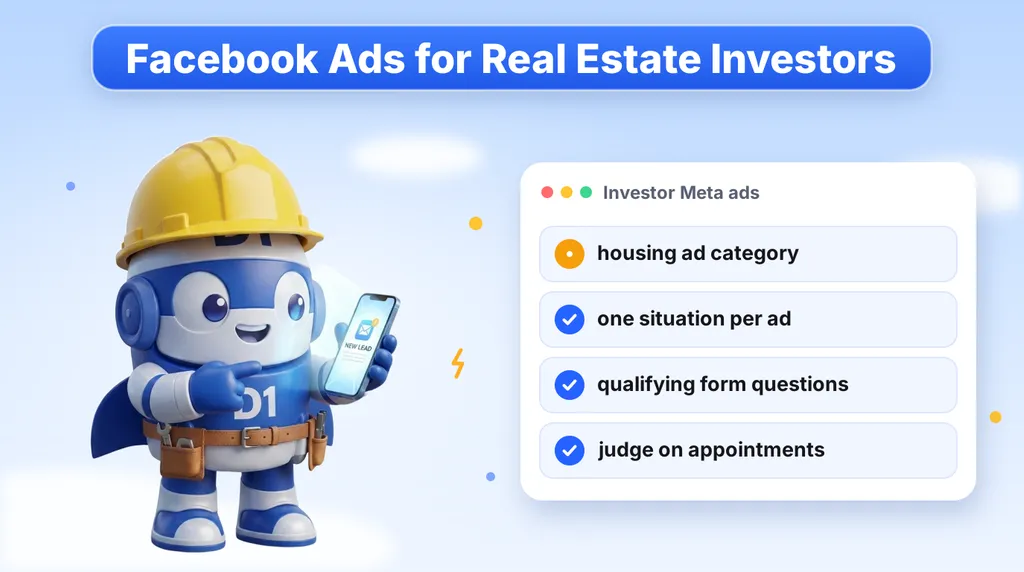
The Housing Special Ad Category
Meta treats ads for housing as a special ad category. In practice this means the targeting options are limited compared with a normal campaign. You cannot narrow by age, gender or ZIP code the way you could for other advertisers, and the location options are broader. Check Meta's current ad policies in your Ads Manager before you build, because the rules and menus change, and read them for your own account rather than relying on a blog post (including this one).
Whether a particular investor campaign must be filed under that category is a policy question for Meta and for your own advisor. What matters for planning is the practical result: you will often have less control over who sees the ad. When targeting is loose, three things have to do the qualifying instead:
- The ad copy and creative decide who stops scrolling.
- The form questions decide who submits.
- The follow-up call decides who becomes an appointment.
Build every campaign with that in mind. If you rely on targeting to do the work, the campaign will disappoint you.
Lead Form or Landing Page?
Meta offers instant forms that open inside the app, with the person's name and phone already filled in. The alternative is sending the click to a landing page on your own site. Both work, and they fail in different ways.
| Option | Strengths | Watch out for |
|---|---|---|
| Instant lead form | Very low friction, high form volume, fast to launch, works well on phones | Autofilled phone numbers can be wrong, and low effort means more tire-kickers |
| Landing page | More effort from the visitor, so more intent; you control the message, tracking and trust signals | Fewer submissions, needs a page that loads fast on mobile |
| Instant form with extra questions | Middle ground: still easy, but the added questions filter out casual taps | Too many questions and completion drops |
A reasonable plan is to start with an instant form that has two or three real questions, and test a landing page against it once you have a few weeks of data. Compare them on appointments and contracts, not on form fills. If you build the page, our real estate investor website guide covers what it should include.
Form Questions That Filter Tire-Kickers
Every question you add costs you some submissions and removes some of the wrong people. The goal is to ask only what helps you decide whether to call, and to ask it in the seller's language.
| Question | Why you ask it |
|---|---|
| Property address | Tells you instantly whether the home is in your buying area, and lets you research it before you call |
| What is going on with the property? (multiple choice) | Behind on payments, inherited, tenant issues, needs repairs, other. This sorts the lead by situation |
| How soon do you want to sell? | Separates "this month" from "someday" |
| Best phone number and best time to call | Confirms the number and raises your pickup rate |
Use multiple choice for the situation and timeline questions, so the person taps instead of typing. Leave out anything that feels like an application, such as asking for a price in the form. If you want to ask about price, do it on the call.
Add your consent language next to the submit button if you plan to text. Our TCPA-compliant SMS guide explains what to include. This is general information, not legal advice, so have your own counsel review your wording.
Creative That Speaks to One Situation at a Time
A single ad that tries to speak to every seller speaks to no one. The ads that work best usually name one situation and one outcome. Think of it as the Facebook version of the ad groups you would build for search.
- Inherited property: speak to someone who has a house they do not want to manage, maybe far away.
- Tired landlord: speak to an owner with a rental that has become a headache.
- Needs repairs: speak to an owner who does not want to fix or clean the house before selling.
- Behind on payments: use calm, honest wording and never promise to stop a foreclosure or save anyone's credit. Say what you actually do: make a cash offer on a set timeline.
Plain, specific copy beats clever copy. A real photo of a typical house in your market, or a short video of you explaining how the process works, often holds attention better than a stock image of a handshake. Show your name and your company so the seller knows who will call.
Keep the claims honest. Do not state prices, closing dates or results you cannot back up. If you mention a timeline, make it one you can keep.
What Drives Cost Per Lead Up or Down
We do not quote a standard cost per lead for investor campaigns. It depends on your market, your offer, your creative and how long the account has been learning. What we can describe is what moves it.
- Creative fatigue. The same ad shown for weeks gets ignored, and costs climb. Plan to refresh creative on a regular schedule.
- Relevance of the offer. An ad that matches a real situation tends to earn more engagement, which Meta rewards.
- Form friction. A short form lowers cost per lead and often raises cost per appointment. A longer, filtered form does the reverse. Track both.
- Market and competition. A crowded metro costs more than a smaller one, and costs shift through the year.
- Learning period. New campaigns need time and conversion data before delivery settles. Changing everything every two days resets that learning.
The trap is chasing the cheapest lead. The cheapest lead is often the least serious one. A higher cost per lead with a much better appointment rate can be the better deal, which is why the next section matters.
Judge Campaigns on Appointments, Not Raw Leads
Raw lead count is the easiest number to see and the least useful one to optimize. Build a simple scoreboard in your CRM and compare campaigns on what happens after the form:
- Leads received
- Leads reached by phone
- Appointments or offer calls set
- Offers made
- Contracts signed
If one ad produces fewer leads but twice the appointments, it wins. If a form produces plenty of leads but few people answer the phone, the problem may be the form or the follow-up, not the audience. Send those stage outcomes back to Meta where you can, so the platform learns what a good lead looks like.
For a real example of volume at work, Residential Foreclosure Prevention, a brand of a real estate investment company, was given Meta lead campaigns that D1TechCreative built and managed, which bring in 800+ homeowner leads a month. Your numbers will differ with your market and offer, and the lead count is only the start of the story. What happens in the first minutes after each lead arrives decides the rest.
Follow-Up Decides the Outcome
A lead from social is a lead that did not plan to talk to you today. If the phone rings within minutes, you are a helpful voice answering a request they just made. If it rings hours later, you are a stranger. Our speed-to-lead guide explains why the first call tends to win.
A workable follow-up setup includes:
- An instant call alert to your phone or your team, and an automatic text if your consent language allows it
- A repeat call attempt later the same day, and again the next day
- A longer nurture track for sellers who say "not yet"
- Every lead logged in a CRM with its source, situation and status
We lay out the full stage and cadence plan in our post on a motivated seller follow-up system. If you want help running the whole thing, our lead generation and paid traffic service covers the campaigns and the follow-up together.
If You Also Work in Other Industries
Many of the same ideas apply to other local businesses, although the audience rules and the creative differ. Our post on Facebook ads for moving companies and real estate investors covers both audiences in one place. This post goes deeper on the investor side.
Starter Checklist
- Read Meta's current policy for the housing special ad category in your own Ads Manager before you build.
- Pick one situation per ad: inherited, tired landlord, needs repairs, behind on payments.
- Build an instant form with the address, a situation choice, a timeline and a phone number.
- Put consent language next to the submit button if you will text.
- Test an instant form against a landing page on appointments, not form fills.
- Refresh creative on a schedule so ads do not go stale.
- Set up instant call alerts and a repeat attempt plan before you spend a dollar.
- Log every lead in a CRM and review appointments and contracts by campaign each week.
Want Us to Build and Run Your Investor Facebook Ads?
We build the lead forms, creative and follow-up for real estate investors, then manage the campaigns month to month. Book a call and we will review your current ads or plan a new campaign with you.
Or call us directly: (888) 330-1434.
D1TechCreative builds websites, paid traffic, CRM and AI automation systems for service businesses and real estate investors across the United States. Based in Fort Lauderdale, FL.