
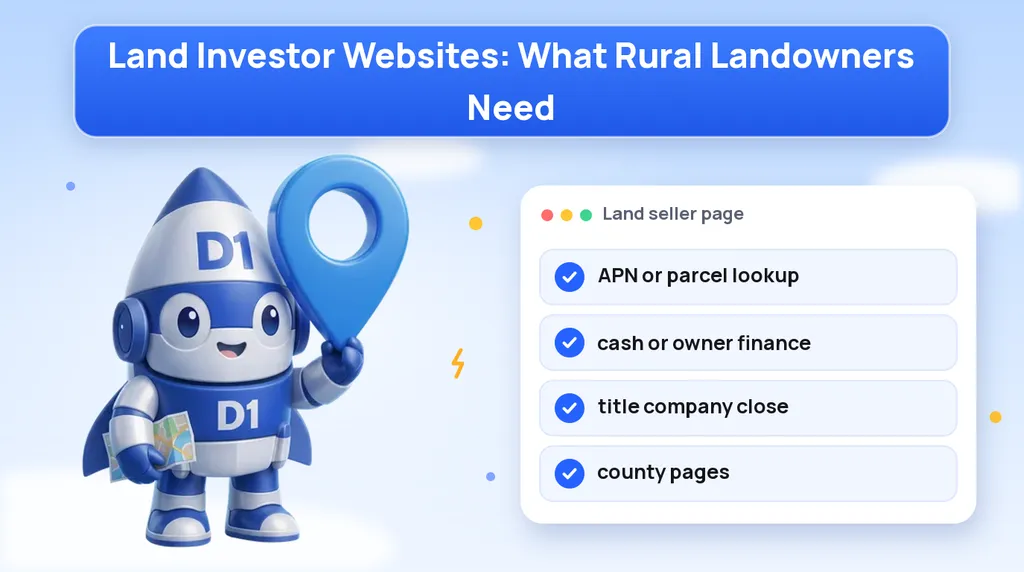
A land seller is not the same person as a house seller, and a land investor website should not look like a "we buy houses" site with the word "land" swapped in. The owner of a rural parcel often lives in another state, may have inherited the property years ago, and usually feels no pressure to sell this month. They will read more, compare more and check you out before they ever pick up the phone.
This post is for land investors and land flippers who send mail or run ads and want a website that turns that interest into calls and form submissions. It covers what the seller needs to see, how to build the parcel form, how to explain cash and owner-finance offers, why the title company belongs on the page, and how to set up county pages that support your mail.
How Land Sellers Differ From House Sellers
Most house-seller websites are built around urgency: a repair bill, a move, a missed payment. Land sellers rarely have that. A typical rural landowner is in a different position:
- Often out of state: they may have never visited the parcel, or not for years. They can't drive by and check what it looks like.
- Often inherited: the land came from a parent or relative, and siblings or other heirs may share it.
- No urgency: the main cost of keeping the land is usually the property tax bill, so there is no deadline forcing a decision.
- Unsure of value: there are fewer comparable sales for rural land, so the owner may have no idea what a fair price looks like.
- Cautious: an unexpected letter offering to buy land they barely think about can feel suspicious.
That changes what the website has to do. A house-seller page mainly needs to be fast and easy. A land-seller page also needs to answer questions, prove you are real and show the owner you know which property you are talking about. Our real estate investor website guide covers the basics that apply to both; this post covers what is different for land.
What the First Screen Should Say
Most land sellers arrive from a letter, a postcard or a search. In the first few seconds they want to know three things: who you are, whether you actually buy land like theirs, and what happens if they reach out. Answer all three above the fold.
- A headline that names land, not houses: "We Buy Land in [County] County" or "Get an Offer on Your Vacant Land".
- One sentence on how it works: tell us the parcel, we review it, we send a written offer, a title company handles the closing.
- The start of a short form (more on that below) and a phone number they can tap.
- Your company name, a real business address and a clear statement that you are a buyer, not an agent or a government office.
Leave out the countdown timers and "offer expires" banners. A landowner who feels no urgency will read those as a pressure tactic, which is the opposite of what you want.
Build the Form Around the Parcel
A house seller can type an address. Many rural parcels don't have one, or the owner doesn't know it. The form has to work with what the owner actually has, which is usually the parcel number (APN) from their tax bill or from your letter.
| Field | Why it is there | Required? |
|---|---|---|
| Parcel number (APN) or reference code from your letter | Lets you find the exact parcel without back-and-forth | Either this or county plus location |
| County and state | Narrows the search when there is no APN | Yes |
| Street address or nearest road (if known) | Helps when the owner doesn't have the APN handy | No |
| Name and phone or email | So you can send the offer and follow up | Yes |
| Are you the only owner? | Flags inherited or shared parcels early | No |
| Anything we should know? | Access, liens, back taxes, a timeline | No |
Put the APN field first and explain in one line where to find it: "It is on your property tax bill, or printed on the letter we sent you." If you mail with a reference code, accept that code in the same field so the owner can paste it in and move on. Asking for one simple thing first gets more people started than a long form does.
If you want to go further, a lookup that shows the parcel on a map after the owner enters the APN gives them a moment of "yes, that's the one" before they submit. That is a nice extra, not a requirement. A plain APN field with a clear label does most of the work.
Explain Cash and Owner-Finance Offers in Plain Words
Many land investors buy for cash and sell with owner financing, and some also offer owner-finance terms to sellers. Whatever you do, the seller needs to understand it before they talk to you. Give each option a short section in plain language:
- Cash offer: you pay one agreed price at closing. Say how you set the price in general terms (recent sales nearby, access, size, zoning), and that the written offer is theirs to accept, counter or ignore.
- Terms or owner finance: if you offer it, explain the basic idea in a sentence or two and say it suits owners who care more about the total price than getting everything at once.
- Who pays costs: state whether you cover closing costs, and say so only if it is true for every deal.
Avoid promising a price, a tax result or a timeline you can't control. You don't need a disclaimer wall, but a line such as "every offer depends on the parcel and title review" keeps you honest and sets expectations. If the owner has tax or legal questions, suggest they ask their own advisor.
Show How the Closing Works
For an out-of-state owner selling to a stranger, the closing is the scariest part. Make it boring and visible. A simple step list works well:
- You send us the parcel details.
- We review the parcel and send a written offer.
- If you accept, we open escrow with an independent title company.
- The title company checks the title, prepares the documents and handles the funds.
- You sign from home, often with a mobile notary, and the title company sends your payment.
Naming the title company step does a lot of trust work. It tells the owner that a neutral third party holds the money and checks the paperwork, so they are not wiring anything to you or taking your word for it. Only describe signing options you actually offer, and check what each state and title company requires.
County Pages That Support Your Mail
Land investors usually buy in specific counties, so build a page for each county you mail. Each one should feel written for that county, not a template with the name swapped:
- A headline with the county and state: "Sell Your Land in [County] County, [State]".
- The kinds of parcels you buy there (vacant lots, acreage, recreational land, infill lots) and anything you don't buy.
- A short note on what affects value in that area, written in general terms.
- The same APN-first form and phone number.
County pages help in two ways. They give your mail a matching page to point to, and they give search engines a page for "sell land in [county]" style searches. Our PPC keyword guide for investors lists land seller search terms if you plan to run ads to these pages too.
Pair the Site With Your Mail Campaigns
For most land investors, mail does the reaching and the website does the convincing. Many owners won't call straight from a letter. They will search your company name or type the URL, look around, then decide. The two should be built together.
- Print a short, easy URL on every piece, ideally pointing to the matching county page.
- Print the APN or a reference code on the letter so the owner can enter it on the form.
- Use a tracked phone number per campaign so you can see which mailing produced which calls.
- Keep the offer wording on the site consistent with the letter, so nothing looks different when they arrive.
Our guide to direct mail for real estate investors has a full section on land mail, including list choice and why land usually needs more rounds than a house list. For the wider picture of where mail sits next to ads, SEO and lists, see our lead generation guide for real estate investors.
Follow Up Fast, Then Patiently
Even without urgency, the first response still matters. An owner who submits a form is usually comparing you with whoever else wrote to them, and the first buyer to reply clearly makes the best impression. Send an instant text or email confirming you received the parcel, then call. Our speed-to-lead guide explains why response time matters even for slower sales.
After that, land is a long game. Many owners say "not now" and mean "maybe next year". Put every lead into a CRM with a follow-up schedule, note why they paused (taxes, heirs, price), and check in on a set rhythm. If you text, follow consent rules and keep a record of opt-ins.
We build investor websites with forms, county pages and CRM follow-up through our smart websites and funnels service. Our investor work so far has been for house buyers such as Valor House Buyers and Homeland Property Solutions, and the same structure applies to land with the changes in this post.
Land Website Checklist
- Headline names land and the county, with a one-line explanation of how it works.
- APN or reference code is the first form field, with a note on where to find it.
- County and state are required, the street address is optional.
- Cash and any owner-finance options are explained in plain words, with no promised price.
- The closing steps name an independent title company.
- Each county you mail has its own page, and your mail points to it.
- Every campaign has a tracked number, and every lead gets an instant reply and a long follow-up schedule.
Want a Land Seller Website That Backs Up Your Mail?
We build investor websites with parcel lookup forms, county pages and CRM follow-up, and we can connect them to the mail and ads you already run. Book a call and we will plan the site with you.
Or call us directly: (888) 330-1434.
D1TechCreative builds websites, paid traffic, CRM and AI automation systems for service businesses and real estate investors across the United States. Based in Fort Lauderdale, FL.