
When a homeowner searches "electrician near me", Google answers with a map, three business listings and a list of websites underneath. Most of the calls go to the businesses in that map block and the first few results below it. This guide explains how an electrical contractor earns a place there: how to set up your Google Business Profile, which pages your website needs, how to write service area pages that aren't copies of each other, and how to collect reviews without making it a chore.
It is written for electrical contractors and the office staff who handle their marketing. No one can promise a ranking, and we don't. What we can do is lay out the things local search rewards, in the order we would fix them. If you want the website side in more detail, our electrician website checklist covers headers, forms and mobile speed. This post stays on getting found.
How Local Search Decides Who Shows Up
Google has said for years that local results come down to three ideas: relevance, distance and prominence. In plain words, does your business match what the person searched for, how close are you to them, and how well known and trusted are you online.
- Relevance: your profile categories, services and website pages clearly say you do the job being searched, such as a panel upgrade or an EV charger install.
- Distance: how near your business location or service area is to the searcher. You can't change geography, but you can make your service area clear.
- Prominence: reviews, the quality of your website, mentions on other sites and how consistent your business details are across the web.
You control relevance and prominence almost completely. That is where the work below goes. For the broader picture of how these pieces fit together across trades, see our guide to local SEO for service businesses.
Start With the Google Business Profile
For a local trade, your Google Business Profile often gets seen more than your website. It is free, and it is the first thing to get right.
Claim It and Verify It
Search for your business name in Google Maps. If a listing exists, claim it. If not, create one. Complete whatever verification Google asks for so you can edit the profile and reply to reviews. If your company works out of a home or a truck and customers never visit, set the profile up as a service-area business rather than showing an address you don't serve customers from.
Choose Categories That Match the Work
The primary category is one of the strongest signals on the profile. For most electricians that means the electrician category. Add secondary categories only if they describe real, separate parts of your business. Don't stuff in every category that sounds close. A profile that claims everything looks like it does nothing particularly well.
List Your Services
Add the services you want more of, in plain words customers use: panel upgrades, EV charger installation, generator installation, whole-house rewiring, outlet and lighting work, troubleshooting and repairs. Write a short description for each one. Keep the list matched to the pages on your website, which is the next step.
Fill In the Rest Properly
- Business name: use your real name as it appears on your sign, truck and license. Adding keywords to the name breaks Google's guidelines and can get a profile suspended.
- Hours: accurate, including whether you take emergency calls. If you don't answer after hours, don't list yourself as open.
- Phone number: one main number that someone answers or that texts back when missed.
- Service area: the towns and counties you actually work in, not a whole state.
- Photos: your own jobs, crew and trucks. Add new ones regularly.
- Website link: your homepage, or a matching location page if you run more than one location.
Give Every Service Its Own Page
The profile tells Google what you do. Your website has to back it up. A single "Services" page with a bulleted list gives Google little to work with and gives a homeowner little reason to call. Each major job is a different search and a different customer, so give each one a page.
| Page | Search it should answer | What belongs on it |
|---|---|---|
| Panel upgrades | panel upgrade electrician, replace breaker box | Signs a panel is due for replacement, permit and inspection process, photos of your own panel work |
| EV charger installation | EV charger installer, home charger installation | What a load check involves, charger types you install, real garage installs |
| Generator installation | whole-home generator installer, transfer switch | Brands you install, what the install involves, service options |
| Rewiring | whole house rewiring, replace old wiring | Older wiring types you replace, how you protect finished walls, what a typical job involves |
| Repairs and troubleshooting | electrical repair, breaker keeps tripping | Common problems, how you diagnose them, how to book a visit |
| Commercial | commercial electrician | Building types, working around business hours, who to contact |
Each page should have a headline that names the service and your area, a plain-language explanation of the job, photos from real projects, a short FAQ, and the same tap-to-call button and quote form used across the site. Link related pages to each other: the EV charger page should point to the panel upgrade page, since many chargers need one.
Build pages only for work you actually want. A thin page for something you rarely do attracts the wrong calls. If you are unsure which pages to start with, begin with the three jobs that earn you the most and add the rest over time. Our electrician website design page describes how we lay these out.
Service Area Pages That Say Something Real
Customers search with a place attached: "electrician [city]", "EV charger installer [county]". A footer line listing fifteen towns won't compete for those searches. A page for each main town can, but only if each page earns its place.
The common mistake is to copy one page and change the city name. Search engines see through it, and customers do too. Each area page should include something that is true only of that area:
- The jobs you are most often called for there, and any you have recently completed
- Photos from work in that town, with the town in the caption
- Reviews from customers there, where they have agreed to be named
- Local details that matter for electrical work, such as older housing stock, common panel types or how the local permit office handles inspections
- Links to the matching service pages
If you don't have anything real to say about a town yet, wait to build that page. Start with the two or three places where you do the most work and add more as your job history grows. Fewer strong pages beat many weak ones.
Show Your License and Real Proof
Electrical work carries risk, and customers want to know you are qualified before they let you into their home. That also makes it a trust signal worth putting where search visitors can see it.
- Put your license number in the site header or footer on every page, if your state or city licenses electrical contractors.
- State your insurance accurately, with no claims you can't back up.
- Add any manufacturer or program certifications you actually hold, such as certifications for a generator or charger brand you install.
- Use photos of your own work, trucks and team rather than stock images.
Mark up the business details on your site with LocalBusiness schema so search engines can read your name, address, phone, hours, service area and services. Schema doesn't replace good pages, but it helps Google connect your site to your profile. Our SEO service includes that setup.
Reviews: Ask After Every Job
Reviews are the biggest part of prominence you can influence directly. They also affect whether a searcher picks you once they see you. A steady stream of recent, specific reviews beats a burst of them followed by months of silence.
Make Asking Routine
- Finish the job and confirm the customer is happy.
- Send a text the same day with a direct link to your Google review page.
- Keep the message short and personal: thank them by first name and ask for an honest review.
- Send one friendly reminder if they haven't responded, then leave it alone.
The same-day text works because the job is fresh, and the link removes the effort. Done by hand it gets forgotten, so many contractors automate it. Our reviews and reputation management service sends the request after each completed job without anyone remembering to do it.
Reply to Every Review
Reply to good reviews with a short, specific thank you. Reply to bad reviews calmly, with facts and an offer to make it right offline. Never include private details about the customer's home or account in a public reply. Future customers read your replies as much as the reviews themselves.
What Not to Do
Don't buy reviews, don't write them yourself and don't offer discounts or gifts in exchange for them. Don't ask only happy customers while steering unhappy ones elsewhere, a practice known as review gating, which Google's policies prohibit. These shortcuts risk removed reviews and a suspended profile, which is far worse than a slow start.
Keep Your Name, Address and Phone Consistent
Search engines compare your business details across your website, your profile and other directories. When they match, Google trusts them more. When they don't, they muddy the picture.
- Use the same business name everywhere, with no abbreviations in one place and full words in another.
- Use the same phone number on the site, the profile and every directory. If you use a tracked call number on the site, keep your main number listed as well and talk to whoever manages your tracking so nothing conflicts.
- If you have moved or changed numbers, fix the old listings instead of leaving them to disagree.
- Claim the major directories your customers actually use, and check that each one matches.
This is dull work, and it pays off because most competitors skip it. Do it once, then review it when anything changes.
Answer the Phone, Then Measure
Ranking brings in calls, and those calls only pay off if someone responds. A missed call with no reply sends the customer to the next electrician in the results. An automatic text back, a number that forwards to a person on a job and a form that alerts your phone all help here. Our speed-to-lead guide explains why the first contractor to respond usually wins the work.
Then check what is working. Look at your profile's call and direction requests, the pages that bring in form submissions and the searches that lead people to your site. Use those numbers to decide which service or town page to build or improve next. Our broader post on SEO for service businesses covers how to read those reports.
Local SEO Checklist for Electricians
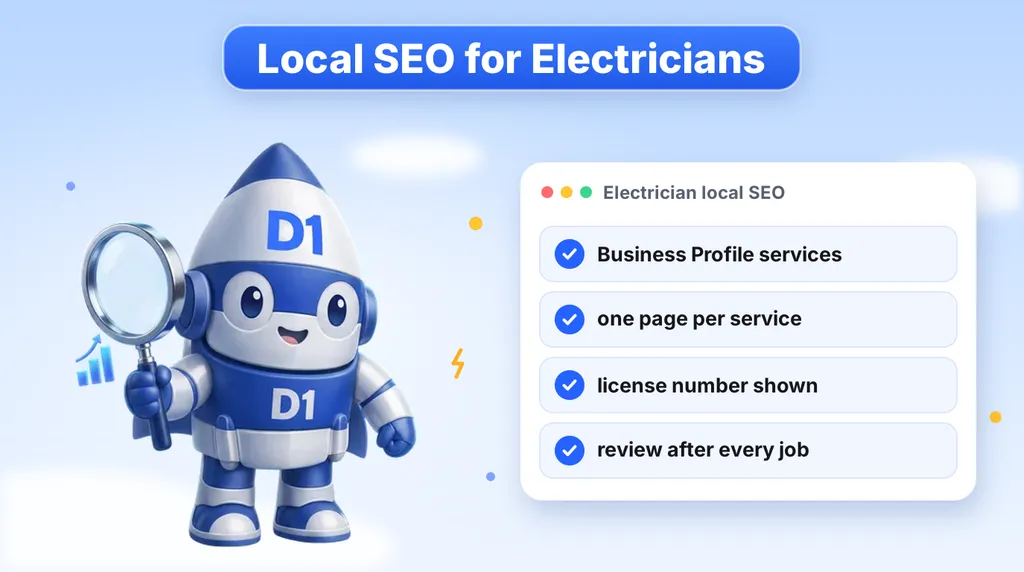
- Claim and verify your Google Business Profile, set as a service-area business if customers don't visit you.
- Choose an accurate primary category and only the secondary ones that fit.
- List your real services with short descriptions that match your website pages.
- Use your actual business name, accurate hours and one main phone number.
- Build one page for each service you want more of: panel upgrades, EV chargers, generators, rewiring and repairs.
- Build area pages only for towns where you have real work to show, each with its own photos, details and links.
- Show your license number and accurate insurance on the site.
- Add LocalBusiness schema for name, phone, hours, area and services.
- Text a review request after every job and reply to every review.
- Keep your name, address and phone number identical across your site, profile and directories.
- Answer or text back every call, then review calls, forms and searches each month.
Start with the profile and the service pages, since those do the most work for the least effort. Add area pages and the review routine next, and keep going from there. Local search rewards steady work more than any single trick.
Want Your Electrical Company Found in Local Search?
We set up the pages, the Google Business Profile match and the review routine that local search rewards for electrical contractors. Book a call and we will look at how your company shows up today and what to fix first.
Or call us directly: (888) 330-1434.
D1TechCreative builds websites, paid traffic, CRM and AI automation systems for service businesses and real estate investors across the United States. Based in Fort Lauderdale, FL.