
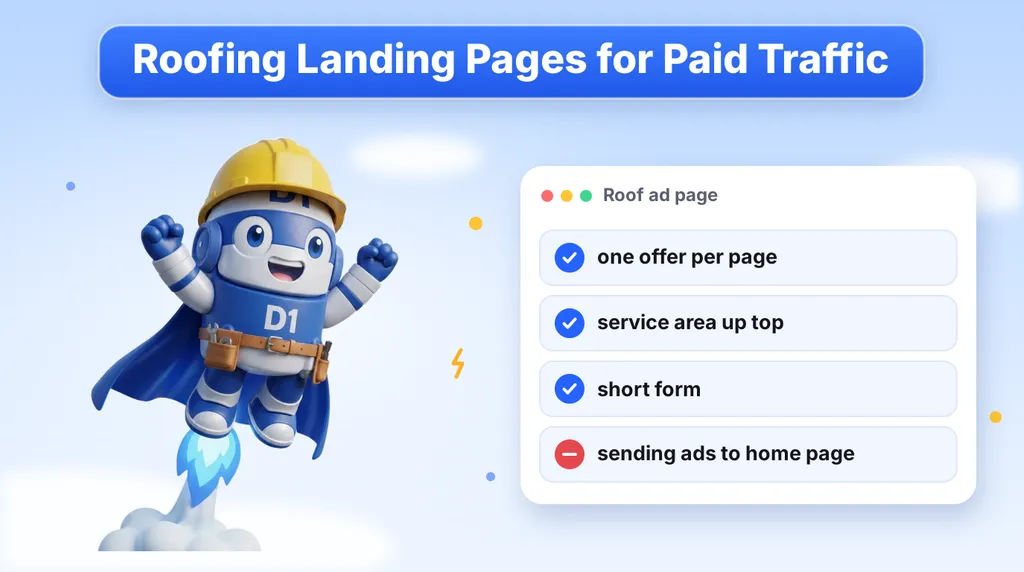
If you pay for roofing clicks and send them to your home page, you are paying to show visitors a menu. A homeowner with a leaking roof or a storm-damaged ridge does not want to browse your services, read your company history and then hunt for a contact form. This guide explains why paid traffic needs its own landing page, what belongs on it, and how to set it up so a click becomes an inspection request.
It is written for roofing contractors and the people who run their marketing. If you are still deciding between ads and organic search, read our Google Ads vs SEO breakdown first. If you already buy clicks, or plan to, this post is about the page those clicks land on.
Why Ads Should Not Land on Your Home Page
A home page has several jobs. It introduces the company, links to every service, shows the team, and gives people a way to explore. That is useful for someone who found you through a referral and wants to look around. It is a poor fit for someone who just typed "metal roof replacement near me" into Google and clicked your ad.
That searcher has one question: can this company do the job I need, where I live, and how do I get an inspection? Every extra link on the page is another way to leave without answering it. A landing page removes the exits. It repeats the promise the ad made, proves you can keep it, and asks for one action.
There is a second reason. Google rewards ads that match the page they point to, and a page that matches the search is easier to write, test and fix. When the ad says "storm damage roof inspection" and the page headline says the same thing, the visitor knows they are in the right place within a second.
One Offer Per Page
The most common mistake is building one page that tries to sell everything: new roofs, repairs, gutters, siding and a free estimate. Roofing buyers arrive with very different problems, and each needs a different message.
| Page | Who it is for | Headline direction | What the form offers |
|---|---|---|---|
| Re-roof | Owners whose roof is old and near the end of its life | Name the material and the service area | Roof replacement estimate |
| Repair | Owners with a leak or a few damaged areas | Fast response and a clear next step | Repair inspection or callback |
| Storm damage | Owners after hail, wind or a fallen tree | Free inspection and help with the claim paperwork | Storm inspection request |
| Commercial | Property managers and building owners | Flat roof systems, maintenance and inspections | Site visit request |
Pair each page with its own ad group. Someone searching for repairs should never see a re-roof pitch, and someone comparing metal roof quotes should not be asked whether they have a leak. If you only offer two of these services, build two pages and do them well. You can add more later when the first ones are working.
Be careful with storm and insurance wording. Describing what you do, such as documenting damage with photos and explaining the inspection process, is fine. Do not promise that a claim will be approved or that the homeowner will pay nothing. Let the homeowner decide.
Put the Service Area Above the Fold
Roofing is local. A homeowner wants to know right away that you work in their city or county, and a page that names the area builds that confidence faster than any slogan. Put the area in the headline or the line directly under it, and repeat it near the form.
If you serve several areas, do not cram them all into one line. Build a page per major area, or at least a version of the page per campaign location, so the headline can name the place the searcher is actually in. This also helps the ad: location in the ad, location in the headline, location next to the form.
A good example of the single-purpose approach is the page we built for Metal Roof Experts. It is described on our site as "a single-purpose paid-traffic landing page for metal re-roofs in Palm Beach and Broward". One material, one job type, two named areas. You can see the full write-up in the Metal Roof Experts project.
A Short Form That Asks for the Right Things
Roofing leads are worth chasing, and that is exactly why the form should be short. A visitor who has to fill in eleven fields will go and call the next company in the search results. Ask for what you need to make a useful first call and nothing else.
- Name and phone number: required. Add email only if you will actually use it.
- Property address or ZIP code: so you can confirm the job is inside your area before anyone drives out.
- Roof type or material: a simple choice list (shingle, metal, tile, flat, not sure).
- Timeline: as soon as possible, within a month, just planning. This tells your team who to call first.
- Optional message or photo upload: useful for storm damage, but never required.
Put the form above the fold on mobile. Most paid roofing clicks come from phones, often from a homeowner standing outside looking at the damage. A big tap-to-call button next to the form gives people who dislike forms a faster way in. Both actions should be easy to find without scrolling.
Write the button as what happens next: "Request My Roof Inspection" beats "Submit". Under the button, one line that says when they will hear back sets expectations and reduces anxiety.
Trust Items That Belong on the Page
A homeowner is about to let a stranger onto the roof and pay a large invoice. Trust matters more here than on almost any other local service. A landing page has little room, so choose the trust items that answer the biggest worries and leave out the rest.
- License and insurance: show the license number and say you are insured. Many states let homeowners look the number up, so make sure it is current and correct.
- Warranty: state the workmanship and manufacturer warranties you actually offer, in plain words.
- Financing: mention it only if you really offer it, and do not quote rates or approval promises.
- Real photos: finished roofs from your own jobs in the area, not stock images of smiling crews.
- Reviews: real reviews from real customers with a link to the source. If you do not have many yet, leave this out rather than inventing anything.
- Manufacturer certifications: only the ones you hold.
Everything here has to be true and checkable. A roofing page that overstates credentials damages trust the moment a homeowner checks, and it creates problems far bigger than a lost lead.
Track the Phone Number and the Form
Paid traffic only makes sense if you know what it produces. Use a tracked phone number on the landing page so calls from ads are counted separately from calls that come from your home page, your Google Business Profile or a yard sign. Record form submissions as conversions in your ad account, and set a minimum call length so a wrong number does not count as a lead.
Then connect the page to your lead handling. At the very least, every submission should email and text someone on your team immediately. Better, it should create a record in your CRM with the source, the campaign and the roof type, so you can later see which ads brought jobs that actually closed. On the Total Roofing Systems project, leads arrive through a webhook and route themselves into the system. We wrote about how that works in our roofing operations app case study, and you can read the full Total Roofing Systems project too.
Follow Up Before the Homeowner Calls Someone Else
A roofing click costs real money, and the lead is rarely exclusive. A homeowner with a leak often requests two or three quotes in the same hour. The company that responds first usually gets the first conversation, and that conversation shapes everything after it.
That is why the page and the follow-up are one system. Before you raise the ad budget, make sure that:
- The form sends an instant text to the homeowner confirming you got the request.
- Someone on your team is alerted at the same moment, including after hours.
- A call goes out within minutes, not at the end of the day.
- Missed leads get a second and third attempt over the next few days.
Our speed-to-lead guide explains why the first call wins and how to set up the routing. If your office cannot answer every lead quickly, an automated text and call routing from our lead generation and paid traffic setup covers the gaps without adding staff.
Keep the Page Fast and Simple
Slow pages waste ad spend. Every second a visitor waits is a chance for them to hit the back button and click the next ad. Keep images compressed, avoid heavy sliders and autoplay video, and test the page on a real phone over a mobile connection, not only on your office wifi.
Keep the page simple in other ways too. Remove the main navigation menu, or cut it down to the logo and the phone number. Avoid pop-ups that cover the form. Use one clear colour for the main button and do not use that colour anywhere else on the page.
When you are ready to improve the page, change one thing at a time and give each change enough traffic to show a difference. Headline, form length and button text are the three tests worth running first. Do not guess at percentages. Read your own data, because a result from another roofer in another market tells you very little about yours.
Landing Page and Website: How They Work Together
A landing page does not replace your main site. Your roofing website still has to explain every service, show your past work, rank in local search and answer questions from homeowners who are not ready to book. Our roofing website design service builds that foundation, and the landing pages sit on top of it for the traffic you pay for.
If your offer is broader, such as roofing plus siding plus windows, the same logic applies to the quote flow. Our post on the home improvement quote funnel shows how to guide a visitor through a few short steps instead of one long form.
Roofing Landing Page Checklist
- One page per offer: re-roof, repair, storm damage or commercial.
- Headline that repeats the ad and names the service area.
- Form above the fold on mobile, with five fields or fewer.
- Tap-to-call button with a tracked phone number.
- License, insurance and warranty stated clearly and truthfully.
- Real photos of your own work and real reviews only.
- No main navigation menu and no links that lead away from the offer.
- Conversion tracking on both calls and form submissions.
- Instant text confirmation and an alert to your team the moment a lead arrives.
- A call within minutes, and a follow-up plan for leads you miss.
Work through this list on your current page before you spend more on ads. If several boxes are empty, fixing the page will usually do more for your cost per inspection than raising the bid. When you want help, we build and manage this end to end through our paid traffic service.
Want a Roofing Page Built for Your Ads?
We build single-purpose landing pages for roofers, connect the form to your follow-up, and manage the paid traffic that feeds them. Book a call and we will look at your current ads and the page they land on.
Or call us directly: (888) 330-1434.
D1TechCreative builds websites, paid traffic, CRM and AI automation systems for service businesses and real estate investors across the United States. Based in Fort Lauderdale, FL.