
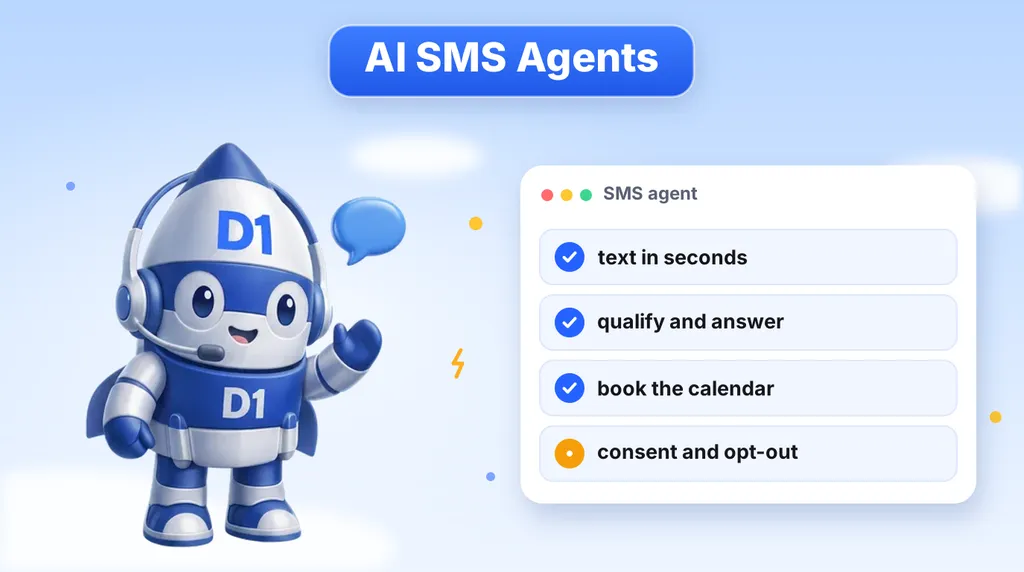
An AI SMS agent is software that holds a text conversation with a new lead on your behalf. It replies in seconds, asks your qualifying questions, answers the common ones, books a time on your calendar and passes the thread to a person when the conversation needs one. This post explains what that looks like in practice, where it should stop, and how to tell whether it is paying for itself.
It is written for owners and sales managers at service businesses, moving companies and real estate investors who already get leads and lose some of them to slow follow-up. If you are weighing a voice agent as well, read our guide to AI voice agents alongside this one, because the two work best as a pair.
What an AI SMS Agent Is, and What It Is Not
A basic auto-reply sends the same canned text to everyone. An AI SMS agent reads what the lead wrote back and responds to that. If someone replies "Is Tuesday possible?" to a quote request, the agent checks the calendar and answers the question instead of repeating a form message.
It is also not a person pretending to be a robot, or a robot pretending to be a person. Good setups say up front that the lead is texting an assistant for your company, and they make it easy to ask for a human. Hiding that fact buys you a short-term reply rate and a long-term trust problem.
Three things separate a useful agent from a novelty:
- It has a job. The goal is a booked appointment, a qualified lead record or a clean handoff. "Chat with customers" is not a job.
- It knows your business. It is loaded with your services, service area, hours, booking rules and the questions you actually ask on the phone.
- It writes to the CRM. Every reply, answer and booking lands on the lead record, so your team sees the whole thread before they pick up the phone.
What Happens in the First Few Minutes
The trigger is a new lead: a form submission, a missed call, an ad lead form or a web chat that ended. The agent sends a first text within seconds, using the lead's name and the thing they asked about. A typical first message names your company, says it is an assistant, and asks one easy question.
From there the agent works through a short list of qualifying questions, one at a time, in plain language. For a mover that might be the move date, the two ZIP codes and the size of the home. For an investor it might be the property address, the condition and the timeline. Asking one question per message keeps replies high and answers clean. A wall of five questions in one text tends to get ignored.
Speed matters because a lead who filled out several forms often goes with whoever responds first. Our speed-to-lead guide covers why, and an SMS agent is one of the few ways to answer at 9 pm on a Sunday without paying someone to sit by a phone.
A Sample Conversation, Step by Step
It helps to read one conversation before you build anything. The example below is for a moving company and uses made-up details, so treat it as a shape to copy, not a script to paste.
- First text: the agent greets the lead by name, says it is the assistant for your company, mentions the quote request and asks for the move date.
- Second text: after the date comes back, the agent asks for the two ZIP codes, then the size of the home, one question at a time.
- Answering a question: if the lead asks whether you cover their area, the agent answers from your service area list and goes back to the open question.
- Booking: the agent offers two or three open times for the estimate call and confirms the one the lead picks.
- Handoff: if the lead asks for an exact price in writing, the agent says a team member will follow up and passes the thread along with a summary.
Notice what is missing: no long pitch, no pressure, and no promise the agent cannot keep. Every message either asks one thing or answers one thing.
The Five Jobs It Should Do
| Job | What the agent does | What a person still does |
|---|---|---|
| Respond | Texts a new lead within seconds, day or night | Owns the relationship from the first live conversation |
| Qualify | Asks your standard questions and records the answers in the CRM | Decides which answers make a lead worth a quote or an offer |
| Answer | Replies to common questions about service area, hours and process | Handles pricing exceptions, complaints and anything unusual |
| Book | Offers open times and confirms the appointment on the calendar | Shows up, quotes and closes |
| Hand off | Passes the thread, with a summary, to the right person | Picks it up fast and tells the lead who is writing now |
Booking is the step that matters most. Our post on AI appointment-booking bots goes deeper on calendars, reminders and no-shows, so we will not repeat it here.
What to Load Into the Agent Before It Goes Live
An agent is only as good as what it knows. Most weak setups fail because nobody wrote the basics down, so the agent improvises. Gather these before you start:
- Your services and what you do not do. A clear "we do not handle that" saves a wasted booking.
- Your service area. A list of cities, ZIP codes or counties, so the agent can answer the first question most leads ask.
- Hours and booking rules. Which days you take appointments, how much notice you need and how long each one runs.
- Your qualifying questions, in order. The same ones you ask on the phone, with the answers that make a lead a fit.
- Approved answers to common questions. Process, timing and what happens next, in your words.
- The handoff rules and who receives each one. A name or a team inbox, not "someone".
Keep this material in one document that you update when your offer changes. When prices, hours or areas change and the agent still repeats the old version, that is a maintenance gap, not an AI problem.
Rules for When It Hands Off to a Human
An agent that never hands off will eventually say something wrong to someone upset. Write the handoff rules before you turn it on, and test each one by texting the agent yourself.
- The lead asks for a person. Any version of "can I talk to someone" ends the bot's turn and alerts your team immediately.
- The lead is angry or upset. A complaint, a threat to cancel or an emotional reply should go to a human, not another cheerful question.
- The question is outside the script. If the agent is not sure, the right answer is "let me get someone from the team to reply," not a guess.
- Price, legal or financial questions come up. The agent should not promise a price, a result or a legal outcome. It can explain your process and book the call where those are discussed.
- The lead is ready. A hot lead who says "yes, let's do it" should reach a person while the interest is high, not wait in an automated sequence.
Each handoff should carry a short summary: who the lead is, what they asked for, what the agent already collected and why it passed the thread along. Nobody likes answering the same questions twice.
Consent, Opt-Outs and A2P 10DLC
Texting is regulated, and an AI does not change that. This section is general information, not legal advice, and the rules for your business depend on your state and how you collect numbers. The short version:
- Get consent before you text. The lead should agree to receive texts, in clear language near the submit button or on the call, before any marketing message goes out. Our SMS marketing guide for service businesses and our TCPA post for real estate investors cover where consent comes from and where it does not.
- Honor opt-outs instantly. A reply of STOP must end the conversation and stop all further messages, every time, with no follow-up asking them to reconsider.
- Register your numbers. US carriers expect businesses to send texts over registered A2P 10DLC numbers. Registration ties a number to a business and a use case. Unregistered traffic can be filtered or blocked, so build registration into the project plan, not the last day.
- Respect quiet hours. Set the agent to hold outbound messages overnight unless the lead just wrote in and is waiting on a reply.
- Keep the records. Store where, when and how each person agreed to be texted.
No setup can promise that messages will never be filtered. What you can do is register properly, keep lists clean, honor opt-outs and send messages people asked for.
Where an SMS Agent Fits Next to a Voice Agent
Texting and calling cover different moments. A lead who just filled out a form on a phone is often happy to text. A lead calling about a leaking pipe wants a voice. A person driving or working may ignore a call and answer a text an hour later.
That is why the strongest setups use both. One of our own builds, Safebound Moving and Storage, runs an "AI voice and SMS agent calls every new lead within seconds, qualifies it, and books the appointment straight into the GoHighLevel CRM we set up." The case study also notes that its appointment count "includes the ones the SMS agent booked without a call ever connecting." That is the argument for texting in one line: some leads never answer a call but will reply to a message. Our AI voice and SMS bots service builds the two together.
A missed-call text back is the simplest version of the same idea. If you run a moving company, see our post on missed-call text back.
What to Measure
You do not need a dashboard full of metrics. Four counts tell you most of what you need, and your CRM should be able to produce them.
| Measure | What it tells you | What to do if it looks weak |
|---|---|---|
| Reply rate | Whether the first message earns an answer | Shorten it, name your company, ask one easy question |
| Qualified leads | Whether the questions produce usable answers | Reword or reorder the questions |
| Bookings | Whether conversations turn into appointments | Check open times, and how many steps stand between "yes" and "booked" |
| Handoffs and opt-outs | Whether the agent is annoying people or getting stuck | Read the threads, then fix the script or the rules |
Do not trust any number you did not measure yourself. Read a sample of real threads every week for the first month. That is the fastest way to find the question that confuses people, the reply the agent misreads and the moment a lead wanted a human. Track outcomes in your CRM, not just in the texting tool, so you can compare booked jobs by source. Our CRM and automation service is built for that, and our AI CRM overview explains how the pieces connect.
Common Mistakes to Avoid
- Turning it on before the consent language is in place. Fix the forms and call scripts first, then connect the agent.
- Sending a wall of questions in the first message. One question per text keeps the conversation moving.
- Letting it answer pricing or legal questions. Route those to a person every time.
- Never reading the real threads. A weekly read of a sample of conversations catches problems that no count will show.
- Treating registration as an afterthought. Start A2P 10DLC registration early, because approval is outside your control.
- Hiding that it is an assistant. Say so in the first message and make a human easy to reach.
- Skipping the CRM connection. If bookings and answers do not land on the lead record, your team works blind.
Launch Checklist
- Write the one job: a booked appointment, a qualified record or a handoff.
- List the five to seven questions you ask on the phone, and put them in order.
- Write the handoff rules above, and test each one by texting the agent yourself.
- Add consent language to every form and call script that feeds the agent.
- Register your sending numbers for A2P 10DLC before launch.
- Make sure STOP works, and that opted-out people never receive another message.
- Connect the agent to your calendar and your CRM, and check a test lead appears correctly.
- Review real conversations every week for the first month and fix what you see.
If you want this built and tuned for your business, start with our AI voice and SMS bots page, then book a call and we will map the first conversation with you.
Want an AI SMS Agent Set Up Properly?
We build AI voice and SMS agents that text new leads in seconds, ask the right questions, book into your calendar and hand off to your team. Book a call and we will map the first conversation with you.
Or call us directly: (888) 330-1434.
D1TechCreative builds websites, paid traffic, CRM and AI automation systems for service businesses and real estate investors across the United States. Based in Fort Lauderdale, FL.