
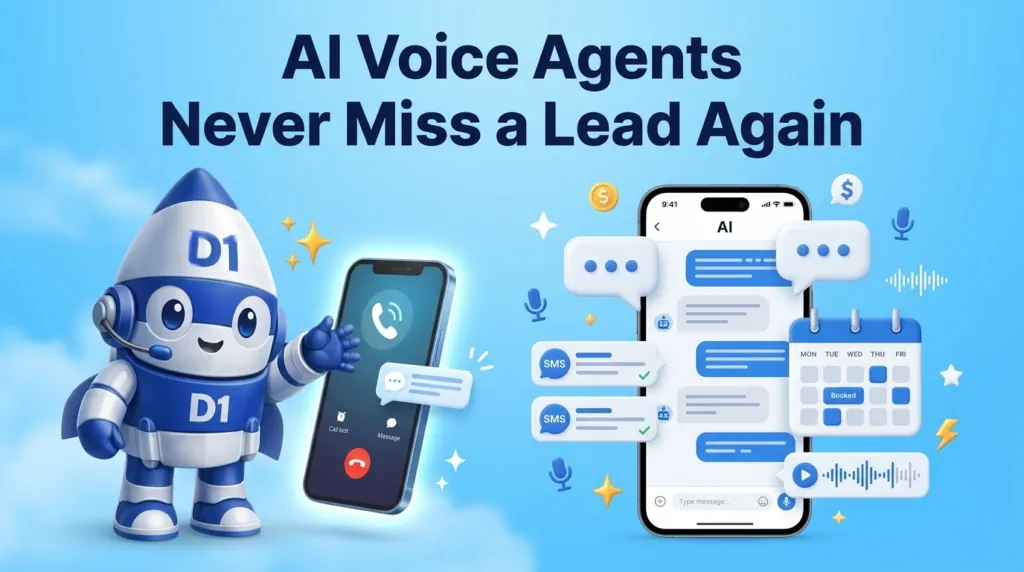
There’s a number in your business right now that you’ve never looked at, and it’s costing you tens of thousands of dollars a year: the number of inbound calls that ring through to no one.
Some of them are people who already are your customers — fine, they’ll call back. But many are first-time prospects who clicked your campaign, found your number, dialed, got voicemail, and immediately called the next business on the list. That’s revenue you paid to generate and gave away for free.
An AI voice agent for business fixes that — and a lot more besides. This guide explains what AI voice agents actually do, what they don’t, and how a service business can use one to never miss a lead again.
What an AI Voice Agent Is (and Isn’t)
An AI voice agent is a software agent that answers a phone call, holds a real conversation, and takes action — booking an appointment, transferring to a human, sending a text follow-up, or capturing detailed information into your CRM.
It is not:
- An IVR menu (“press 1 for sales, press 2 for support”) — that’s 1990s phone tree tech, and it’s why most people hang up.
- A generic chatbot — chatbots live on websites and text. Voice agents handle real phone audio.
- A replacement for your best human salesperson — it handles the work your best salesperson shouldn’t be doing.
It is:
- A real conversational AI trained on your business — services, pricing tiers, scheduling rules, FAQs.
- Multi-channel: usually pairs with an AI SMS agent so calls and texts work together.
- Available 24/7, never has a bad day, never forgets to log a lead.
The technology jumped a generation in 2024-2025 — latency dropped below a second, voices became natural enough that most callers don’t realize they’re talking to AI, and the cost dropped to the point where small businesses can afford it.
The Five Use Cases Service Businesses Pay For
1. Inbound Call Answering (Primary Use)
Every call rings normally. If a human answers in three rings, the call goes through as usual. If not, the AI picks up, identifies itself politely (most jurisdictions require this — and your callers prefer it), gathers the caller’s name, service interest, and contact info, and either books an appointment or escalates to a human via warm transfer.
Net effect: 0 missed leads. The leads you previously lost to voicemail are now in your pipeline.
2. Outbound Lead Qualification
You bought a list of 2,000 leads. Calling them all takes 80 hours. An AI voice agent dials all 2,000 in the time it takes your team to drink coffee, qualifies the ones who pick up, books the qualified ones onto a real human’s calendar.
This is where AI voice gets controversial — and where it must be done correctly. There are clear FCC and TCPA rules around outbound AI calling. Reputable AI voice setups include consent management, do-not-call list scrubbing, and proper disclosures.
3. Appointment Reminders and Confirmations
The day before a scheduled job or appointment, the AI calls to confirm. If the prospect cancels, the slot is freed automatically and reassigned. If they confirm, the human team gets a heads-up. No-shows drop noticeably with this layer alone.
4. After-Hours Receptionist
Most service businesses get 20-40% of their inbound calls outside business hours. An AI voice agent handles all of those. It books emergency calls, schedules next-day callbacks for non-urgent ones, and texts your team a summary so they hit the ground running in the morning.
5. Customer Service Triage
For businesses that take a lot of routine questions (“are you open?”, “do you serve my area?”, “what’s your pricing?”), the AI handles 60-80% of those without ever needing a human. It transfers anything complex.
How a Modern AI Voice Stack Works
The mechanics behind the scenes:
- Call comes in (via your business number, ported or forwarded to the AI platform).
- AI answers with a natural-sounding voice trained on your script.
- Conversation happens — the AI listens, understands intent, asks follow-ups, handles objections.
- Action is taken — booking made on your calendar, lead added to CRM, text sent to your team, or call transferred.
- Recording and transcript are saved to the lead record so a human can review later.
The good news: you don’t have to build any of this. Modern AI voice platforms (the ones we deploy at D1TechCreative) handle the infrastructure. Your job is to tell us how your business actually works, and we configure the agent.
Voice + SMS: Why the Two Belong Together
A great AI voice setup is paired with AI SMS. Here’s the killer combination:
- Lead calls, AI answers and books an appointment.
- AI sends an SMS confirmation immediately.
- 24 hours before the appointment, AI sends an SMS reminder.
- If the lead replies to that SMS with a question, the AI handles it conversationally.
- Day-of, AI sends a “we’re on the way” or “see you in 10 minutes” text.
- After the job, AI sends a review request.
That entire sequence happens automatically — and from the customer’s perspective, your business looks unusually organized and responsive.
The Economics: What an AI Voice Agent Actually Costs
Honest pricing for a service business:
- Software / platform: $200-$800/month depending on call volume and features
- Setup and configuration: $1,500-$5,000 one-time
- Ongoing optimization: $300-$1,000/month for active tuning
Compare to a human receptionist or answering service: $3,000-$5,000/month for one shift, and they’re not working nights or weekends.
The real ROI math: how many leads were you losing to missed calls? If you were losing 5 leads a week at a $2,000 average job value, that’s $40,000/month in lost revenue. Recovering even half pays for the system 10x over.
The Five Mistakes That Sink AI Voice Deployments
- Trying to make the AI handle everything. Define what AI handles, what it transfers, and what it escalates.
- Generic script. The agent should sound like your business, use your language, and know your services.
- No human fallback. There must be a “transfer me to a real person” command that works flawlessly.
- Not training on real call data. The first 30 days should include reviewing transcripts and tuning the agent.
- Skipping legal and compliance work. Disclosure requirements vary by state.
Frequently Asked Questions
What is an AI voice agent?
It’s a software-based phone agent that answers calls, holds natural conversations, and takes actions — booking appointments, transferring to humans, capturing lead info — without a human picking up the phone.
Can callers tell they’re talking to AI?
Most of the time, no — voice quality is excellent in 2026. Reputable AI voice deployments disclose that the caller is speaking with an AI agent at the start of the call.
How much does an AI voice agent cost?
Total all-in cost for a small business is typically $500-$1,500/month including platform fees, setup, and ongoing optimization.
What happens if the AI can’t handle a call?
It transfers to a human (warm transfer, with context) or takes a message and texts your team with a full transcript.
How long does setup take?
A standard deployment takes 2-4 weeks from kickoff to go-live.
Ready to Stop Losing Calls?
If your business misses even 5 calls per week from new prospects, an AI voice agent pays for itself almost immediately. Book your call and we’ll show you exactly what a deployment would look like for your business.
Or call us directly: (888) 330-1434. (Yes — the AI will answer if we’re busy.)
D1TechCreative builds AI voice, SMS, and CRM systems for service businesses across the U.S. Headquartered in Fort Lauderdale, FL.