
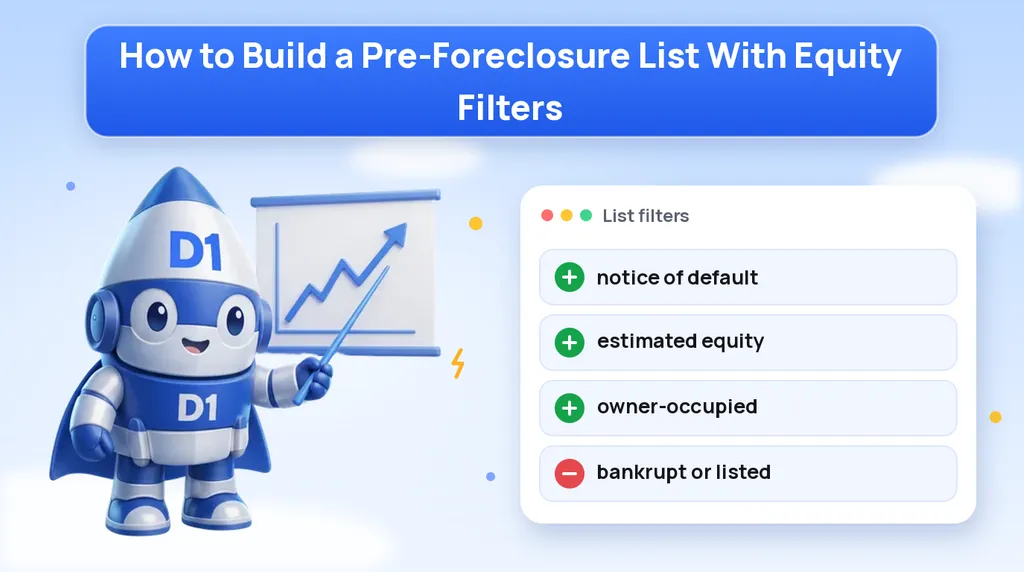
A raw pre-foreclosure list is mostly noise. It includes homeowners with no equity, properties already listed with an agent, owners in bankruptcy, duplicates, and cases that were settled weeks ago. Mail all of it and you pay to reach people you can't help and who can't sell to you. Filter it well and the same data turns into a short list of owners worth a letter, a call and a follow-up.
This guide is for real estate investors and foreclosure-help companies who already have a data source and want to turn it into a working list. If you are still choosing where to get the data, read our ranking of the best pre-foreclosure lead sources first. This post picks up where that one stops: what to filter, in what order, and how to split the result into mail, call and drop.
Start With the Notice Type
Every pre-foreclosure record begins with a public filing, but the filing depends on how foreclosure works in that state. Knowing which notice you are looking at tells you roughly where the owner is in the process.
| Notice | Where you usually see it | What it tells you |
|---|---|---|
| Notice of default (NOD) | States that mostly use non-judicial foreclosure | The lender has formally declared the loan in default. Often the earliest public signal. |
| Lis pendens | States that mostly use judicial foreclosure | A lawsuit has been filed that affects the property. Not every lis pendens is a foreclosure, so check the case type. |
| Notice of sale (or notice of trustee sale) | Most states, later in the process | A sale date has been set or is being set. Less time, more urgency. |
Names, order and timing differ by state, and some states use both judicial and non-judicial processes. Do not assume a fixed number of days between a notice and a sale. Check the rules for each state you work in, and use our foreclosure timeline by state as a starting point before you plan your follow-up cadence.
Keep the notice type and filing date as columns in your list. They drive almost every decision after this, from how urgent the message should be to when you stop contacting someone.
Clean the Raw Data Before You Filter
Filters are only as good as the data under them. Before you apply anything else, spend a few minutes cleaning:
- Standardize addresses so "123 Main St" and "123 Main Street" are the same record. Most mailing tools can run address standardization for you.
- Remove duplicates. The same property can appear more than once if there were several filings or if you pull from more than one source.
- Match filings to property records by parcel number where you can, not just by owner name. Names are spelled inconsistently across county systems.
- Drop records with no usable property address or that point to vacant land if you only buy houses.
- Note the property type (single family, condo, multifamily, commercial) so you can filter to what you buy.
If you pull from county websites yourself, this is where most of the time goes. Our data scraping service can collect public records from the sources you choose and deliver them in a consistent format, which makes this step much shorter.
Estimate Equity: Value Minus Loan Balances
Equity is the filter that matters most, because an owner with little or no equity usually has few options for a sale that pays off the loan. The formula is simple:
Estimated equity = estimated property value minus the total of all known loan balances.
The inputs are where it gets hard:
- Estimated value usually comes from an automated valuation model in your data provider or from recent comparable sales. Treat it as a range, not a number. Automated values can miss condition problems and recent renovations.
- Loan balances are estimated from recorded mortgages, the original loan amount, the recording date and typical payment schedules. They do not know about missed payments, late fees, or a loan modification.
- Second mortgages and HELOCs are easy to miss. Check for every open lien recorded against the property, not just the first mortgage.
- Other liens such as tax liens, judgments or HOA liens can reduce what is left after a sale. Some data providers flag these, some don't.
Because the result is an estimate, most investors use equity bands instead of a single cutoff: likely high equity, possible equity, and likely little or none. Where you draw those lines is your call. It depends on your market, your buying criteria, your exit strategy and how much you are willing to spend to verify each lead. There is no standard threshold, so set your own, write it down, and adjust it after you see which records turn into conversations.
Owner-Occupied vs Absentee Owners
Occupancy changes both the message and the channel. Compare the property address with the owner's mailing address in the tax records:
| Owner type | How to spot it | How to approach |
|---|---|---|
| Owner-occupied | Mailing address matches the property address, homestead exemption on file where your state has one | A personal, respectful letter that explains the options you can offer. The homeowner is living through it, so tone matters. |
| Absentee owner | Mailing address is somewhere else | Often a landlord, an heir or someone who moved. Mail goes to the mailing address, not the property. A direct offer can work. |
| Entity-owned | Owner is an LLC, trust or company | Find the person behind the entity before you contact anyone. Treat it as a business conversation. |
Keep both groups in the list but tag them, so each gets its own letter and script. A tired landlord behind on a rental and a family trying to keep their home need very different first messages.
Whatever the group, keep your copy honest. Don't promise to stop a foreclosure or protect anyone's credit. Describe what you actually do and let the owner decide. If you run a foreclosure-help service rather than buying houses, the same rule applies. We have built sites for companies like Homeowner Foreclosure Prevention and Foreclosure Solutions USA, and clear, careful language is part of every one.
Remove Bankrupt, Listed and Resolved Properties
This step saves more money than any other. Every record you drop here is postage and call time you don't waste.
- Active bankruptcy: a bankruptcy filing changes the foreclosure process and brings its own legal rules. Most investors drop these records or move them to a separate list they only touch with legal advice.
- Listed with an agent: if the property is already on the market, the owner has chosen a path. Check the MLS or listing sites and remove active listings. Expired listings can come back later.
- Cancelled or dismissed cases: the owner may have caught up, refinanced or worked out a modification. Look for a recorded rescission or dismissal and remove the record.
- Already sold: if a sale has taken place, the record is no longer a pre-foreclosure lead.
- Properties outside your buy box: wrong area, wrong property type, or a price range you don't buy in.
- Do-not-contact requests: anyone who has asked you not to contact them stays off every list.
Run these removals every time you refresh the list, not only once. Status changes quickly in pre-foreclosure, and a record that was active last week may be resolved today.
Skip Trace the Records That Pass
Only skip trace what survives the filters. Skip tracing costs money per record, so running it on the full raw list pays for phone numbers you will never dial.
When the results come back:
- Keep every phone number and email with its confidence score, and try the highest-ranked numbers first.
- Scrub phone numbers against the national Do Not Call registry and your own internal do-not-call list before anyone dials.
- Flag mobile numbers separately. Texting has its own consent rules, which our TCPA-compliant SMS guide covers.
- Note records with no usable contact. They can still get mail.
Some states also have specific laws about contacting or buying from owners in foreclosure. Check the rules for your state with a local attorney before you start a campaign.
Score the List and Split It Into Mail, Call and Drop
Once the list is clean, give each record a simple score so your time goes to the best ones first. Keep the scoring rules plain enough that anyone on your team can apply them. Here is a template you can copy and adjust:
| Factor | Higher priority | Lower priority |
|---|---|---|
| Equity band | Likely high equity | Possible equity |
| Notice stage | Early notice, more time to talk | Late stage, sale date close |
| Contact data | Verified mobile and mailing address | Mailing address only |
| Fit with your buy box | Area and property type you buy most | Edge of your area or criteria |
| Other signals | Absentee, inherited, vacant, tax delinquent | No extra signals |
Then split the list into three groups:
- Call and mail: top-scoring records with good contact data. They get a letter, a call from a trained person and a follow-up sequence in your CRM.
- Mail only: records worth reaching but without a reliable phone number, or lower on the score. They get a letter series. Our guide to direct mail for real estate investors covers letter formats and timing.
- Drop or hold: likely little or no equity, out of your buy box, or missing data. Hold them for the next refresh instead of deleting, since equity estimates and status change.
Keep the List Fresh and Connect It to Follow-Up
A pre-foreclosure list goes stale fast. New notices are filed, cases settle, properties sell. Decide how often you will pull new filings and re-run your removals, and stick to it. Many investors refresh on a fixed weekly or monthly schedule so the mail and call teams always work from current data.
The list is only half the system. Owners in pre-foreclosure often hear from many investors at once, so the response they get from you matters. Send every lead, whether it came from a letter, a call or your website, into one CRM with the notice type, filing date, equity band and score attached. That way the person who picks up the phone knows the situation before they say hello. Our foreclosure lead generation playbook shows how lists fit with paid search, SEO and a landing page, and our guide on how to get pre-foreclosure leads covers the outreach side in more depth.
Pre-Foreclosure List Checklist
- Pull filings from your chosen sources and record the notice type and filing date for each.
- Standardize addresses, remove duplicates and match records to parcel numbers.
- Estimate equity from value minus all known liens, and sort records into equity bands you define.
- Tag owner-occupied, absentee and entity-owned properties.
- Remove bankrupt, listed, cancelled, sold and out-of-box records.
- Skip trace only what remains, then scrub against Do Not Call lists.
- Score each record and split the list into call and mail, mail only, and drop or hold.
- Check your state's foreclosure timeline and contact rules before the first letter goes out.
- Refresh on a fixed schedule and send every response into your CRM.
Want Help Building and Working Your Foreclosure List?
We pull and clean property data, build the landing pages and set up the CRM follow-up for real estate investors and foreclosure-help companies. Book a call and we will look at your current list and process with you.
Or call us directly: (888) 330-1434.
D1TechCreative builds websites, paid traffic, CRM and AI automation systems for service businesses and real estate investors across the United States. Based in Fort Lauderdale, FL.