
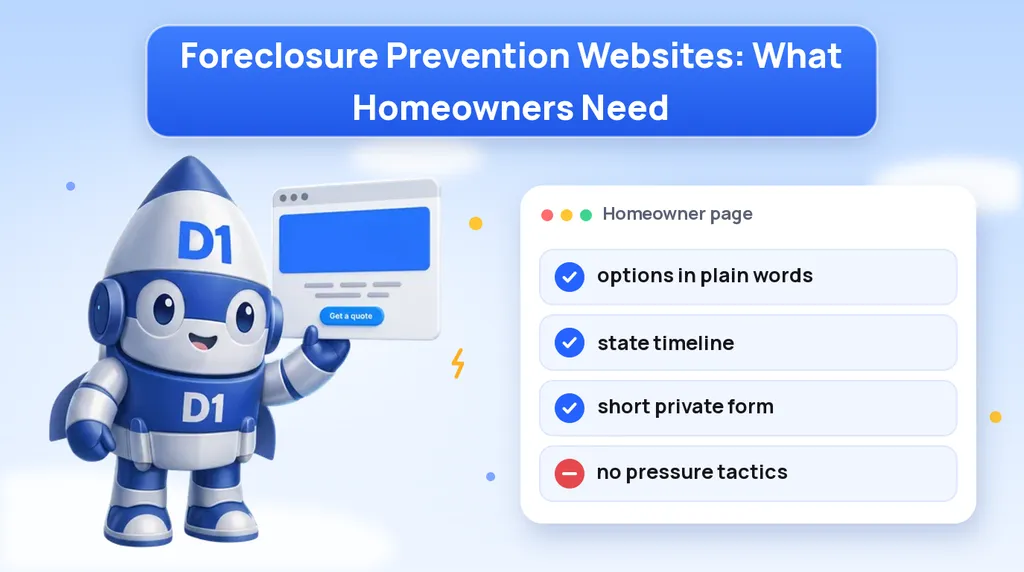
A homeowner who has just received a notice of default is not shopping the way most website visitors shop. They are worried, often embarrassed, and short on time. They want to know what is happening, what their choices are and whether they can trust the person on the other side of the screen. Most foreclosure sites answer none of that. They lead with a giant "Get Cash Now" button and hope.
This guide is for investors, loss mitigation companies, housing counselors and other businesses that help homeowners who are behind on payments. It covers what a homeowner needs to see first, how to explain options and timelines in plain words, what the form should ask, which disclosures belong on the page, and why the follow-up matters as much as the design.
Start With How the Homeowner Feels
Before you write a single headline, picture the visitor. They may have missed several payments. They may have been avoiding mail from the lender. They may be getting letters and calls from strangers who found their name in public records. They are deciding, quickly, whether you are one more of those strangers.
That shapes every decision on the page:
- Calm beats urgent. They already feel urgency. Adding countdown timers and all-caps warnings makes you look like the problem, not the help.
- Clear beats clever. Use the words they use: "behind on my mortgage", "missed payments", "got a letter from the bank". Avoid jargon unless you explain it.
- Private beats public. Many homeowners have not told family or neighbors. Say plainly that their information stays private and how you use it.
- Choice beats a single push. If the only option on the page is selling to you, many visitors will assume you are not being straight with them.
The Residential Foreclosure Prevention landing page we built was written with this in mind, in large, high-contrast type for older homeowners who are behind on the mortgage or property taxes. Two paths sit side by side: keep the home or sell it.
Explain the Options in Plain Words
The single most useful thing your site can do is lay out the options honestly, before asking for anything. A homeowner who understands their choices is more likely to reach out, and more likely to trust the person who helped them understand.
| Option | Plain-language explanation | Who it may fit |
|---|---|---|
| Talk to the lender | Many lenders have programs for borrowers who fall behind. Calling early gives you more choices. | Anyone who has not contacted the lender yet |
| Loan modification | The lender changes the loan terms so the payment is easier to manage. | Homeowners with steady income who want to stay |
| Forbearance | Payments are paused or reduced for a set period, then repaid later. | A short, temporary hardship |
| Repayment plan | The missed amount is spread over future payments. | Homeowners who are back on their feet |
| Short sale | The home sells for less than the loan balance, with the lender's approval. | Owners who owe more than the home is worth |
| Cash sale | A buyer purchases the home directly, often on a set timeline and as is. | Owners who have equity and want to move on |
| Free counseling and legal help | HUD-approved housing counselors and local legal aid can review a situation at no cost. | Anyone unsure where to start |
Pointing people to free counseling may feel like sending away a lead. In practice, it builds the trust that makes the homeowner call you back. The Homeowner Foreclosure Prevention site we built takes a similar approach: a short check asks where things stand and leads to two ways forward, a lease-back or a cash offer, and each state page lists free resources alongside the options.
Be careful with how you describe outcomes. You cannot promise that any option will work, and you should never suggest that contacting you will end the foreclosure. Describe what each option is and what you actually do, and let the homeowner decide.
Show State Timeline Information
The second question every homeowner has is "How much time do I have?" The honest answer depends on the state. Some states run foreclosures through the courts, which usually takes longer. Others allow a non-judicial process that can move faster. Notice periods, cure rights and redemption rights all vary.
A good foreclosure site gives each state its own page, written in plain language, covering:
- Whether the state is mainly judicial or non-judicial.
- The main stages, from missed payments to sale, in the order they happen.
- What the homeowner can still do at each stage.
- Free state and local resources, such as housing counseling and legal aid.
- A clear note that timelines vary and the homeowner should confirm their own dates with the lender, a counselor or an attorney.
Our foreclosure timeline by state guide is a useful reference when you write these pages. On the Homeowner Foreclosure Prevention site, a clickable map opens a page for every state, covering how the process works there, the options and free resources. That structure helps the homeowner and it helps search, since people often search with their state name.
Foreclosure Solutions USA goes a step further with one page per option per state: loan modifications, forbearance, short sales and cash offers. The visitor lands on a page that matches what they searched for before the form ever appears.
Keep the Form Short and Private
The form is where most foreclosure sites lose the visitor. A long form that asks for loan numbers, income and a full address on the first screen feels like an interrogation. A short form that starts with an easy question feels like a conversation.
What works on the sites we build:
- Start with the situation, not the contact details. "Where are things right now?" with simple choices such as "a few payments behind", "received a notice" or "sale date set".
- Ask for the property state or address next. That tells you which rules apply.
- Ask who to call and when last. Name, phone and a preferred time to talk.
- Say what happens after. "A real person will call you to talk through your options. There is no obligation."
- Explain privacy in one line. Who sees the information and that you do not sell it, if that is true.
The Residential Foreclosure Prevention page uses a three-step survey that asks what is going on, where the property is and who to call. Multi-step forms like this feel lighter than one long form, and every step gives the homeowner a small, easy decision.
If you call or text the people who fill in the form, put clear consent language next to the submit button, name your business, and include opt-out instructions.
Disclosures That Build Trust
Disclosures are not just legal cover. For a homeowner who is already wary, a clear statement of who you are and who you are not is one of the strongest trust signals on the page. Place them near the form and in the footer, in readable type.
Disclosure checklist:
- You are a private company, not a government agency, and not affiliated with any government program or the homeowner's lender.
- You are not a law firm and do not give legal advice, unless you are one.
- Free help is available from HUD-approved housing counselors.
- Any results depend on the homeowner's situation and the lender, and nothing is promised.
- How you use the homeowner's information, with a link to your privacy policy.
- If you charge for any service, how and when, in line with the rules that apply in your state.
Avoid seals, logos, colors and names that look official. A site that resembles a government page might get more clicks for a while, but it creates complaints, platform problems and legal risk. It also breaks trust the moment the homeowner realizes the truth.
Pressure Tactics to Leave Out
Some foreclosure marketing relies on fear. It may produce form fills, but it attracts the wrong kind of attention and drives off the homeowners most likely to work with you. Leave out:
- Countdown timers and "only today" offers.
- Promises about the outcome, such as ending the sale, keeping the house or repairing credit.
- Photos of eviction notices or locked doors.
- Pop-ups that block the page before the visitor has read anything.
- Language that blames or shames the homeowner.
Replace them with a calm headline, a short explanation of options, real names and faces if you have them, and a clear way to talk to a person.
Fast, Human Follow-Up
A homeowner who fills out a form at night is often contacting more than one company. The first calm, helpful voice they hear usually earns the conversation. That makes follow-up part of the website, not an afterthought.
- Send an instant text that confirms the request and names the person who will call.
- Call within minutes during business hours, and first thing the next morning for overnight leads.
- Route every lead into a CRM with the state, the situation answer and the preferred call time attached.
- Keep a short, respectful follow-up sequence for people you cannot reach, and stop immediately when someone opts out.
- Train whoever answers to explain options first and pitch second.
If you are also building traffic to the site, our foreclosure lead generation playbook covers the channels, and our guide on getting pre-foreclosure leads covers the data side. For the broader site structure investors use, see our real estate investor website guide.
Build Checklist
- Write the homepage headline in the homeowner's words, with a calm tone and no countdowns.
- Explain every option you offer, plus free counseling, before asking for anything.
- Create a plain-language page for each state you serve, with stages and local resources.
- Use a short multi-step form: situation, property location, then name, phone and best time.
- Place disclosures near the form and in the footer: private company, not a government agency, not a law firm, no promised results.
- Remove pressure tactics, official-looking design and any promise about the outcome.
- Connect the form to a CRM with instant text, fast human calls and clear opt-out handling.
We design and build sites like this through our smart websites and funnels service, including the three foreclosure help sites mentioned above.
Need a Foreclosure Help Site Homeowners Can Trust?
We build calm, plain-language foreclosure help sites with state pages, short private forms, clear disclosures and fast follow-up in the CRM. Book a call and we will review your current site or plan a new one with you.
Or call us directly: (888) 330-1434.
D1TechCreative builds websites, paid traffic, CRM and AI automation systems for service businesses and real estate investors across the United States. Based in Fort Lauderdale, FL.