
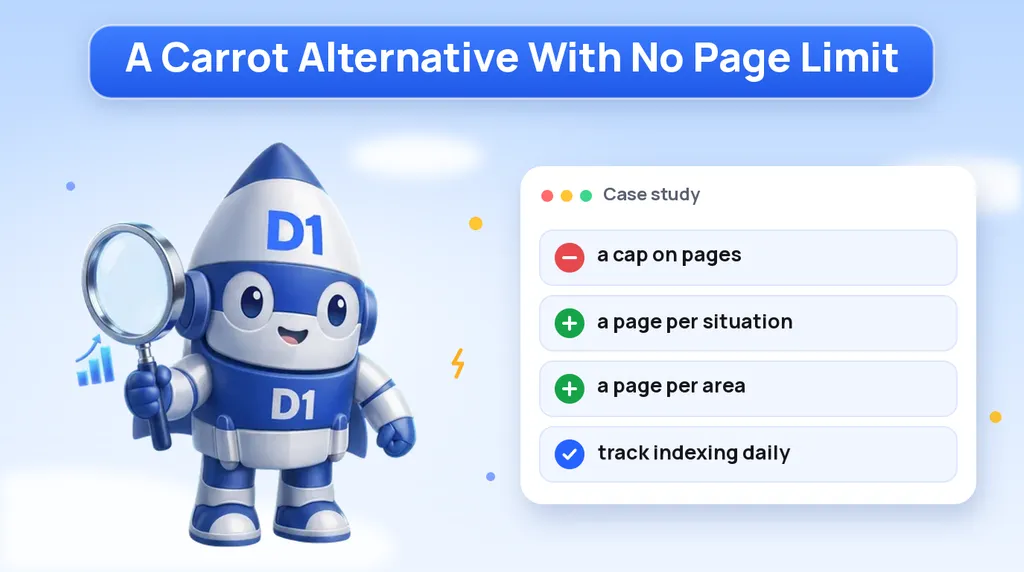
Carrot is where a lot of real estate investors start, and for a good reason: you get a working "we buy houses" site quickly, without hiring a developer. The trouble starts later, when the business grows and the site needs to grow with it. One of the first walls investors hit is a limit on how many pages a site can have.
This post is for investors and home buyers who are weighing a move off Carrot or a similar platform. It walks through what happened when Darren B. Brown of Sacramento Home Selling hit that wall, what we built in its place, what Google has picked up since, and a checklist you can use to decide whether your own site has outgrown its platform.
Why the Page Limit Matters for Investor SEO
Motivated sellers don't search for "we buy houses" and stop there. They search for their situation, in their town. Someone who just inherited a house searches differently from someone behind on payments, and someone in Elk Grove searches differently from someone in Roseville. Each of those searches is a chance to show up, and each one is best answered by a page written for it.
That is why the number of pages matters so much for an investor site. A site with ten pages can rank for ten ideas, more or less. A site with a page for every situation in every area it serves can rank for hundreds or thousands of specific searches, each one with a reader who already knows what they need. We cover the basic structure in our real estate investor website guide. The short version: situations times areas is where the long tail lives.
When a platform caps the number of pages, it caps that math. You end up choosing which situations to cover and which towns to leave out, and every page you can't build is a search a competitor gets instead.
Where Darren Was Before
Darren B. Brown buys houses across the Sacramento area. His business covers probate and inherited homes, fast sales, and a guaranteed sale program. His sites ran on Carrot, and he was running into the limit on how many pages he could create there.
For his business, the limit hit hardest exactly where the opportunity was biggest. Probate alone has many distinct situations: an heir who lives out of state, a house that needs repairs before anyone can sell it, siblings who don't agree on what to do. Each one is a different search with a different worry behind it. Multiply that by every town he buys in, and the number of pages a full site needs runs well past what his plan allowed.
What We Built Instead
We rebuilt the site in Next.js, as a custom site that Darren owns. There is no plan tier that decides how many pages he can have. The structure follows how his sellers actually search:
| Part of the site | What it holds |
|---|---|
| Probate and Inherited Property hub | 17 situations, each with its own page |
| Sell Fast hub | 20 situations, each with its own page |
| Guaranteed Sale hub | 16 situations, each with its own page |
| Location pages | 44 Sacramento-area locations |
| Sitemap | 1,860 URLs in total |
Page count alone doesn't make a site work, so the rest of the build is about trust and conversion:
- A video hero. The home page opens on video instead of a stock photo, so the first thing a seller sees feels local and real.
- A credentials section with proof. It links to his documents, from his broker license to his BBB listing, instead of just claiming to be trustworthy.
- Google reviews on the page. Real reviews from his Google profile, where sellers can see them without leaving the site.
- A custom admin console. More on that below, because it is the part that makes a site this size manageable.
You can see the finished site and Darren's own video review on our Sacramento Home Selling portfolio page.
Why a Big Site Needs a Console, Not Just a CMS
Here is the catch with going from a capped site to 1,860 URLs: Google doesn't index everything you publish, at least not right away. With a site this size, the question every morning is no longer "is my site live?" but "which of my pages has Google picked up, and what do I do about the ones it hasn't?"
Search Console can answer that, but slowly and one URL at a time. So we built Darren a console of his own. Its Indexing screen shows which pages Google has indexed, how they rank, and what to change on the ones it hasn't. Google is re-checked daily, important pages first. From the same screen he can:
- Check the next batch of pages right now instead of waiting for the daily run
- Send every page that isn't indexed yet to Bing in one click
- Resubmit the sitemap to Google
- Filter pages by indexed, not indexed, unknown to Google, failed checks and ranking
The console also holds a leads inbox for every one of his sites, with a count per site and date filters, plus the pages and site copy he can edit himself. It installs on his phone like an app. The full tour is on the console portfolio page, and if you want something similar built around your own business, see our custom software and apps service.
What Google Has Picked Up So Far
These numbers come from Darren's console, on screen in the video review he recorded for us on 8 November 2026. They are a snapshot, not a final result, and indexing on a site this size keeps moving.
| Measure | Number |
|---|---|
| URLs in the sitemap | 1,860 |
| Pages checked so far | 1,858 |
| Indexed by Google | 1,065 |
| Not indexed yet | 792 |
| Showing in search (pages with impressions, 11 August to 8 November 2026) | 351 |
The number to watch is the last one. 351 pages showing in search means 351 different pages that real people have seen in Google results. On a capped site, most of those pages could not have existed in the first place.
The 792 pages not indexed yet are not a failure. They are the work list. That is exactly what the console is for: it shows which pages are waiting, and gives Darren the buttons to push them along instead of guessing.
Should You Leave Carrot? An Honest Way to Decide
Not every investor needs to move. If you buy in one small market, handle one kind of deal, and your site brings in the leads you can handle, a platform site may be all you need. Moving costs time and money, and a custom site is a commitment.
The move starts to make sense when the platform is the thing standing between you and more sellers. Signs that point that way:
- You have situations or towns you want pages for, and the plan won't let you add them
- You run more than one site and want every lead in one place
- You want to know which pages Google has indexed without checking them one by one
- You want to own the site and its code, not rent them
- You want a page design or a feature, like a video hero or a proof section, that the templates don't allow
If you are weighing a custom build against other options, our custom website vs WordPress comparison covers the tradeoffs in more detail.
How to Move Without Losing What You Have
The biggest risk in any move is losing the rankings and links the old site already earned. A careful migration protects them:
- Inventory every URL on the old site. Pull the sitemap and the pages Search Console shows with impressions.
- Map each old URL to its new home. Keep the same URL where you can. Where you can't, set up a permanent redirect.
- Carry over what works. Titles and copy that already rank should move across, then improve.
- Build the new pages in batches. Hubs first, then situations, then areas, so the most important pages get crawled first.
- Submit the new sitemap and watch indexing. Expect it to take weeks, not days, on a large site. Track it page by page.
Our guide to local SEO for service businesses goes deeper on location pages and how to keep them from reading like copies of each other, which matters a lot once you have dozens of them.
Your Next Steps
Before you decide anything, get the facts about your own site. Use this checklist:
- Count the pages your site has now, and the most your plan allows
- List every seller situation you handle, and every town you buy in
- Multiply the two: that is roughly how many pages a full site would need
- In Search Console, note how many pages are indexed and how many have impressions
- Write down every lead source, so nothing gets lost in a move
If the number of pages you need is far past what your plan allows, the platform is likely capping your growth. That was the case for Darren, and you can watch him talk about the result in his own words on his portfolio page.
Has Your Investor Site Outgrown Its Platform?
We build custom sites for real estate investors with no cap on pages, plus an admin console that shows which pages Google has indexed. Book a call and we will look at your current site and plan the move with you.
Or call us directly: (888) 330-1434.
D1TechCreative builds websites, paid traffic, CRM and AI automation systems for service businesses and real estate investors across the United States. Based in Fort Lauderdale, FL.