If you sell health insurance, you have probably asked the same question every agent and agency asks sooner or later: should the ad budget go to Google or to Facebook? Both can produce leads. They produce very different leads, and the difference shows up in your close rate, your follow-up workload and your compliance risk long before it shows up in the ad dashboard.
This guide is for independent agents, small agencies and marketing teams that run their own paid traffic. It compares search intent with social volume, explains when a call-first funnel beats a form-first one, covers the consent and ad copy rules that keep you out of trouble, and ends with a practical way to split a budget across both channels.
Intent vs Volume: The Core Difference
Google Ads is a demand capture channel. Someone types "health insurance quotes", "private health insurance for self employed" or "health plans near me" into a search box. They have a need right now and they are looking for someone to help. Your ad shows up because they asked.
Facebook and Instagram ads are a demand creation channel. The person was scrolling, saw a message that matched their situation, and tapped. Some of them were already shopping. Many were not, at least not until they saw your ad. That is not a flaw. It is the reason social can reach people search never will, such as a freelancer who has been putting off the problem for months.
The practical effect is simple:
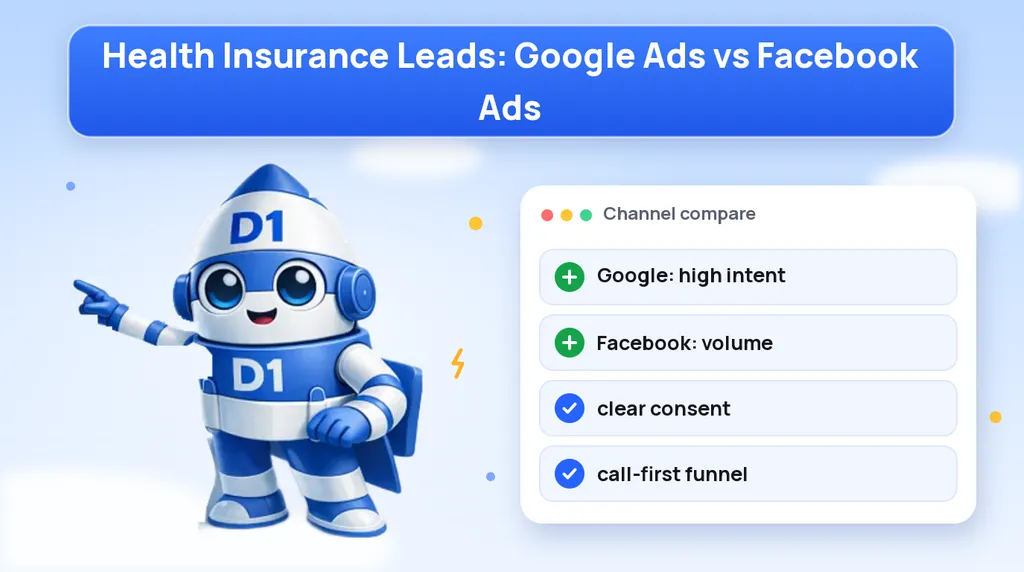
- Google leads tend to arrive warmer. They know what they want and often expect a call. You will usually get fewer of them, and each click costs more.
- Facebook leads tend to arrive in larger numbers and colder. More of them need a second or third touch before they will talk about plans. Some never answer at all.
Neither is "better" on its own. The right answer depends on how many agents you have, how fast they can call, and how much nurturing your CRM can handle without a human.
What Each Channel Costs You in Lead Quality
Cost per lead is the number most people compare, and it is the least useful one on its own. A cheap lead that never picks up the phone is more expensive than a costly lead that enrolls. Compare the channels on the full path instead.
| Factor | Google Ads (search) | Facebook and Instagram ads |
|---|---|---|
| Buyer intent | High: the person searched for coverage | Mixed: the ad started the conversation |
| Lead volume | Limited by how many people search in your area | Scales with budget and creative |
| Cost per click | Higher, especially for broad insurance terms | Lower per click or impression |
| Contact rate | Usually better, since many expect a call | Lower without fast, persistent follow-up |
| Best funnel | Call-first or short form | Short form or quiz, then instant text and call |
| Main risk | Paying for research and job seeker clicks | Unqualified or low-intent submissions |
| Targeting limits | Keyword and location based | Health-related detailed targeting is restricted, so creative does the filtering |
For a wider view of how paid search compares with organic work, our Google Ads vs SEO guide covers when each one makes sense for a service business.
Our own health insurance lead generation case study shows the other side. Healthcare Coverage Hub generates 750+ health insurance leads every month, mainly from Meta ads, because the funnel and the automation behind it were built to qualify social traffic quickly. Volume only pays off when the follow-up can keep up with it.
Call-First vs Form-First Funnels
How you ask for contact matters as much as where the click comes from.
Call-first
A call-first funnel puts the phone number at the center: call ads or call extensions on Google, a tap-to-call button above the fold on the landing page, and a short form only as a backup. It works best when:
- You have licensed agents available during the hours your ads run.
- Your traffic is mostly high intent, which usually means Google search.
- Your prospects are older or less comfortable typing into forms on a phone.
The weakness is coverage. If nobody answers, the lead is gone. Schedule your call ads only for staffed hours, and route missed calls to an instant text back.
Form-first
A form-first funnel collects details first, then calls. Native Facebook lead forms, short landing page forms and multi-step quizzes all fall here. It suits social traffic, since most people scrolling Facebook are not ready to dial a stranger. It also gives you the data you need to qualify before an agent spends time on the call: age range, household size, state, current coverage and preferred contact time.
The weakness is decay. A form lead cools off fast. The only fix is speed, which is why our speed-to-lead guide matters even more for insurance than for most industries. A text within a minute and a call within minutes beats any clever ad.
Many agencies end up with both: call-first on Google, form-first on Facebook, and one CRM pipeline that treats every new lead the same way regardless of where it came from.
Consent and Compliance: Get This Right Before You Spend
Health insurance is a regulated product, and paid lead generation for it draws attention from regulators, carriers and the ad platforms themselves. This section is not legal advice. Have your compliance contact or an attorney review your forms and ads before launch, because consent rules have changed more than once in recent years and may change again.
The practical rules most agencies follow:
- Clear consent language on every form. If you plan to call or text a lead, the form should say so plainly, name who will contact them, and include opt-out instructions. Do not hide it in gray text below the button.
- Consent for your business, not a crowd. A form that lets a long list of unnamed "partners" call the prospect invites complaints and is the kind of practice regulators have targeted. Name your own agency.
- Keep records. Store the form version, the timestamp, the page URL and the consent text each lead agreed to. Your CRM should hold this, not a spreadsheet.
- Honor opt-outs fast. When someone replies STOP or asks not to be called, every system you use should stop.
If you text leads, the same principles apply as in our TCPA-compliant SMS guide. It was written for real estate investors, but the consent logic carries over.
Honest Ad Copy: No Government Look-Alikes
The fastest way to get an ad account restricted, and to attract complaints, is copy that looks official or promises something you cannot deliver. Avoid:
- Language, logos, colors or seals that suggest you are a government agency or an official marketplace.
- Claims of "free" coverage, specific subsidy amounts or promises that everyone qualifies.
- Urgency that is not real, such as fake deadlines outside actual enrollment periods.
- Headlines that call out a personal health condition. Facebook in particular rejects ads that imply it knows something about the viewer's health.
What works instead is plain and specific: who you are, what you help with, that a licensed agent will compare options, and what happens after the form. The Clear Choice Health Plans funnel we built follows this approach. The page answers the visitor's question first and asks for contact details second, which suits cold paid-social traffic.
Your footer and form area should state that you are a private agency or brokerage, not affiliated with any government program, and link to your privacy policy.
Landing Page Rules for Both Channels
A good landing page lifts both channels. A poor one wastes both. The rules are the same for search and social traffic, with small differences in emphasis.
- Match the headline to the ad. If the ad says "Health plans for self-employed workers", the page headline should say the same thing.
- Keep the form short. Ask only what the agent needs to make the first call useful. Use a multi-step layout if you need more, so the first step is easy.
- Put the phone number where a thumb can reach it. Most health insurance traffic is on phones. Test the page on a phone before every launch.
- Show real trust signals. Licensed agent names, the states you serve, your agency name and real reviews if you have them. Never use stock testimonials.
- Explain what happens next. "A licensed agent will call you within a few minutes during business hours" is better than a vague "We'll be in touch".
- Load fast. Social traffic in particular leaves quickly if the page stalls.
The Healthcare Coverage Hub site pairs local, veteran-owned positioning with nationwide plan access, plus short-form video cut for Reels and Stories. That is a good example of the page and the ad creative being planned together rather than separately.
Follow-Up Is Where Either Channel Wins or Loses
Whichever channel you pick, the lead is worth the most in the first few minutes. After that, it belongs to whoever calls first. Build the follow-up before you raise any budget:
- An instant text that names the agent and confirms the request.
- A call attempt within minutes during open hours, with missed-call text backs.
- A short, consented sequence of texts and emails for leads you cannot reach on day one.
- Pipeline stages that show which leads were contacted, quoted and enrolled.
- Source tracking on every lead so you can compare Google and Facebook on enrollments, not form fills.
Our guide to CRMs for insurance agents compares the options and explains how to set up pipelines and automations like these. Once enrollments are tracked per lead, you can send that data back to both ad platforms so their bidding learns what a good lead looks like.
How to Split a Budget Across Google and Facebook
There is no correct percentage that fits every agency, so start from your capacity rather than a formula.
| Your situation | Where to lean | Why |
|---|---|---|
| Solo agent, limited calling time | Mostly Google search, call-first | Fewer leads, but more of them want to talk now |
| Small team with strong automation | Balanced, test both | Automation can qualify social leads while agents take hot calls |
| Agency with several agents and a call floor | Mostly Facebook, with Google as a steady base | Volume keeps agents busy and search fills gaps |
| Entering a new state or market | Google first | Search shows real demand before you invest in creative |
Run both for long enough to judge them on enrolled policies, not clicks or forms. Then move money toward whichever channel produces enrollments at a cost you can live with. Revisit the split around enrollment periods, when both search volume and social competition change. If you would rather have someone build and manage this for you, that is what our lead generation and paid traffic service does.
Next Steps Checklist
- Decide how many leads your agents can call within minutes each day. That number sets your budget ceiling.
- Pick call-first for Google search and form-first for Facebook, unless your team is set up differently.
- Write consent language that names your agency and explains calls and texts, and have it reviewed.
- Remove anything from ads and pages that could look like a government agency or a promised outcome.
- Build one landing page per ad message, test it on a phone, and keep the form short.
- Connect every lead to a CRM with instant text, fast call routing and source tracking.
- Compare channels on enrolled policies after a fair test, then shift budget toward what works.
Want Help Choosing and Running Your Health Insurance Channels?
We build health insurance landing pages, set up Google and Facebook campaigns with clear consent, and connect every lead to a CRM that follows up fast. Book a call and we will look at your current setup or plan a new one with you.
Or call us directly: (888) 330-1434.
D1TechCreative builds websites, paid traffic, CRM and AI automation systems for service businesses and real estate investors across the United States. Based in Fort Lauderdale, FL.