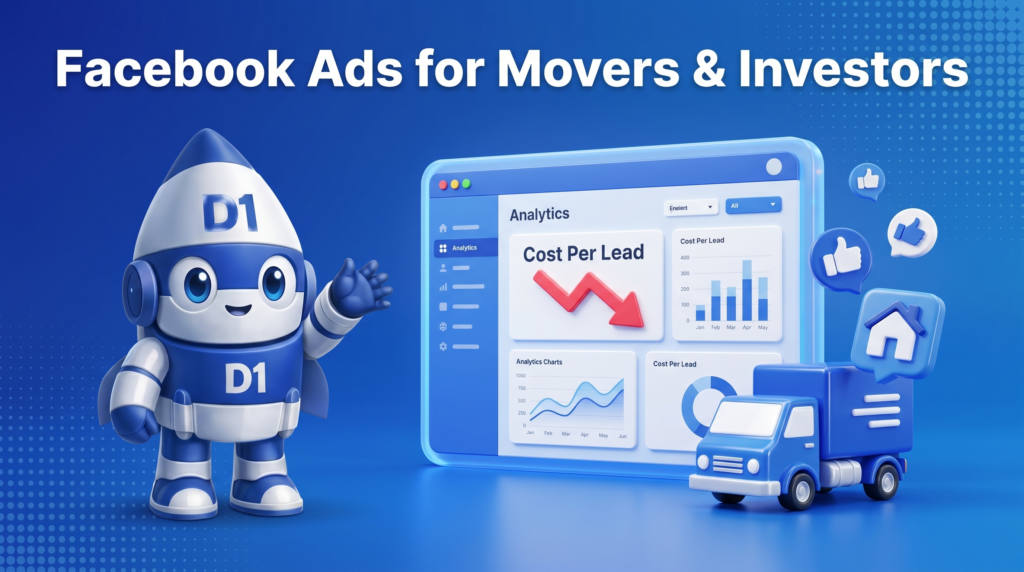
Facebook and Instagram ads are one of the cheapest ways for a moving company or real estate investor to generate leads in 2026 — often well below what the same lead costs on Google. The platform puts your offer in front of people who weren’t even searching yet, at a cost per lead that can start in the teens. The catch is that Facebook leads are colder than search leads, which means the entire game is won or lost on how fast and how well you follow up.
Get the targeting, creative, and follow-up right and Meta becomes a reliable, scalable lead source. Get any one of them wrong and you’ll burn a budget and conclude “Facebook doesn’t work.” Here’s the 2026 playbook for both verticals.
The 2026 Cost-Per-Lead Reality
Real numbers, because budgets depend on them. Across industries, Facebook’s cost per lead in 2026 runs roughly $28–$50, but the verticals we work in often come in cheaper when campaigns are built well:
- Moving companies: Facebook can generate consistent leads at a fraction of Google Ads cost. A sensible starting budget is $15–25/day, with 3–4 weeks for the algorithm to learn before you judge results.
- Real estate / motivated sellers: Real-estate cost per lead has been volatile but favorable — roughly $13–$35 through 2025–2026, with seller-lead campaigns commonly landing in the $25–$60 range depending on market. By comparison, Google often runs ~$66 for similar real-estate intent.
One important 2026 headwind for investors: the NAR commission settlement pushed more agents into paid acquisition, flooding the Meta auction and driving CPMs up 20–35% in major metros. Targeting precision and creative quality matter more than ever to keep costs down.
Why Facebook Leads Are Different From Google Leads
This is the concept that determines whether Facebook works for you. On Google, someone is actively searching “movers near me” or “sell my house fast” — they have intent right now. On Facebook, you’re interrupting someone scrolling who fit your targeting. They raised their hand because your offer caught them, but they weren’t actively shopping.
That has two consequences:
- Your creative does the qualifying. Since there’s no search intent, the ad itself has to attract the right person and repel the wrong one.
- Speed-to-lead is everything. A Facebook lead’s interest fades fast. If you call within five minutes you have a real conversation; if you call the next day, they’ve forgotten they filled out your form.
Movers and investors who treat Facebook leads like Google leads — slow, casual follow-up — always conclude the leads are “junk.” The leads are fine. The follow-up was too slow.
What Actually Works in the Creative
The ad is where most budgets are won or lost. What performs in these verticals:
For movers:
- Short video of your crew working — loading a truck, wrapping furniture, the empty house at the end. Motion beats static images.
- A specific, concrete offer: “Free moving quote in 60 seconds” or “$50 off your local move this month.”
- Local proof — your trucks, your city, real reviews.
For investors:
- Problem-first hooks that name the seller’s situation: “Behind on payments?”, “Inherited a house you don’t want?”, “Need to sell as-is, fast?”
- A clear, low-friction promise: “Get a fair cash offer in 24 hours. Any condition. No fees.”
- Real photos, not stock — sellers are scam-wary and authenticity converts.
Use Meta’s lead forms for the lowest friction, give the algorithm 3–4 weeks and enough budget to exit the learning phase, and test 3–4 creatives at a time rather than betting on one.
Cheap Leads Are Worthless Without a Follow-Up System
Here’s the part that separates profitable Facebook campaigns from expensive ones. A $20 lead that nobody calls is more expensive than a $60 lead you close, because it produced zero revenue. The math of Facebook ads is decided after the click.
The system that makes cheap leads profitable:
- Instant response. The moment a lead form submits, an AI voice or SMS agent reaches out within seconds — texting to confirm details and qualify while the lead is still warm. This is the single biggest ROI lever in paid social. See our speed-to-lead breakdown.
- Persistent follow-up. Most leads don’t convert on the first touch. Automated multi-day follow-up sequences (text, call, email) recover the ones that go quiet — without your team remembering to chase them.
- Everything in one CRM. Every lead lands in your CRM with its source, so you know your true cost-per-booked-job, not just cost-per-lead.
This is why we never sell Facebook ads as a standalone service. Paid traffic and the follow-up system are one product — the ads fill the top, the automation closes the bottom.
Don’t Judge Facebook by Cost Per Lead Alone
The number that actually matters is cost per booked job (or per closed deal), not cost per lead. A campaign at $40/lead that closes 1 in 5 beats a campaign at $20/lead that closes 1 in 30. Track all the way down the funnel, give campaigns the 3–4 weeks they need to optimize, and make decisions on revenue — not the vanity metric at the top.
Frequently Asked Questions
How much do Facebook ads cost for a moving company?
Start around $15–25/day and give the algorithm 3–4 weeks to learn. Cost per lead is often well below Google for movers; the real cost that matters is cost per booked job after follow-up.
What’s a good cost per lead for real estate investor ads?
Seller leads commonly run $25–$60, with real-estate CPLs sometimes as low as the teens. Metro markets cost more after 2025’s auction pressure. Focus on closing those leads fast, since they’re colder than search leads.
Why are my Facebook leads low quality?
Usually it’s slow follow-up, not bad leads. Facebook leads cool off within minutes. Combine tighter targeting and clearer creative with instant, automated follow-up and quality jumps.
Facebook ads or Google ads — which is better?
Different jobs. Google captures active searchers (higher intent, higher cost); Facebook creates demand cheaply from people not yet searching. Most movers and investors benefit from both, with Facebook often winning on raw cost per lead.
How fast do I need to follow up with a Facebook lead?
Within minutes — ideally seconds, automatically. Speed-to-lead is the biggest factor in whether paid social is profitable. AI voice and SMS make instant response possible 24/7.
Turn Facebook Ads Into Booked Jobs
Facebook ads can be the cheapest lead source you have — but only with the follow-up system that turns cold clicks into booked jobs. We run paid traffic for movers and investors wired directly to AI follow-up and a CRM, so every lead gets worked instantly and you can see your real cost per deal.
Book your free strategy call →
Or call us directly: (888) 330-1434.
D1TechCreative builds paid traffic, lead generation, CRM, and AI automation systems for service businesses across the United States. Based in Fort Lauderdale, FL.