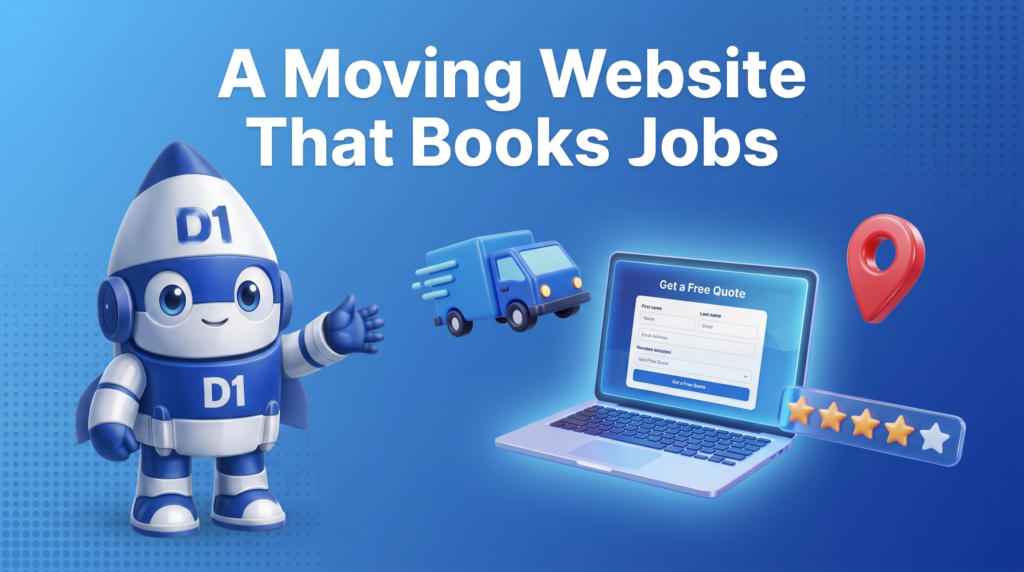
When a homeowner decides to move, the first thing they do is open Google and start clicking. Over half of all service searches now happen on a phone, and the decision of who to call is usually made in under a minute — on your website. If your site loads slowly, looks dated, or makes someone hunt for a quote button, they’re already back on the search results page tapping the next mover.
For a moving company, your website isn’t a brochure. It’s the single point where an expensive click — from Google, from a Facebook ad, from a Map Pack listing — either turns into a booked job or evaporates. Most movers spend money driving traffic to a site that quietly loses two-thirds of it. This is how to build the one that doesn’t.
Your Website Is the Most Expensive Part of Your Funnel to Get Wrong
Think about everything that happens before someone lands on your homepage. You paid for the ad, or you earned the SEO ranking, or a past customer referred you. That visitor is the result of real money and effort. The website is where all of that either pays off or doesn’t.
A weak moving site leaks leads in predictable ways:
- It takes more than three seconds to load, so a third of mobile visitors bounce before they see anything.
- There’s no obvious way to get a quote — just a phone number and a contact form buried in the menu.
- It doesn’t say which areas you serve, so out-of-area visitors waste clicks and in-area ones aren’t sure you cover them.
- There are no reviews or proof, so a first-time visitor has no reason to trust you over the mover ranked above you.
None of these are design opinions. They’re conversion leaks, and each one is a booked move you already paid to generate.
The 8 Things a Lead-Generating Mover’s Website Needs
A moving company website that books jobs is built around how people actually shop for movers. The essentials:
- An instant-quote or “request estimate” form above the fold. The first thing a visitor should see is a clear way to start. Ask for the few details that let you respond fast — move date, origin and destination zip, home size.
- Click-to-call on every screen. A sticky phone button on mobile. Many movers book the most jobs over the phone; make calling a one-tap action.
- Service-area pages. A page for each city or region you cover. These rank locally and reassure visitors you serve them. (More on this in our moving company SEO and Map Pack guide.)
- Real reviews and proof. Google reviews, before/after photos, a recognizable truck. Trust is what separates the call from the back-button.
- Clear services. Local, long-distance, commercial, packing, storage — spelled out so the right customer self-selects.
- Speed and mobile-first design. Compressed images, fast hosting, a layout built for a thumb. Page speed is a direct conversion lever.
- A booking calendar or scheduling step. Letting a qualified lead grab a slot or estimate window removes the back-and-forth that loses momentum.
- Follow-up wired in. Every form and call should drop straight into a CRM so no lead sits unanswered. This is the part almost everyone skips.
A Pretty Website Isn’t the Same as a Profitable One
Plenty of movers have a site that looks fine and still produces nothing. The reason is almost always the same: it was built as a digital business card, not as a lead system. It has no clear next step, no follow-up behind it, and no measurement of what’s working.
The fix is to treat the website as the front end of a smart funnel rather than a standalone page. A funnel is built around one job — turn a visitor into a booked estimate — and every element points at that outcome. The quote form, the phone button, the reviews, the service pages all exist to move one step forward, and what happens after the form submit matters as much as the page itself.
Speed-to-Lead: The Multiplier Most Movers Ignore
Here’s the uncomfortable truth about moving leads: a homeowner planning a move contacts three or four companies in the same sitting and books the first one that actually engages. The data on inbound leads is brutally consistent — the company that responds first wins the large majority of the time, and after about five minutes your odds fall off a cliff.
So a beautiful website that captures a lead at 9 p.m. and lets it sit until morning is still losing the job. That’s why the highest-ROI thing you can bolt onto your site isn’t a design tweak — it’s instant follow-up. When a form comes in or a call goes unanswered, an AI voice agent or SMS bot can respond in seconds, qualify the move, and book the estimate while the customer is still on your page. We go deep on this in our speed-to-lead guide.
The website captures. The follow-up closes. You need both, and they need to share one CRM so nothing falls through.
What a Mover’s Website Realistically Costs
Honest ranges for 2026:
- DIY builder (Wix, Squarespace): $200–$500/year. Fine for a brand-new operator, but rarely optimized for conversion or local SEO, and the follow-up is on you.
- Freelance / template build: $1,500–$5,000 one-time. Looks professional, but often a “set it and forget it” brochure with no lead system behind it.
- Lead-system build (website + funnel + CRM + follow-up): higher upfront and a monthly platform fee, but it’s an actual sales engine — one extra booked long-distance or commercial move usually covers months of it.
The right way to judge the cost isn’t the sticker price of the site. It’s cost-per-booked-job. A cheap site that converts 1% of traffic is far more expensive than a well-built one that converts 5%.
Frequently Asked Questions
Do moving companies really need a website in 2026?
Yes. It’s where nearly every lead — paid, organic, or referred — decides whether to contact you. Even referrals look you up before they call. No site, or a weak one, means losing jobs you’d otherwise win.
What’s the most important thing on a moving company website?
A fast, obvious way to get a quote or call, paired with instant follow-up. Capturing the lead is half the battle; responding before your competitor is the other half.
Why isn’t my moving website getting leads?
Usually one of three things: it’s slow on mobile, it has no clear call-to-action, or it has no follow-up behind the form so leads go cold. Fixing those three covers most cases.
How fast should my site respond to a new lead?
Within minutes — ideally seconds. The first mover to engage books the majority of moves. Automated SMS or an AI voice agent makes instant response possible 24/7.
Can a new website help me rank on Google?
A fast, well-structured site with service-area pages and reviews is the foundation of local SEO and the Map Pack. The site and the rankings work together.
Turn Your Website Into Your Best Salesperson
If your moving company website isn’t booking jobs, the problem is almost never that it needs to be “prettier.” It needs to load fast, make the next step obvious, and follow up instantly. We build moving company websites and funnels that do all three — wired to a CRM and AI follow-up so no lead goes cold.
Book your free strategy call →
Or call us directly: (888) 330-1434.
D1TechCreative builds AI-powered websites, lead generation, CRM, and automation systems for moving companies across the United States. Based in Fort Lauderdale, FL.