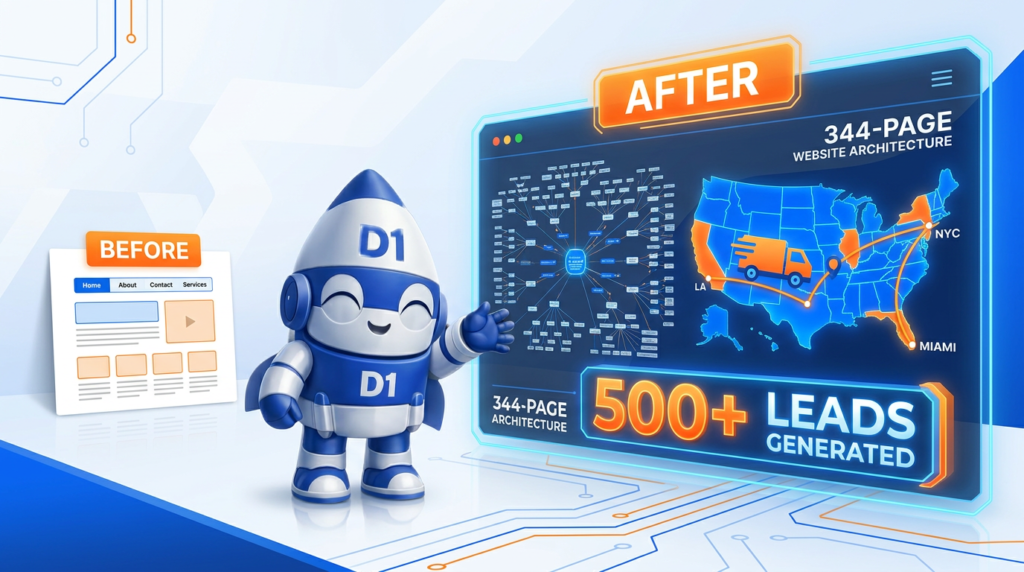
This is the story of how we rebuilt the digital footprint of a real moving company — A Plus Moving & Storage — and turned a six-page website into a 344-page nationwide lead engine in 30 days. Same brand. Same team. Different math.
If you run a moving company and you’re wondering whether SEO and paid social can actually move the needle for your business, this is what it looks like when the work is done right. No theory. Real numbers, real screenshots, real funnels.
You can see the live case study on our portfolio at d1techcreative.com/portfolio/a-plus-moving-and-storage/ — this blog post is the deeper “how we built it” version.
The Client: A Plus Moving & Storage
A Plus Moving & Storage is a long-distance moving company serving customers across the United States. When they came to D1TechCreative, they had the operational side of the business locked down — fleet, crew, capacity, insurance — but the marketing engine in front of all that was leaking pipeline at every step.
Their goal was simple: predictable, qualified long-distance moving leads. Specifically, homeowners actively planning interstate relocations who could be reached, qualified, and booked in days, not weeks.
The Before: A Six-Page Website Doing the Work of Sixty
Here’s exactly what they were working with when we took over:
- Home page
- About Us
- Contact
- A handful of generic service pages (one or two Service sub-pages)
Six live pages total. For a moving company that operates across nearly every state in the U.S., that’s about 1/50th of the surface area Google needs to see in order to rank you for the queries that drive moving business.
Every metro that mattered — Miami, Dallas, Atlanta, Phoenix, Chicago, Los Angeles, NYC — was sharing a single “Service Areas” mention buried somewhere in the footer. Every long-distance route their trucks actually ran — Miami → NYC, LA → Dallas, Florida → California — was invisible to search. Every helpful piece of content that homeowners actually Google in the weeks before a move (packing guides, box estimators, fleet logistics explainers) — also missing.
The site looked fine. It just had no surface area to rank on, and no funnel to convert the trickle of traffic it did get.
The Strategy: Surface Area + Speed of Build
Two decisions framed the entire engagement.
Decision 1: Massive SEO surface area, fast. Most moving company SEO programs take 6–12 months to produce 50–100 pages of optimized content. We decided to compress that into 30 days, with a 344-page architecture that covered every U.S. state, every major metro, every priority route, and every common pre-move question. Volume early, then iterate.
Decision 2: Paid social to bring revenue forward. SEO compounds over months; paid social produces leads tomorrow. We ran the two channels in parallel — paid Meta ads producing immediate booked moves while the SEO ecosystem indexed and started ranking.
That parallel structure — paid for now, SEO for compounding — is the model we use at D1TechCreative for almost every service business client with national or multi-state reach.
What We Built: The 344-Page SEO Ecosystem
The new site architecture mapped onto how real customers actually search for long-distance moves. Six page categories, all working together:
1. Location Pages
Service-area pages for every metro A Plus operates in — Miami, Tampa, Orlando, Fort Lauderdale, Atlanta, Dallas, Houston, Phoenix, Los Angeles, and dozens more. Each one with a localized H1 (“Long-Distance Movers in [City]”), custom intro copy mentioning local neighborhoods, local trust signals, and city-specific pricing context and FAQ. These pages rank for “movers in [city]” and “long distance moving company [city]” queries.
2. State Coverage Pages
State-level landing pages for all 48 contiguous states. Each one includes the regulations specific to that state (interstate vs intrastate, DOT requirements), the most common routes from and to that state, a directory of all cities served within that state, and a state-specific quote CTA. These pages rank for higher-funnel state-level queries — “long distance movers in [state]” — that local-only competitors miss.
3. City Landing Pages
Below state pages, we built city-specific pages for every major and mid-sized metro. Each one has neighborhood context, city-specific pricing ranges, local schema markup (LocalBusiness, PostalAddress, AreaServed), and city-specific testimonials. City pages are how you win the local “near me” intent without needing a physical office in every city.
4. Route Pages
This is where the architecture gets interesting. We built dedicated origin → destination pages for the most common interstate routes A Plus runs: Miami → NYC, Miami → LA, LA → Dallas, NYC → Florida, Dallas → Phoenix, Atlanta → Texas, and dozens more. These pages target queries like “movers from Miami to New York” or “long distance moving company Florida to California” — the exact phrasing of how high-intent customers search when they’ve already decided to move. Route pages convert at 2–3x the rate of generic service pages because they match the buyer’s mental model exactly.
5. Resource Guides
Long-form helpful content that earns organic traffic and backlinks while building trust: packing guides (room-by-room, fragile-items, electronics), box estimator tool, fleet operations explainers, move-day timeline guides, and storage decision guides. Resource content brings the top-of-funnel reader who’ll come back at decision time, and is the link bait that earns the backlinks that lift the entire domain.
6. Tools & Calculators
A box estimator and quote tools that capture lead info while delivering immediate value. These convert browsers into leads at much higher rates than static contact forms.
The full architecture:
| Before | After (30 Days) | |
|---|---|---|
| Total pages | 6 | 344 |
| New SEO pages | 0 | 338 |
| States covered | 1 | 48 |
| Route pages | 0 | dozens |
| Resource guides | 0 | full library |
By day 30, the site went from invisible to Google to a fully indexed national lead engine — and the first 28,200 search impressions started landing.
The Paid Social Layer: 500+ Long-Distance Moving Leads
While SEO compounded in the background, we ran the immediate-revenue layer in parallel. The math on paid social for a moving company is brutal if you do it wrong and beautiful if you do it right.
Facebook Lead Generation Campaigns — targeting homeowners actively researching long-distance moves. Custom audiences built from website visitors, lookalike audiences seeded from existing customers, and interest-based targeting layered with intent signals.
Instagram Advertising Campaigns — visual storytelling for the brand. Real trucks, real crews, real moves. The kind of social proof that homeowners screenshot and send to their spouse before requesting a quote.
Conversion-Focused Landing Pages — dedicated, branded landing pages built specifically for paid traffic. Single CTA, instant quote form, trust signals above the fold, no nav distractions. Conversion rate dramatically higher than directing paid traffic to the homepage.
500+ Qualified Moving Leads Generated — homeowners with active relocation timelines, contact info, route details, and quote requests.
This is also where the speed-to-lead layer matters. Every Meta lead got routed into the CRM with sub-5-minute follow-up. A lead that converts on Facebook at 11pm Saturday is a competitor’s lead by Monday morning if no one responds. Fast follow-up is the multiplier on every paid ad dollar — something we covered in detail in our Speed to Lead playbook.
The Tech Stack Under It All
Google Search Console — 344 pages submitted in a single XML sitemap, indexing requested in batches to stay under daily quotas, weekly coverage and performance monitoring set up.
Google Analytics 4 — conversion events on form submits, phone-click tracking, traffic-source attribution. Every paid ad dollar tied back to leads and quotes via UTM tracking.
Yoast SEO (every page) — custom title tag, custom meta description, focus keyword, internal linking, breadcrumbs, and schema on every single page. No “default” Yoast output anywhere.
FAQ Schema — structured data on every page with a FAQ section. Google rewards FAQ schema with expanded SERP listings, which lift CTR by 20–30%.
LocalBusiness + AreaServed Schema — on every city and state page, so Google understands the geographic relationships.
301 Redirects — every old URL from the original six-page site mapped to its closest equivalent on the new site. No 404s, no lost equity, no broken inbound links.
Internal Linking Architecture — state pages link to their cities, city pages link to their routes, routes link back to states and to relevant resource guides. The site is a tightly-knit hub that distributes link equity from the homepage out to every corner of the architecture.
This is the part most agencies cut corners on. The page count without the schema, redirects, and internal linking is just bulk — and Google has spent the last decade getting better at distinguishing bulk from actual relevant depth.
The Results So Far
- 500+ qualified Meta leads generated through the Facebook + Instagram paid layer
- 28,200 search impressions in the first reporting window from the new SEO ecosystem
- 48 states covered with dedicated state-level content
- 30 days from kickoff to full launch — full site live, paid running, GSC verified, GA4 firing
- 6 → 344 pages — a 57x increase in indexable surface area
The SEO impressions number is the leading indicator that matters most. When a 344-page architecture indexes in 30 days and starts pulling 28K+ impressions, that’s a sign Google is taking the new site seriously. Click and conversion data compound from there as positions move from page 4–5 to page 1.
The paid leads are the lagging indicator that matters most to the bottom line. 500+ leads in the same window means the business is funded for the next phase of growth.
What Other Moving Companies Can Learn From This
1. Page count matters, but only if every page actually answers a real query. 344 pages of generic boilerplate would have been useless. 344 pages mapped to real geographic and route intent is a lead engine.
2. Paid social is not a replacement for SEO — it’s the bridge to it. You need leads in months 1–6 while SEO indexes. Run both. Don’t pick one.
3. Speed-to-lead is the unlock on every channel. Whether a lead comes from a Facebook ad or an organic search, the close rate is determined in the first 5 minutes. We built A Plus’s CRM and AI-assisted follow-up layer so every inbound lead gets a real conversation in under 60 seconds.
4. The right CRM matters more than the website. A beautiful website that dumps leads into a chaotic inbox is a tragedy. Every page A Plus launched feeds into a CRM where leads are tracked from first click to booked job.
5. National coverage is buildable, fast. If you operate across multiple states, you don’t have to grow city-by-city over years. The right SEO architecture can light up a national footprint in 30 days.
What This Looks Like for Your Moving Company
- Local-only: 60–120 pages, focused on your service metros, GBP optimization, local link building, sub-5-minute follow-up
- Regional (3–10 states): 150–250 pages, state and route coverage, paid social parallel
- National: 300+ pages, full state/city/route architecture, paid social parallel, AI voice + SMS follow-up
The work is real, the timelines are tight, and the ROI math typically pays back the build within 60–90 days for any moving company spending more than $1,500/month on traffic.
Frequently Asked Questions
Did you really build 344 pages in 30 days? Yes — 344 live, indexed pages within 30 days of kickoff. The architecture, copy templates, and schema were systematized so each page type could be built fast without sacrificing quality.
How much did the build cost? Specific client pricing is confidential, but a 300+ page SEO ecosystem with paid social parallel typically lands in the $8K–$15K setup range plus ongoing management. For a moving company doing $50K+/month in revenue, the payback math is usually 60–90 days.
Can you do this for a local-only moving company? Yes, with a different architecture. A local-only operator doesn’t need state and route pages — they need deep neighborhood content, hyper-local citations, and a Google Business Profile dialed in. The framework adjusts to the geographic scope.
What does the lead handoff look like? Every paid lead flows into the CRM with full attribution (which ad, which audience, which creative). AI voice + SMS follow-up triggers within 60 seconds. A human sales rep takes over the moment the AI either closes the qualifying conversation or hits its routing threshold.
How long until SEO results show up? For a build this aggressive, meaningful impressions start within 30 days. Meaningful clicks and conversions from organic typically start showing in month 3–4. Steady-state organic lead flow kicks in around month 6–9.
Can I see the live site? Yes — check the A Plus Moving portfolio entry on D1TechCreative for the full case study including screenshots, brand colors, and the page-type breakdown.
Want the Same for Your Moving Company?
We build SEO ecosystems, paid social funnels, AI voice + SMS follow-up, and full CRM systems for moving companies across the U.S. From local-only operators to national long-distance fleets, the framework adjusts — the underlying principle (massive surface area + fast follow-up + clean attribution) stays the same.
Book your free strategy call →
Or call us directly: (888) 330-1434.
D1TechCreative builds AI-powered lead generation, SEO ecosystems, paid social campaigns, and CRM systems for moving companies and other service businesses across the United States. Based in Fort Lauderdale, FL.