SMS is the highest-converting marketing channel for service businesses in 2026. Open rates above 95%. Response rates 7–10x higher than email. Average click-through rates above 19%. The math is uncatchable by any other channel.
It’s also the channel where the most lawsuits get filed. Every week, plaintiffs’ attorneys file TCPA cases against businesses that ran perfectly well-intentioned SMS campaigns without realizing they were liable for $500–$1,500 per text.
This is the practical guide. What SMS marketing actually delivers in 2026, how to use it without getting sued, and the sequences that drive the most bookings for service businesses.
Why SMS Outperforms Every Other Channel
The data has held steady for five years:
- Email open rate: 18–22%
- SMS open rate: 95–98%
- Email response rate: 1–3%
- SMS response rate: 19–30%
- Email click-through rate: 2–4%
- SMS click-through rate: 19–26%
For a service business, that means a 1,000-contact list sends 1 email and gets ~25 clicks. The same list sends 1 SMS and gets ~220 clicks. An order of magnitude.
The mechanism is simple: phones are always within arm’s reach, SMS notifications cut through, and people read texts within minutes of receipt. Email is a 24-hour decision window; SMS is a 5-minute decision window.
The TCPA Bottom Line You Cannot Forget
Every SMS marketing program for a service business in 2026 must have:
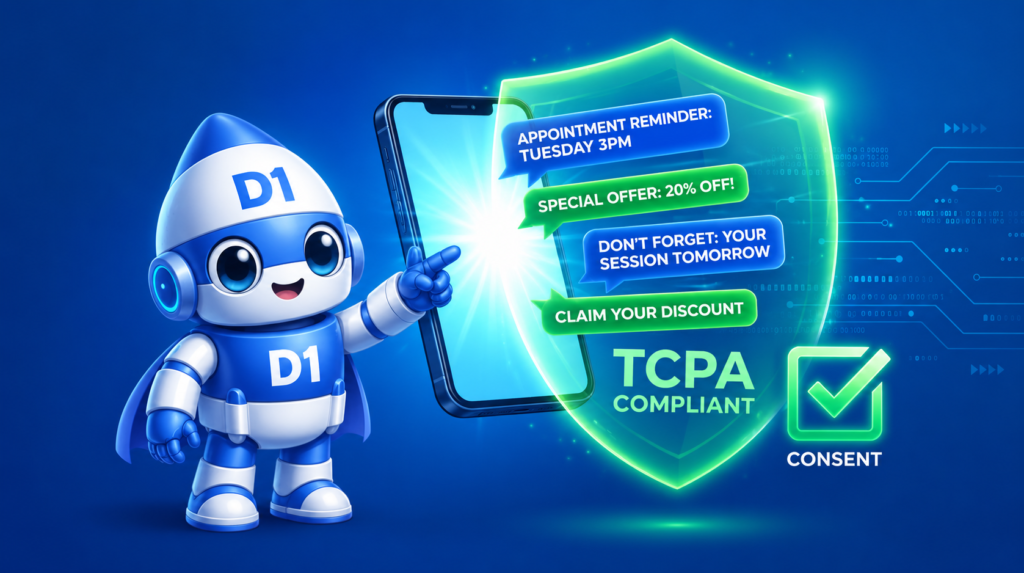
Express written consent before any marketing SMS.
Express written consent means:
– A specific opt-in (not pre-checked, not buried)
– Disclosure that the consumer will receive marketing texts
– Disclosure of message frequency (“up to 4 messages per month”)
– Disclosure of data rates (“Msg & data rates may apply”)
– Disclosure of opt-out (“Reply STOP to unsubscribe”)
– Timestamped record of the consent (audit-ready)
Anything less and you’re personally liable for $500–$1,500 per text under the TCPA. Class actions can cost $50,000–$5 million+. The biggest TCPA settlement in the last five years was over $100 million.
Get the consent layer right before sending the first text. No exceptions.
Where to Collect SMS Consent (And Where Not To)
Compliant consent collection:
- Website form with explicit checkbox: “Yes, send me appointment reminders, service updates, and occasional promotions via SMS. Msg & data rates may apply. Reply STOP to unsubscribe.”
- In-store sign-up with the same disclosure visible
- Quote calculator submission with the same disclosure
- Post-service follow-up form explicitly asking for SMS opt-in
- AI voice agent collecting verbal consent with recording stored
NOT compliant:
- “By submitting this form you agree to receive texts” — too buried
- Pre-checked opt-in boxes (illegal in many states)
- Importing a contact list bought from a third party
- Adding existing customers without re-opting them in
- Sending to anyone who replied STOP, ever, even if they later opt back in via a different channel
The audit standard: if you were sued tomorrow, could you produce the timestamped opt-in record for the recipient in court? If no, don’t send.
The SMS Sequences That Drive Most Revenue
Across hundreds of service business SMS programs we’ve built at D1TechCreative, the highest-ROI sequences are these five:
1. The 60-Second Lead Response
The most important sequence. When a lead submits a form:
- +5 seconds: “Hi [Name], thanks for the inquiry on [service]. I’m calling in 60 seconds — pick up so we can get this booked.”
- +5 minutes if no call: “Hi [Name], I tried calling — can I text you a few quick questions to get your appointment set up?”
- +30 minutes if no response: “[Name], here’s a link to book a time that works for you: [calendar link]. We can get you on the schedule this week.”
Single highest-ROI message in any service business marketing stack.
2. Appointment Confirmation + Reminder
Reduces no-shows by 30–60%:
- 24 hours before: “Hi [Name], confirming your [service] appointment tomorrow at [time]. Reply YES to confirm or RESCHEDULE to change.”
- 2 hours before: “[Name], your appointment is in 2 hours at [address]. See you soon!”
- 15 minutes before (technician’s arrival): “Your technician [Name] is on the way and will arrive in 10–15 minutes.”
3. Post-Service Review Request
Drives Google reviews — the #1 local SEO factor:
- +1 hour after service: “[Name], thanks for choosing [Business]! How did we do? If you have 30 seconds, we’d love a Google review: [direct link]”
- +24 hours if no response: “[Name], a quick review would mean the world to us. Tap here: [direct link]”
4. Estimate / Quote Follow-Up
Recovers stalled deals:
- +2 days after estimate sent: “Hi [Name], wanted to check in on your [service] estimate. Any questions I can answer?”
- +5 days after: “[Name], the estimate is still good — want to lock in the [day] availability? Tap here to book: [link]”
- +10 days after: “Final check-in on your [service] project. Want to chat for 5 minutes about next steps?”
5. Reactivation Campaign
Brings back customers from 6+ months ago:
- “[Name], it’s been a while! We’re offering [seasonal promotion] this month. Interested in a free [inspection / quote]?”
- Limit to once per quarter to avoid SMS fatigue.
What NOT to Send via SMS
Avoid these or unsubscribe rates spike:
- Long-form marketing copy (text is not email)
- Multiple messages per week to the same contact
- Anything that doesn’t have a clear call-to-action
- Generic promotions with no personalization
- Messages outside 8am–9pm local time (illegal under TCPA)
- Anything that contradicts the original consent disclosure
The SMS channel collapses fast if it’s abused. Treat every send like it’s the last one the customer will allow.
The 6-Message-Per-Month Ceiling
Service businesses that send more than 6 marketing SMS messages per contact per month see unsubscribe rates spike from 1–2% to 8–15%. Stay below the ceiling.
The math: a 5,000-contact list that holds at 1% unsubscribe loses ~50 contacts per month. The same list at 12% unsubscribe loses 600. That’s 10 months from a working list to a dead list.
Discipline on send volume is what keeps the channel viable for years.
The Hidden ROI Multiplier: Two-Way Conversations
The biggest mistake service businesses make with SMS is treating it as broadcast-only. The real value is two-way:
- Customer replies to an appointment reminder with “can I reschedule?” — AI or staff handles the rebook
- Customer replies to a quote with “what about a smaller version?” — sales rep responds within minutes
- Customer replies to a review request with “actually we had an issue” — service recovery happens before a 1-star review hits Google
Build the system to handle inbound. The conversational layer is where the revenue lift compounds — and it’s where AI voice + SMS agents earn their cost back many times over.
What an SMS Program Costs in 2026
Honest pricing:
- Twilio raw infrastructure: $0.0075 per outbound SMS in US
- Software layer (Klaviyo SMS, Attentive, EZ Texting): $50–$500/month + per-message fees
- GoHighLevel SMS add-on: $97/month base + per-message fees
- D1TechCreative custom SMS stack: $400–$1,000/month operating + integrated with CRM and AI voice
For most service businesses with 1,000–10,000 contacts, the right SMS spend is $200–$800/month all-in. The ROI on that spend, properly executed, is typically 8–20x.
The 30-Day Implementation Plan
Week 1: Compliance foundation
– Add TCPA-compliant opt-in language to every form on the site
– Write the SMS disclosure language (have an attorney review)
– Set up opt-in record storage in the CRM
– Configure STOP/HELP keyword automation
Week 2: First three sequences
– Build the 60-second lead response sequence
– Build the appointment confirmation + reminder sequence
– Build the post-service review request sequence
– Test all three with internal team members
Week 3: Soft launch
– Roll out the 60-second response to all new leads
– Roll out reminders to all booked appointments
– Roll out review request to all completed jobs
– Monitor delivery rates, unsubscribe rates, response rates
Week 4: Expansion
– Build estimate follow-up sequence
– Build reactivation campaign for cold customers
– Set up weekly reporting dashboard
– Document the playbook for the team
By day 30, SMS should be producing measurable lift in appointments booked, no-show reduction, and review volume.
Frequently Asked Questions
Can I send SMS to my existing customer list without explicit SMS consent?
In most cases, no. Existing customer relationships don’t automatically extend to SMS marketing under TCPA. Re-opt them in with a clear, compliant invitation.
What’s the difference between transactional and marketing SMS?
Transactional SMS (appointment reminders, order confirmations, password resets) generally needs lower consent friction than marketing SMS. But many states treat them similarly, so safest practice is to get explicit consent for both.
Can I use AI to write SMS copy?
Yes — but every send still needs to comply with TCPA and contain accurate information. AI accelerates copy production; it doesn’t change the consent or content requirements.
What’s the best time of day to send SMS to service business customers?
10am–12pm and 4pm–6pm local time produce the highest response rates. Never send before 8am or after 9pm (legally restricted in most states).
How often can I send marketing SMS without unsubscribes spiking?
Keep marketing-only messages to 4–6 per month per contact. Transactional messages (confirmations, reminders) can be more frequent because they’re requested.
Do I need a lawyer to set up SMS marketing?
For the initial compliance language and opt-in flow, yes — an hour of a marketing attorney’s time is the cheapest insurance you’ll ever buy in this channel.
What’s the single biggest SMS marketing mistake?
Sending without timestamped consent records. When the TCPA lawsuit lands, the consent record is what either ends the case or costs you six figures. Build the record-keeping system first.
Want an SMS Marketing Stack Built for Your Business?
We build TCPA-compliant SMS marketing programs for service businesses across the U.S. — opt-in flows, automated sequences, AI-powered conversational replies, integrated with your CRM. Book a free strategy call and we’ll audit your current setup and map out exactly what your build would look like.
Book your free strategy call →
Or call us directly: (888) 330-1434.
D1TechCreative builds SMS marketing programs, AI voice agents, CRM systems, and full marketing automation for service businesses across the United States. Based in Fort Lauderdale, FL. We are not attorneys; consult a qualified attorney for TCPA compliance specific to your business.