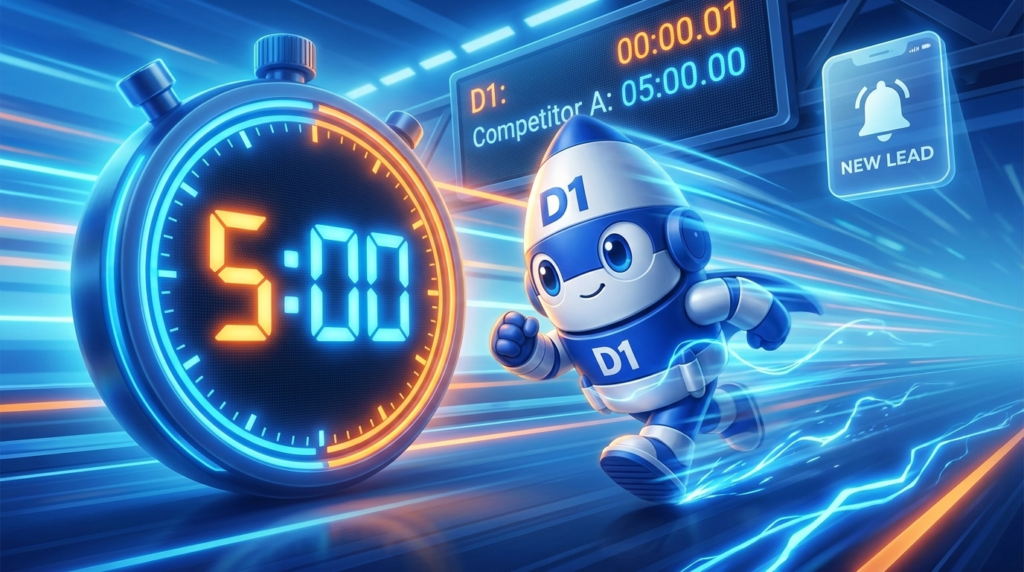
There’s one variable in service business sales that affects close rate more than every other variable combined. Not the headline on your landing page. Not your pricing. Not your follow-up email copy. Not your sales rep’s training.
It’s how fast you respond to a new lead.
The data has been consistent for 15 years, across every vertical anyone has bothered to measure. The MIT Lead Response Management Study, the InsideSales benchmarks, the Harvard Business Review follow-ups, the dozens of agency-published case studies. The pattern holds:
- Respond in under 5 minutes → you close at the highest rate possible for your offer
- Respond in 5–30 minutes → your close rate drops 21x
- Respond in 1+ hours → your close rate drops 60x
- Respond next-day → you’re essentially nurturing, not selling
The brutal version: a lead that gets called in 6 hours is worth roughly 1/60th of one that gets called in 5 minutes. Most service businesses are spending real money to generate leads they then destroy by responding slowly.
This is the playbook for fixing it.
Why Speed Matters So Much
Three psychological forces compound in the first 5 minutes of a lead’s life:
1. Intent decays fast. When a homeowner fills out a “get a free roof inspection” form, they’re at peak intent in that moment. Their roof is leaking, they just remembered, they’re thinking about it. Five minutes later they’re on a Zoom call for work, dinner is being made, the kids are interrupting. Intent is highest now.
2. They’re comparison-shopping in parallel. The same homeowner who just filled out your form just filled out two competitors’ forms. Whoever calls first gets the conversation. Whoever calls second gets the “thanks, we already talked to someone.”
3. Speed signals professionalism. A 90-second callback feels like a real business that takes the customer seriously. A 6-hour callback feels like an afterthought. Buyers extrapolate from speed to every other dimension of your business.
The compounding is why the close-rate drop is non-linear. It’s not 2x slower → 50% close rate. It’s 6 hours slower → 2% close rate.
What “5 Minutes” Actually Means in 2026
The 5-minute benchmark from the original MIT study is now table stakes — competitive markets demand faster. Here’s the current operating standard for high-performing service businesses:
- <60 seconds — SMS text confirmation auto-sent to the lead
- <60 seconds — AI voice agent calls the lead OR a human dials
- <3 minutes — Live human conversation initiated
- <5 minutes — Discovery / qualification complete, booking or next step set
- <24 hours — Multi-channel follow-up sequence kicks in for unreached leads
Anything slower than this in a competitive market and you’re paying for traffic that’s converting for someone else.
The Math: Why Speed Beats Spend
Pretend you’re running a moving company. You’re spending $5,000/month on Google Ads. You generate 50 leads. Your current response time averages 4 hours because your team picks up forms during slow periods.
At 4-hour response:
– 50 leads × 3% close rate = 1.5 booked jobs
– Cost per job = $3,333
Now imagine you cut response to under 5 minutes via AI voice + SMS follow-up:
– 50 leads × 18% close rate = 9 booked jobs
– Cost per job = $556
Same ad spend. Same lead volume. 6x more booked jobs. That’s the leverage. The single highest-ROI investment you can make in your business in 2026 isn’t more traffic — it’s faster response to the traffic you already have.
How Most Service Businesses Are Doing It (Badly)
Walk through a typical small-to-mid service business’s lead flow. The form submission lands in:
- The business owner’s email inbox (notification)
- A spreadsheet or basic CRM
- Sometimes a Slack channel
- Sometimes a Twilio SMS to the owner
Then what?
- Owner is in a sales call → doesn’t see the lead for 90 minutes
- Or in the field → doesn’t see the lead until evening
- Or asleep → 8+ hour delay if the lead came in overnight
- Owner forwards lead to a sales rep → another 30 minutes lost
- Sales rep finally calls 4 hours later
That’s the standard. And it’s killing 75–90% of the conversion potential of every lead.
The fix is automation that runs the first 60 seconds without a human in the loop, then escalates to a human as soon as one is available.
The 60-Second Automated Response Stack
The pattern that works in 2026:
0 seconds — Form submitted. Lead’s data lands in the CRM with full source attribution (which ad, which keyword, which page).
5 seconds — SMS auto-sent. “Hi [Name], thanks for the inquiry on [service]. I’m calling you in 60 seconds — pick up so we can lock in your appointment.” This single message dramatically improves answer rate on the inbound call.
10 seconds — Calendar slot reserved. The next available consultation slot is held for 5 minutes pending the call.
60 seconds — AI voice agent dials. A real conversational AI calls the lead, says the business name, references what they filled out, and tries to either (a) book the appointment directly, (b) route to a live human if one is available, or (c) schedule a callback at a time the lead chooses.
5 minutes — Human takeover. If the AI didn’t reach the lead, a human gets a CRM notification with full context (what the lead asked for, what the AI tried, current call status).
1 hour — Email follow-up sent. Personalized email with a recap, a calendar link, and the proposal (if applicable).
24 hours — Second SMS follow-up. Soft nudge, no-pressure check-in.
3 / 7 / 14 / 30 day cadence for unconverted leads. Multi-channel.
That’s the standard playbook. It works. It’s the same one we build at D1TechCreative for every service business client.
Why You Can’t Do This With a Human Team Alone
The math on humans-only response:
- 50 leads/day, 7 days/week = 350 leads/week
- Each lead requires 5 minutes of attempt time minimum
- 350 × 5 = 1,750 minutes = 29 hours of human time per week just for initial response attempts
- That’s nearly one full-time hire just answering leads
And humans can’t operate at 90-second-response speeds 24/7. They eat, sleep, go on vacation, and have other tasks. The leads that come in at 11pm Saturday wait until Monday morning.
The hybrid model — AI for first contact, humans for closing — is the only way to maintain sub-5-minute response at scale.
The Hidden Cost of Slow Response: Your Existing Pipeline
It’s not just new leads that suffer from slow response. Existing pipeline leaks too:
- A lead asks a follow-up question, you reply 4 days later → they’ve already booked with a competitor
- A booked customer texts to reschedule, no one responds → they’re calling around for someone else
- A past customer asks about an additional service → ignored for a week, they go elsewhere
Every minute of delay across the entire customer lifecycle is leaking revenue. Speed-to-lead automation is really just the visible tip of “speed-to-everything” — and businesses that fix speed-to-lead almost always discover the same fix applies to existing customer conversations.
What Speed-to-Lead Does NOT Solve
It’s worth being honest. Fast response doesn’t fix:
- A bad offer
- An overpriced service in a price-sensitive market
- A website that doesn’t convert visitors into leads in the first place
- A team that doesn’t know how to close once they’re talking to a buyer
Speed-to-lead is the multiplier on everything else. If your offer is broken, faster response just gets you rejected faster. Fix the offer first, then add speed.
How to Audit Your Current Response Time
Five-minute audit you can do today:
- Submit a fake lead to your own website using a friend’s phone number.
- Time how long until someone calls. From form submit to ring.
- Time how long until someone texts. Same metric.
- Repeat at 11pm on a Saturday. Most businesses fail this test catastrophically.
- Check your CRM: are inbound leads tagged with response timestamps?
If your weekday response time is over 15 minutes, you have a 5x revenue lift available right now from automation. If your weekend response is over 4 hours, you have a 10x lift available.
The 14-Day Implementation Sprint
Days 1–2:
– Pick the speed-to-lead stack (AI voice + SMS + CRM integration)
– Map your current lead flow end-to-end
– Identify all lead intake points (forms, phone, social DMs, email)
Days 3–5:
– Build the AI voice agent scripts for each lead type
– Build the SMS sequence templates
– Wire calendar integration into the AI
Days 6–8:
– Test internally with team members submitting fake leads
– Listen to AI conversations, tune the scripts
– Set up escalation rules: when does the AI hand to a human?
Days 9–11:
– Soft launch — only after-hours leads go through automation
– Monitor every conversation, fix what breaks
– Tune the SMS copy based on actual response rates
Days 12–14:
– Roll out to all hours
– Set up the reporting dashboard (response time, AI vs human conversion, lead source ROI)
– Document the playbook so new hires can maintain it
By day 14, you should be averaging under 2-minute response on 95%+ of leads. By day 30, you’ll see the conversion rate lift clearly in the data.
Frequently Asked Questions
What’s the actual “ideal” response time in 2026?
Under 60 seconds for SMS confirmation, under 5 minutes for human or AI voice conversation. Faster is always better but the returns diminish below 60 seconds.
Does AI voice work for high-trust verticals like financial services?
Yes, when set up properly with transparent disclosure (“Hi, this is the AI assistant for [Business Name]”). For sensitive conversations the AI’s job is to verify identity and route to a human fast — not to close. Transparency about the AI doesn’t reduce conversion in any data we’ve tested.
Will customers be annoyed by such fast responses?
The opposite, in nearly every measured case. Fast response signals professionalism. The complaints come when response is slow, not fast.
How much does a speed-to-lead stack cost?
Off-the-shelf tools are $99–$500/month. Custom-built integrations with full CRM, calendar, and multi-channel follow-up are $1,500–$3,500 setup plus $400–$1,000/month operating. ROI typically pays back in 30–60 days.
Can I just hire more humans instead of automating?
You can, but you’d need 24/7 coverage which means 4–5 hires at $35K–$50K each, plus management. The automation approach hits the same conversion lift at roughly 5% of the cost.
How does speed-to-lead affect Google Ads ROI?
Dramatically. Paid traffic is the most time-sensitive type of lead because the visitor is actively shopping competitors in the same browser session. Cutting response time from 4 hours to 5 minutes on paid leads typically lifts close rate by 4–6x.
What’s the single highest-leverage change a business can make in 2026?
For service businesses spending $1K+/month on lead generation, building the sub-5-minute response stack is almost always the answer. Bigger lift than another ad campaign, a redesigned website, or a better landing page.
Want a Sub-5-Minute Response Stack Built for Your Business?
We build the full speed-to-lead stack — AI voice agents, SMS follow-up, CRM integration, multi-channel sequences — for service businesses across the U.S. Book a free strategy call and we’ll audit your current response time and map out what a build would look like for your business.
Book your free strategy call →
Or call us directly: (888) 330-1434.
D1TechCreative builds AI voice agents, SMS automation, CRM systems, and full speed-to-lead infrastructure for service businesses across the United States. Based in Fort Lauderdale, FL.