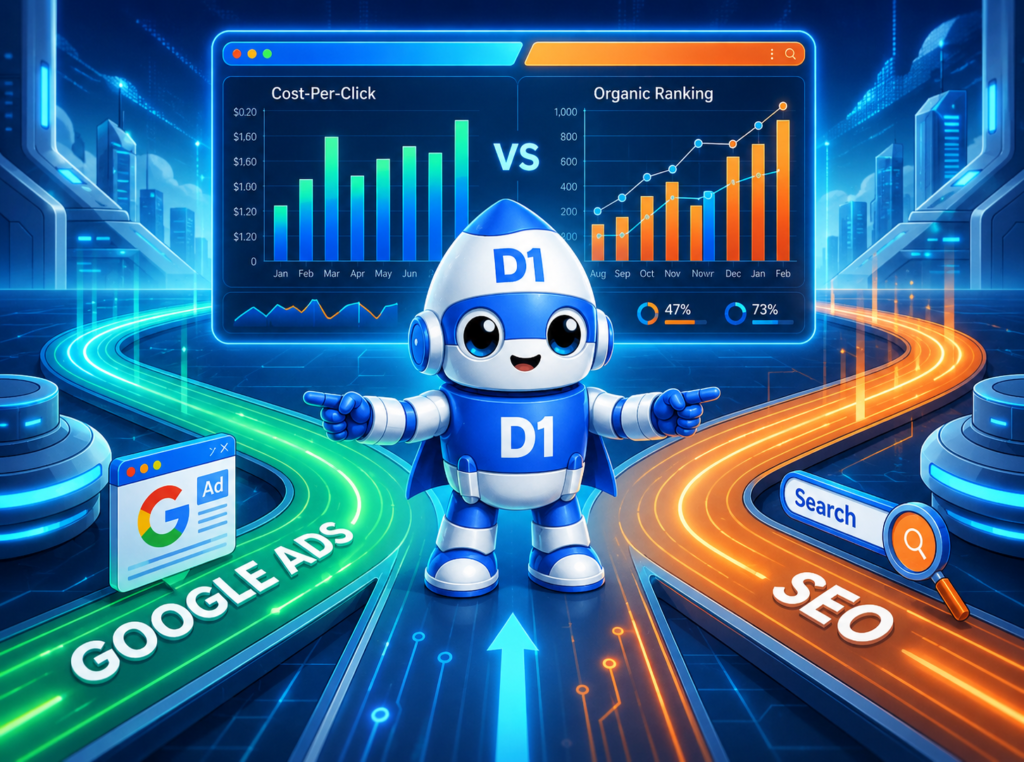
Every service business owner asks the same question within 30 seconds of looking at a marketing budget: Google Ads or SEO? The answer most agencies give — “both, because we sell both” — isn’t wrong, but it isn’t useful either. The right answer depends on three things: how much cash you can put at risk this quarter, how soon you need the phone to ring, and how much patience you have for compounding.
This post breaks down the real costs, real timelines, and real conversion math for service businesses in 2026. No fluff. By the end you’ll know which channel makes sense for your stage — and when to add the second.
What Google Ads Actually Costs in 2026
Costs have climbed every year for the last five. Across the service-business verticals D1TechCreative works in, average cost-per-click in 2026 looks roughly like this:
- Moving services: $8–$22 per click
- Solar: $15–$60 per click
- HVAC / plumbing: $12–$35 per click
- Real estate (we-buy-houses): $20–$80 per click
- Insurance: $25–$120 per click
- Legal: $40–$300+ per click
Conversion rates from click to lead average 8–15% for well-built landing pages, dropping to 2–4% for poorly built ones. Lead-to-customer conversion sits between 10–35% depending on follow-up speed and quality.
Run the math for a typical moving company:
- $15 CPC × 100 clicks = $1,500 ad spend
- 10% landing page conversion = 10 leads
- 25% lead-to-job = 2.5 booked moves
- $1,500 ÷ 2.5 = $600 cost per booked job
That’s profitable if your average job is $2,500+. It’s a disaster if your average job is $800. The math punishes thin margins.
What SEO Actually Costs in 2026
SEO has no per-click cost, but it has real costs in time and money. A realistic 2026 SEO program for a service business breaks down as:
- Content production: $300–$800 per article × 4–8 articles/month = $1,200–$6,400/month
- Technical SEO + on-page optimization: $500–$1,500/month
- Local SEO / GBP management: $300–$1,000/month
- Link building / digital PR: $500–$3,000/month
- Total: $2,500–$10,000/month for a credible program
Or DIY at zero cash but real time cost — about 12–20 hours/month of focused work, which means an opportunity cost of $1,200–$4,000/month even for a small operator who values their own time at $100/hour.
The catch: SEO produces zero leads in month one. Real organic traffic kicks in around month 4–6 and compounds from there. By month 12 a well-run program typically delivers 30–80% of total lead volume.
The Honest Pros and Cons
Google Ads — Strengths
- Leads tomorrow. Set up an account today, leads start arriving within 48 hours.
- Fully measurable. Click → lead → sale, with tight attribution.
- Scalable on demand. Need 3x leads next month? Triple the budget.
- Geographic precision. Target zip codes, radius around your office, even neighborhoods.
- Works for any vertical. Even niche services have ad inventory.
Google Ads — Weaknesses
- Stops the moment you stop paying. Every month is a fresh blank slate.
- Costs rise as competitors enter. Your CPC in 2027 will be higher than 2026, almost guaranteed.
- Quality leads are expensive. Cheap clicks mean comparison shoppers; quality clicks mean enterprise-grade CPC.
- Click fraud is a 5–20% tax in competitive verticals — invisible bot clicks, competitor click bombing.
- Requires constant management to stay efficient.
SEO — Strengths
- Compounds over time. Articles published in month 3 still generate leads in year 3.
- Lower cost per lead at scale. Once ranking, cost per lead drops to single-digit dollars.
- Higher trust signal. Buyers trust organic results more than paid ads.
- Multi-keyword coverage. A single article can rank for dozens of related queries.
- Asset value. A ranking website is a real business asset; an ad account isn’t.
SEO — Weaknesses
- 6–12 month runway before meaningful traffic appears.
- Requires consistent content production. Skip 3 months and rankings slip.
- Algorithm risk. Google updates can move you 2–5 positions overnight.
- Local SEO is competitive. The Map Pack in any major city is brutal.
- Hard to scale on demand. You can’t “buy” more leads next month.
The Real Answer: It Depends on Where You Are
Here’s how to choose — based on actual revenue stage, not theory.
Stage 1: $0–$50K/month revenue
Pick Google Ads first. You need cash flow this month, not in 9 months. Budget $1,500–$3,000/month for paid traffic and focus 100% of attention on dialing in landing page conversion and speed-to-lead. SEO is a luxury at this stage.
Stage 2: $50K–$200K/month revenue
Run both, but lean paid. Maintain $3,000–$8,000/month in Google Ads while starting a 4-articles-per-month SEO content program. The paid is paying the bills; the SEO is the long-term asset you’re building in the background.
Stage 3: $200K–$1M/month revenue
Run both, lean SEO. By this stage SEO should be producing 30–50% of leads at half the cost-per-lead of paid. Paid becomes the demand-spike management tool: increase spend when you have capacity, dial back when you don’t. SEO is the steady baseline.
Stage 4: $1M+/month revenue
SEO + paid + everything else. YouTube, podcasts, partnerships, PR, and a 10-articles-per-month content program. Paid still matters but is one channel among many.
The Channel That Matters Most: Speed of Follow-Up
Here’s the harsh truth most agencies don’t tell you: the channel matters less than what happens in the 60 seconds after a lead converts.
A $50 click that gets a human callback in 90 seconds outperforms a $5 click that gets a callback in 4 hours. Every time. The leads from paid traffic are more time-sensitive than organic leads, because the paid visitor is comparison shopping on three other sites in the same browser session.
This is where AI voice and SMS agents change the economics. A $1,500 Google Ads spend that produces 10 leads with 5-minute callback closes 1.5x more deals than the same spend with 30-minute callback. The same is true for SEO leads. The follow-up layer is the multiplier on whichever traffic channel you choose.
Common Mistakes
Spending on SEO before fixing the website. A beautiful new blog post can’t save a slow, conversion-broken site. Fix the website first.
Treating Google Ads as set-and-forget. Accounts that aren’t actively managed bleed 30–60% of budget to wasted clicks within 90 days. Active management is non-negotiable.
Running paid ads with no follow-up automation. A lead that gets a callback 6 hours later is a lead worth 30% of one that gets a callback in 5 minutes. Build the follow-up layer first; then turn on the ads.
Trying to “do SEO” with content that’s 600 words and generic. Modern ranking content is 1,500–3,000 words, original, and answers questions competitors haven’t. Volume without quality is a waste.
Picking the cheapest agency. A $500/month SEO agency cannot produce competitive content. A $300/month Google Ads agency cannot competently manage spend. Cheap producers waste budget faster than no-agency-at-all.
The 90-Day Test
If you have $5,000 to allocate over 90 days to figure out which channel works best for your service business, do this:
Month 1:
– $2,000 into Google Ads with a single dialed-in landing page
– Start a 4-article-per-month SEO content program ($1,000/month)
– Build the AI voice + SMS follow-up layer ($500-$1,000 one-time)
Month 2:
– Maintain $2,000 in Google Ads, kill underperforming keywords
– Continue 4 articles/month
– Tune AI follow-up scripts based on real call recordings
Month 3:
– Maintain $2,000 in Google Ads, scale winning campaigns
– Add 2 more articles (6 total this month)
– Measure: cost per lead from paid, organic impressions in GSC, lead-to-job rate from each source
By day 90, paid Google Ads will be producing measurable leads. SEO will be producing measurable impressions and the first organic conversions. You’ll have data to scale whichever is producing the better economics for your specific business.
Quick Decision Framework
Answer these five questions:
- Do you need leads this week? If yes → Google Ads is required.
- Do you have 6–12 months of budget runway? If yes → SEO becomes viable.
- Is your average customer value above $1,500? If yes → Google Ads margins work.
- Do you have 5+ pieces of original content you can publish? If yes → SEO has the raw material to compete.
- Is your follow-up under 5 minutes? If no → fix this first, before either channel.
Two yes answers and you can pick one channel. Four yes answers and you should be running both.
Frequently Asked Questions
Should a brand-new service business start with Google Ads or SEO?
Google Ads, almost always. New businesses need cash flow this month, not in 9 months. Start paid, build SEO in the background once paid is profitable.
How much should I spend on Google Ads as a small service business?
A minimum viable test is $1,500/month for 60 days. Below that you can’t gather enough data to make optimization decisions. Above $3,000/month and you should have someone actively managing the account.
Can I do SEO myself or do I need an agency?
You can do basic SEO yourself with 10–15 hours/month — Google Business Profile optimization, basic on-page SEO, and 2 articles per month. Anything more ambitious benefits from an agency or in-house specialist.
Why is my Google Ads cost-per-lead so high?
Three usual causes: (1) landing page conversion is below 5%, (2) keywords are too broad, (3) follow-up speed is too slow so qualified leads aren’t closing. Fix in that order.
How long until SEO produces real leads?
Realistic timeline: meaningful organic impressions in GSC by month 2–3, first organic leads by month 4–6, meaningful organic revenue by month 8–12. Anyone promising faster is either lying or operating in an uncompetitive niche.
Is Google Ads dead because of AI search results?
Not even close. The ad inventory at the top of search results has expanded, not shrunk, as AI features have rolled out. Paid intent-based search remains one of the highest-ROI channels in 2026.
Can I rank #1 on Google in 30 days?
For low-competition long-tail queries, sometimes yes. For competitive money keywords (“plumber Miami,” “moving company Dallas”), no. Anyone promising 30-day rankings for competitive keywords is selling fiction.
Want Help Picking the Right Mix?
We run integrated paid + SEO programs for service businesses across the U.S. Honest assessment of your stage, your margins, and what’s realistic to expect from each channel. Book a free strategy call and we’ll map out exactly what the right allocation looks like for your business.
Book your free strategy call →
Or call us directly: (888) 330-1434.
D1TechCreative builds AI-powered lead generation, SEO programs, Google Ads management, and CRM/automation systems for service businesses across the United States. Based in Fort Lauderdale, FL.